Captain Sonar
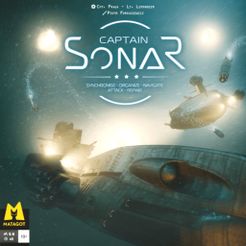
Two submarine crews divide navigation, tracking, charging and repairs, coordinating in real time or alternating turns to locate and sink their opponent.
Captain Sonar supports 2–8 players; community best: 8 players; playing time: 45–60 minutes. A WANGO browser trial has not been confirmed.
Background & introduction
Captain Sonar divides a hidden naval duel into four interdependent stations. The Captain chooses the course, the Radio Operator infers the enemy position from spoken orders, the First Mate prepares systems, and the Engineer manages accumulating breakdowns. Each team knows its own route but must reconstruct its opponent’s movements from fragments of information.
Every movement advances system preparation while creating another breakdown. Firing a torpedo therefore requires both a charged gauge and working weapon systems. Surfacing to repair reveals your sector and leaves your submarine exposed while the opposing crew continues acting. Navigation, detection and maintenance all depend on each other.
Turn-by-turn mode lets crews alternate courses and system use while learning their stations. Real-time mode lets each team move at its own pace until a system announcement pauses play. The tension comes from accurate communication and coordination across the crew. Standard victory revolves around four points of hull damage, with special rules on particular maps.
Core rules & scoring
Form two teams and give Captains and Radio Operators matching scenario maps. Use dark sides for real time and light sides for turn-by-turn. With 2–3 players, turn-by-turn is mandatory. Four-person crews split all roles; in a three-person crew the Captain also handles First Mate, and in a two-person crew also Engineer.
The Captain secretly chooses a sea-space start. Each ordinary course moves 1 space north, south, east or west with a clear public announcement. You cannot enter islands, your previous route or your own mines. If no course is possible, you must surface immediately.
The Radio Operator plots each enemy course on a transparent sheet and slides it over the map, checking islands and route restrictions to report possible enemy positions. Real-time crews choose their own pace; turn-by-turn crews alternate movements.
After each ordinary course, the First Mate marks an empty space on any system gauge and the Engineer crosses out an available symbol in that direction’s control panel. The Captain must wait for both to finish and acknowledge before announcing another course.
A system must be fully charged and have no breakdown in its corresponding category. Each breakdown symbol covers a pair of weapon, detection or special systems. The Captain can activate any system; the First Mate may also activate sonar and drones. Clear the relevant gauge after use, and move between system activations.
Completing all four linked symbols of a central circuit repairs and clears that circuit. Crossing out every radiation symbol or every symbol in one directional control panel causes 1 damage, then clears all breakdowns. Clearing breakdowns does not heal hull damage.
A torpedo targets a space 1–4 orthogonal steps away; announce its impact and clear its gauge. Place a mine on an adjacent space outside your old route, clear its gauge, and announce its detonation separately later, never while surfaced. An impact deals 2 damage in its space, 1 in adjacent spaces including diagonals, and none farther away. Your own submarine can be hit.
A drone asks whether the enemy submarine is in a specified sector; the enemy Captain must answer truthfully. Sonar requires two different types of location information chosen from row, column and sector, exactly one true and one false. Clear the corresponding gauge after use.
Silence allows up to 4 spaces in one straight line without publicly announcing the course, still avoiding islands and your old route; signal the direction to teammates. The First Mate still marks 1 space on a chosen system gauge, and the Engineer crosses out 1 breakdown for the indicated direction. Surfacing reveals your sector and erases the old route while preserving your position and mines. In real time, the crew traces the submarine outline for enemy Engineer approval while the enemy keeps playing; in turn-by-turn, clear breakdowns and let the enemy take 3 consecutive turns.
In real time, raise a fist and call STOP before activating a system; everyone pauses for resolution. In turn-by-turn, activate at most 1 system after your team’s course. In standard play, the first submarine to accumulate 4 damage is destroyed and the other crew wins. Follow any special objectives or surfacing restrictions on the chosen map.
Rules & gameplay questions
Does a full torpedo gauge guarantee that we can fire?
No. Any crossed-out breakdown in the weapon category prevents activation until repaired. Charging and breakdowns impose separate restrictions.
Does surfacing erase damage already suffered?
No. It clears Engineer breakdowns and resets the old route while preserving your current position and mines. Hull damage recorded by the First Mate remains.
Can we activate a system before moving in turn-by-turn mode?
On an ordinary turn, announce the course and complete the crew’s records first, then optionally activate at most one system. Surfacing replaces that turn’s course; it is not a free repair.
Can we trust both pieces of sonar information?
No. They must concern different types of location information, and exactly one is true while the other is false. A drone’s answer about a specified sector must be entirely truthful.
Does a mine explode as soon as it is placed?
No. Placement and later announced detonation are separate steps; an enemy passing over it does not automatically trigger it. Detonation does not require refilling the mine gauge. An explosion can hit your own nearby submarine, so both crews must check damage.
Rules & introduction sources
- Edition
- 2016 Captain Sonar base game for 2–8 players. Read Matagot original English rules pages 1–8 via the CMPL library mirror, cross-checked designer-hosted original French rules pages 1–8 and the designer’s 2016 timing answer. Covers turn-by-turn and real time; excludes Sonar, Sonar Family, 2022 second-edition changes and expansions.
- Rule references
- Introduction source
- BoardGameGeek
WANGO editorial
| Parameter | Recorded value |
|---|---|
| BGG overall rank (snapshot) | #249 |
| Complexity Weight | 2.21 / 5 |
| Best player count (community) | 8 |
| Player range | 2–8 |
| Playing time (minutes) | 45–60 |
| Core mechanisms | Deduction · Grid Movement · Hidden Movement · Line Drawing · Real-Time · Role Playing · Secret Unit Deployment · Simulation · Team-Based Game |
| Chinese publication | Unconfirmed |
| WANGO browser play | No confirmed WANGO trial |
| Year published | 2016 |
| Suggested age | 14+ |
BGG statistics are stored snapshots, not live rankings. Source checked:2026-09-27
Player questions
What is the best player count for Captain Sonar, and can I play online?
Captain Sonar supports 2–8 players; community best: 8 players; playing time: 45–60 minutes. A WANGO browser trial has not been confirmed. Recorded mechanism tags: Team-Based Game.
How complex is Captain Sonar, and which mechanisms does it use?
Weight: 2.21 / 5. Mechanisms: Deduction · Grid Movement · Hidden Movement · Line Drawing · Real-Time · Role Playing · Secret Unit Deployment · Simulation · Team-Based Game. Chinese publication: Unconfirmed.
Where can I learn Captain Sonar?
No rule guide, strategy article or WANGO trial has been confirmed for this record.