Scythe
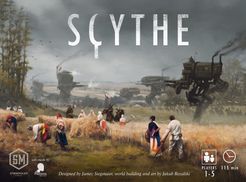
Command giant mechs, deploy workers and develop your economy in an alternate-history 1920s Eastern Europa, competing for the greatest final fortune.
Scythe supports 1–5 players; community best: 4 players; playing time: 115 minutes. A WANGO browser trial has not been confirmed.
Background & introduction
Scythe, designed by Jamey Stegmaier with art and worldbuilding by Jakub Rozalski, places five factions around the mysterious Factory in an alternate-history 1920s Eastern Europa. Agriculture and industrial war machines share the landscape as players expand their influence.
Unless a faction ability says otherwise, move your action token to a different section each turn. The engine revolves around a player mat with paired top- and bottom-row actions. Moving, producing, bolstering and trading feed upgrades, mech deployment, construction and recruitment. Upgrading shifts cubes from upper benefits to lower costs, while the other development actions unlock lasting abilities.
Combat uses secret power dials and combat cards, but forcing enemy workers to retreat on your turn normally costs popularity; merely starting a fight does not. Popularity sets the final coin rates for stars, territories and pairs of resources. A sixth star ends play, while the greatest total fortune wins, making economic development, deterrence and timing equally consequential.
Core rules & scoring
Choose an action section different from your previous turn. You may take its top action, bottom action, both or neither; if both, resolve top before bottom. Pay each full cost before gaining benefits, and take each action at most once. Rusviet may repeat player-mat sections, but current official errata prohibit consecutive Factory-card turns.
Resources stay on the map: wood, food, metal and oil belong to whoever currently controls their territory and may be spent from any territories you control. Workers are not resources. Units, or your structure without enemy units present, provide control; occupying an enemy structure does not grant its abilities.
The basic Move action moves up to two different units one space each, or instead earns one coin. Tunnels are adjacent to one another; rivers and lakes normally block movement unless an ability allows it. All units may carry resources; only mechs carry workers, never characters. A character or mech stops upon entering a territory with enemy units.
For Produce, first pay every exposed red cost, then choose up to two controlled territories. Each worker there may produce one matching resource, or another worker on a village. Take new workers from the player mat left to right; newly revealed costs apply to future Produce actions, without extra payment this time.
Bottom actions use oil to upgrade, metal to deploy, wood to build and food to enlist. Upgrade moves a cube from an upper green box to a lower red box with brackets. Deploy on a territory with your worker, unlocking an ability for every mech and your character. Enlisting gives a one-time reward and an ongoing bonus when you or either immediate neighbor takes the corresponding bottom action.
After movement, combat occurs where opposing characters or mechs share a territory. Each side secretly selects up to seven power, limited by its current power, and normally adds up to one combat card per participating character or mech. Higher total wins; the attacker wins ties. Both spend dialed power and discard used cards. All losing units retreat home, leaving resources to the winner.
Only characters resolve encounters or first claim a Factory card. Encounters resolve after movement and combat, before the bottom action. A Factory card adds an action section but grants no corresponding player-mat recruit, structure or coin bonuses. Forcing enemy workers to retreat on your turn normally costs one popularity each; encountering workers alone is not combat.
The sixth star ends the game immediately, without equalizing turns. Add retained coins, structure bonuses and popularity-based earnings: at popularity 0–6 / 7–12 / 13–18, earn 3 / 4 / 5 per star, 2 / 3 / 4 per territory and 1 / 2 / 3 per pair of resources. The Factory counts as three territories; home bases do not count. Most coins wins, not necessarily the sixth-star player.
Rules & gameplay questions
Must I complete both actions in a section?
No. Each action is optional, and you may skip both while still moving your action token. If you take both, top must precede bottom, so resources gained above can pay the lower cost.
Does every attack cost popularity?
No. Normally, forcing enemy workers to retreat on your turn costs one popularity each. A defender who wins and drives back attacking workers loses none. A specific Polania mech ability also waives the loss when driving workers back after winning as attacker.
Does defeat permanently destroy mechs or workers?
No. All losing units retreat to their home base and resources remain behind. Both sides spend dialed power and discard used combat cards. A loser who revealed at least one power through the dial or cards also draws a combat card.
Does placing six stars make me the winner?
No. It triggers immediate game end. Compare final coins after popularity-based star, territory and paired-resource earnings and structure bonuses. The Factory’s three-territory value can also change the result.
Can Rusviet repeat its Factory card every turn?
Older base rules allowed it, but the current official FAQ prohibits consecutive Factory-card turns. Repeating a player-mat section remains allowed. Official restrictions also ban Rusviet–Industrial and Crimea–Patriotic combinations, except for brand-new players in their first game.
Rules & introduction sources
- Edition
- Stonemaier Games Scythe English base rulebook, 32 pages, copyright 2015, with current official core FAQ errata. Covers the 2–5-player base game; solo Automa uses separate rules. Excludes expansion factions, airships, the Fenris campaign and unofficial variants.
- Rule references
- Introduction source
- BoardGameGeek
WANGO editorial
| Parameter | Recorded value |
|---|---|
| BGG overall rank (snapshot) | #27 |
| Complexity Weight | 3.45 / 5 |
| Best player count (community) | 4 |
| Player range | 1–5 |
| Playing time (minutes) | 115 |
| Core mechanisms | Area Majority / Influence · Card Play Conflict Resolution · Contracts · End Game Bonuses · Force Commitment · Grid Movement · Hexagon Grid · King of the Hill · Movement Points · Narrative Choice / Paragraph · Solo / Solitaire Game · Take That · Tech Trees / Tech Tracks · Variable Player Powers · Variable Set-up · Victory Points as a Resource · Zone of Control |
| Chinese publication | Unconfirmed |
| WANGO browser play | No confirmed WANGO trial |
| Year published | 2016 |
| Suggested age | 14+ |
BGG statistics are stored snapshots, not live rankings. Source checked:2026-09-27
Player questions
What is the best player count for Scythe, and can I play online?
Scythe supports 1–5 players; community best: 4 players; playing time: 115 minutes. A WANGO browser trial has not been confirmed. Recorded mechanism tags: Solo / Solitaire Game.
How complex is Scythe, and which mechanisms does it use?
Weight: 3.45 / 5. Mechanisms: Area Majority / Influence · Card Play Conflict Resolution · Contracts · End Game Bonuses · Force Commitment · Grid Movement · Hexagon Grid · King of the Hill · Movement Points · Narrative Choice / Paragraph · Solo / Solitaire Game · Take That · Tech Trees / Tech Tracks · Variable Player Powers · Variable Set-up · Victory Points as a Resource · Zone of Control. Chinese publication: Unconfirmed.
Where can I learn Scythe?
No rule guide, strategy article or WANGO trial has been confirmed for this record.