Roll Player
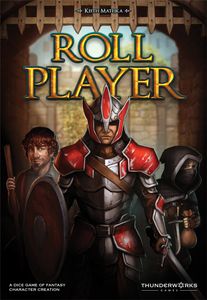
Roll Player is a dice-driven strategy game about creating a fantasy hero. Players fill six attributes on a character sheet, use row-specific die manipulation, move an alignment marker, and buy market cards to meet class and backstory goals before scoring Reputation Stars.
Roll Player supports 1–4 players; community best: 3 players; playing time: 60–90 minutes. A WANGO browser trial has not been confirmed.
Background & introduction
In Roll Player, players do not set out on an adventure with a finished hero; they first build that hero on a character sheet. Race, class, alignment, and backstory define the character’s goals, while dice fill six attribute rows: Strength, Dexterity, Constitution, Intelligence, Wisdom, and Charisma. Both die values and die colors matter. A placement may help satisfy a class target, match the backstory pattern, or improve the final Reputation score, so players must think about the sheet as a whole rather than optimize one row in isolation.
Each round begins with dice drawn from a bag and rolled, then ordered on Initiative cards. In turn, a player chooses one die and places it in the leftmost empty space of an attribute row. That placement triggers the row’s distinctive action: flip a die, swap positions, adjust a value, reroll, move alignment, or take a market discount token. Players then visit the market in their chosen initiative order to purchase weapons, armor, traits, and skills, adding new abilities and scoring opportunities to the hero.
Once every attribute row is full, players finish the current round and score Reputation Stars. They compare row totals with their class goals, then add stars from class-color dice, alignment, backstory matches, armor sets, and qualifying traits. The base rulebook also contains a solo procedure with an automated opponent that removes market cards. Expansions introduce material such as monster battles and familiars, but the base game is built around dice placement, market choices, and several overlapping character-building goals.
Core rules & scoring
Goal and components: This entry covers the 2016 Thunderworks Games base game, Roll Player, for 1–4 players and about 60–90 minutes. Use dice to fill six character attributes, then score Reputation Stars from class, alignment, backstory, armor, and traits. The player with the most Reputation Stars wins.
Prepare a character: Each player chooses a Character Sheet, rolls to determine the Start Player, and receives an Alignment card, Backstory, and Player Aid; place the Alignment marker at the center of its card. Start with 5 Gold; the third and fourth players receive 1 and 2 extra Gold respectively. Then draw a die to select the Class card matching its color, and choose one of that card’s two classes; redraw a gold die or a color already chosen by another player. Race modifiers are printed on the Character Sheet. Arrange the Market deck with single-dot cards above double-dot cards, reveal one more Market card than the number of players and the same number of Initiative cards, and roll starting attribute dice according to player count. The base rulebook includes separate solo setup as well.
Four phases each round: Play proceeds through Roll, Dice, Market, and Cleanup. During Roll, the Start Player draws and rolls dice from the bag; use 3, 4, or 5 action dice in a 2-, 3-, or 4-player game, placing them on Initiative cards in ascending order; the Start Player chooses the order of tied dice. During Dice, in clockwise order, each player chooses one available Initiative card, puts its die in the leftmost open spot of an Attribute Row, takes its Gold, adds 2 Gold if the die is a Gold die and 1 Gold if it fills the row’s final space, and may then use that row’s Attribute Action.
Six Attribute Actions: Strength flips any die on the sheet to its opposite face: 1/6, 2/5, or 3/4. Dexterity swaps the positions of two dice but cannot move one into an empty spot. Constitution raises or lowers one die by 1 without wrapping between 1 and 6. Intelligence rerolls a die and lets the player keep either its old or new value. Wisdom moves the Alignment marker one orthogonal space. Charisma takes a Charisma token that discounts one Gold from a Market purchase that round. Each player chooses one die and may take one row action during the Dice phase.
Buy from the Market: In initiative order, players buy one available Market card by paying its cost and placing it in the matching area of the Character Sheet, or decline to buy, discard a Market card, and gain 2 Gold. The Market is not replenished until Cleanup. Weapons, Armor, Traits, and Skills each add abilities, adjustments, or scoring conditions. Weapon use is limited by the character’s available hands; other categories generally have no quantity cap. Buying a Trait shifts Alignment as indicated if possible, and a purchased Skill can be used immediately.
Skills, Alignment, and Armor: Skills may normally be used at any time, including another player’s turn; move the Alignment marker as directed and exhaust the card sideways. If the marker cannot move, the Skill cannot be used; during Cleanup, each player may refresh up to one Skill. Armor scores through sets of Chain, Leather, or Mystic pieces, using the Reputation Stars shown for the number of pieces collected. A matching class-color set may earn an additional star per set. The Alignment card adds or subtracts the Reputation Stars shown at the marker’s final space; Wisdom-row actions and card effects can move the marker during play.
Cleanup: Discard unused Charisma tokens and refresh up to one Skill. Return the unchosen die to the bag, discard unpurchased Market cards, and refill the Market. If the Market deck is empty, shuffle its discard pile into a new deck. Place one Gold on an eligible Initiative card without Gold, with a maximum of one on a card. Pass the dice bag to the left; that player becomes the Start Player for the next round.
End of the game: Each character sheet has six Attribute Rows with three die spaces apiece. When every player has filled all 18 spaces, finish the current round and calculate Reputation Stars. Stars are not fully scored during the earlier rounds; Gold remains a resource for purchases and other rulebook effects until final scoring.
Final scoring: For each Attribute Row, total its die values, apply any Race modifier and relevant Weapon effect, and compare the result with the matching Class goal. Exact goals must match, range goals must fall within their range, and a plus sign means the total must meet or exceed the shown value. Add one star per class-color die, then score the Alignment card’s final space. Compare the six specified dice with the Backstory grid: 0–1 matches score 0 stars, 2–3 score 1, 4–5 score 3, and all 6 score 6. Score Armor sets, including any class-color bonus, and Traits whose conditions are met. Most Reputation Stars wins; ties go to more Gold, then fewer class-color dice, then shared victory or a replay.
Solo and expansion boundary: The base rulebook includes official solo play. It uses a dedicated setup and an automated opponent’s Gold die to remove Market cards; the player scores by the normal method plus one additional star for every 8 Gold remaining. Monsters & Minions adds a fifth-player option and a final monster battle; Fiends & Familiars adds familiars, fiends, split dice, and other material. Promos and mini-expansions are separately sold. Do not present them as standard components or default scoring rules.
Rules & gameplay questions
What are the four phases of a round?
Each round has Roll, Dice, Market, and Cleanup phases. The Start Player draws and rolls the round’s dice; players then choose one die in turn and may use its attribute-row action; the Market phase lets them buy a card or discard a Market card for Gold; Cleanup returns dice, handles Skills, refills the Market, and passes the bag. The die results and available Market cards change as the game proceeds.
Where can I place a die on my Character Sheet?
Choose an available Initiative card and place its die in the leftmost empty space of one of the six Attribute Rows. Both the die’s value and color can matter for class, alignment, backstory, or Reputation goals. Each player selects only one die and may perform one corresponding row action during that round’s Dice phase; later movement requires an action or card effect that permits it.
What does each Attribute Row action do?
Strength flips a die to its opposite face, Dexterity swaps two die positions, Constitution raises or lowers a value by one without wrapping from 1 to 6, and Intelligence rerolls a die while letting you keep either result. Wisdom moves your Alignment marker one orthogonal space. Charisma gives you a token that discounts one Gold from a Market purchase that round. Apply the selected row action before continuing the round.
Can I choose not to buy a card in the Market?
Yes. Market turns follow the Initiative card numbers from lowest to highest. On your turn, pay for one available Market card and add it to the matching part of your Character Sheet, or decline to buy, discard a Market card, and gain 2 Gold. A Charisma token may reduce a purchase by one Gold. Cards are not replenished until Cleanup, so earlier Market turns may have a wider selection.
When is the game over?
Each of the six Attribute Rows has three spaces, so a Character Sheet holds 18 dice. The game ends only after every player has filled every Attribute Row. Finish the round that was triggered by the last filled space; do not skip the remaining players’ turns. Then calculate Reputation from class goals, class-color dice, Alignment, Backstory, Armor, and qualifying Traits.
How are Class goals checked?
For each row, add the die values and apply any Race modifier or relevant Weapon effect before comparing the total with the corresponding Class goal. An exact target must be matched exactly, a range target must fall within the printed range, and a goal with a plus sign requires at least the shown value. Each satisfied goal awards the Reputation Stars shown on the Class card; a failed goal awards none. Other scoring categories are calculated separately.
How do Armor sets score?
Armor is grouped into Chain, Leather, and Mystic sets. At the end, use the Armor cards to find the Reputation Stars for the number of pieces collected in each set. A set that matches the character’s Class color may receive its class-color bonus, scored per set. Consider the card’s printed value, whether it completes a set, and how its color supports the hero’s class before buying it.
Can I play Roll Player solo with the base game?
Yes. Thunderworks’ base rulebook contains an official solo procedure. It uses its own initial dice setup and an automated opponent’s Gold die to remove cards from the Market. You still build a character through the standard attribute rows and score Reputation Stars by the usual categories, with one additional star for every 8 Gold remaining. The solo mode does not require adding the expansion monster battle.
Is the monster battle from Monsters & Minions part of the base game?
No. Thunderworks sells Monsters & Minions as a separate expansion; it adds a final monster battle, additional components, and a fifth-player option. The base game’s final score comes from Class goals, class-color dice, Alignment, Backstory, Armor, and Traits. Fiends & Familiars, promos, and mini-expansions are also additional products and should be labelled as such.
Rules & introduction sources
- Edition
- This entry covers Thunderworks Games’ 2016 base game associated with BGG 169426. The publisher lists 1–4 players and 60–90 minutes; its official English rulebook PDF has no edition number and file metadata dated May 2, 2020. The base rules include an official solo mode. Monsters & Minions, Fiends & Familiars, promos, and mini-expansions are separate products and are excluded from the default multiplayer flow.
- Rule references
- Introduction source
- BoardGameGeek
WANGO editorial
| Parameter | Recorded value |
|---|---|
| BGG overall rank (snapshot) | #307 |
| Complexity Weight | 2.42 / 5 |
| Best player count (community) | 3 |
| Player range | 1–4 |
| Playing time (minutes) | 60–90 |
| Core mechanisms | Dice Rolling · Open Drafting · Pattern Building · Role Playing · Set Collection · Variable Player Powers |
| Chinese publication | Unconfirmed |
| WANGO browser play | No confirmed WANGO trial |
| Year published | 2016 |
| Suggested age | 10+ |
BGG statistics are stored snapshots, not live rankings. Source checked:2026-09-27
Player questions
What is the best player count for Roll Player, and can I play online?
Roll Player supports 1–4 players; community best: 3 players; playing time: 60–90 minutes. A WANGO browser trial has not been confirmed.
How complex is Roll Player, and which mechanisms does it use?
Weight: 2.42 / 5. Mechanisms: Dice Rolling · Open Drafting · Pattern Building · Role Playing · Set Collection · Variable Player Powers. Chinese publication: Unconfirmed.
Where can I learn Roll Player?
No rule guide, strategy article or WANGO trial has been confirmed for this record.