KLASK
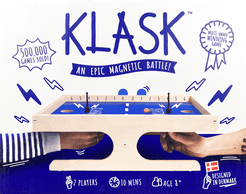
KLASK is a simultaneous magnetic table game for two players. Score through goals or an opponent’s biscuit, control or own-goal mistake; first to six wins.
KLASK supports 2 players; community best: 2 players; playing time: 10 minutes. A WANGO browser trial has not been confirmed.
Background & introduction
In KLASK, both players use steering magnets beneath a raised board to move strikers above it and hit an orange ball toward the opposing goal. There are no alternating turns. A goal is one way to score, but an opponent collecting too many white magnets, losing unrecoverable control, or putting their striker into their own goal can also give you a point. First to six wins.
The three small white magnets, called biscuits, are both obstacles and tactical tools. One attached biscuit allows play to continue; a second creates a scoring event. Players can push biscuits with the ball or striker, making attention to both the ball and these hazards essential. Results follow physical positions and events rather than cards or dice.
The ball must remain in a goal, while a striker entering its own goal scores immediately even if recovered. After a point, reset all three biscuits and let the non-scoring player serve from a chosen corner. This guide covers the two-player game, not KLASK 4’s lives, extra biscuits or team procedures.
Core rules & scoring
Play simultaneously, using the steering magnets below the board to move the strikers above it. Use three biscuits and the scoring tracks. There is no turn consumed by blocking or hitting the ball. The two-player target is six points; do not import KLASK 4’s starting lives and deductions.
Goal: score when the orange ball enters the opponent’s goal and stays there. If it bounces out, continue without a point or reset. Confirm the event before moving the scoring marker.
Biscuits: score when two or three stick to the opponent’s striker. One attached biscuit does not stop play. Never intentionally remove attached biscuits; a natural detachment allows normal play to continue.
Control loss: score if the opponent loses their striker and cannot regain control using the steering magnet. Momentary disconnection alone is not that condition. Distinguish it from the immediate own-goal striker rule.
KLASK: an opponent steering their striker into their own goal immediately gives you a point, even if they pull it out again. The collision sound is the official practical cue, not a rule awarding a point for every arbitrary noise. This differs from a ball bouncing out of the goal.
After scoring, advance the scorer’s disc one point, replace all three biscuits in their field positions and let the non-scoring player kick off from their chosen corner. Do not reset only the two attached biscuits or give the scorer the next serve.
Out of bounds: continue if a biscuit falls over the board edge. If the ball leaves the board, place it in the corner closest to its exit and continue. This is not automatically a point and differs from the chosen-corner restart after scoring.
Biscuit handling: you may hit biscuits with the ball or striker. You may not use the steering magnet to move them directly or intentionally remove them from your striker. A naturally detached biscuit is not required to be reattached.
Scoring order: award only one point at a time even when two scoring events coincide. If both players score, award the point for the event that happened first. If the players cannot agree about an event, reset and replay the point rather than granting one to each.
Finish the game when a player reaches six points. Points come from the defined events, not the number of shots or biscuits touched across the game. Separate any agreed multi-game match format from these base rules; no KLASK 4 last-life or team calculation is used here.
Rules & gameplay questions
Does a ball that bounces out of a goal score?
No. The ball must enter the opponent’s goal and stay there. Continue play if it bounces out. Do not confuse this with a striker entering its own goal: that scores immediately even if the striker escapes. Judge the object and its specific scoring condition rather than every collision sound.
Should we stop and remove one attached biscuit?
No. Play continues with one biscuit, and intentional removal is prohibited. Two or three attached biscuits give the opponent a point. Natural detachment is allowed without reattaching it. Reset all three biscuits after an actual point, not after every single attachment.
Does every brief magnetic disconnection lose a point?
No. The loss-of-control condition requires that the striker cannot be recovered using the steering magnet. A temporary separation that can be recovered does not alone satisfy it. A striker already entering its own goal is a separate immediate scoring event, unaffected by later recovery.
Who scores when the ball or a biscuit leaves the board?
Nobody scores merely because of that exit. Continue if a biscuit falls out. Put an out-of-bounds ball in the corner closest to its exit and continue. Only a real scoring event triggers the full three-biscuit reset and the non-scoring player’s chosen-corner kickoff.
Can a goal and two attached biscuits give two points?
No. Only one point can be scored at a time, even with two simultaneous scoring events. If opposing players both score, the earlier event decides the point. If the event cannot be agreed, reset and replay it rather than giving both players a point.
May I push biscuits toward my opponent?
Yes, using the ball or the striker. Do not use the steering magnet to manipulate them directly, and do not intentionally remove attached biscuits. Natural detachment permits continued play. A single attached biscuit also leaves play running; all three return to their positions after a point.
Rules & introduction sources
- Edition
- KLASK two-player base game, official How To Play rules. Excludes KLASK 4, team play and separately adopted tournament regulations.
- Rule references
- Introduction source
- BoardGameGeek
WANGO editorial
| Parameter | Recorded value |
|---|---|
| BGG overall rank (snapshot) | #261 |
| Complexity Weight | 1.05 / 5 |
| Best player count (community) | 2 |
| Player range | 2 |
| Playing time (minutes) | 10 |
| Core mechanisms | Real-Time · Score-and-Reset Game |
| Chinese publication | Unconfirmed |
| WANGO browser play | No confirmed WANGO trial |
| Year published | 2014 |
| Suggested age | 8+ |
BGG statistics are stored snapshots, not live rankings. Source checked:2026-09-27
Player questions
What is the best player count for KLASK, and can I play online?
KLASK supports 2 players; community best: 2 players; playing time: 10 minutes. A WANGO browser trial has not been confirmed.
How complex is KLASK, and which mechanisms does it use?
Weight: 1.05 / 5. Mechanisms: Real-Time · Score-and-Reset Game. Chinese publication: Unconfirmed.
Where can I learn KLASK?
No rule guide, strategy article or WANGO trial has been confirmed for this record.