Star Wars: Imperial Assault
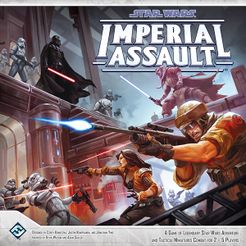
Complete tactical missions on modular Star Wars maps, with one Imperial player opposing Rebel heroes or two players fielding rival armies.
Star Wars: Imperial Assault supports 2–5 players; community best: 2, 5 players; playing time: 60–120 minutes. A WANGO browser trial has not been confirmed.
Background & introduction
Imperial Assault takes place during the Galactic Civil War after the Death Star’s destruction. Modular maps, doors, terrain, and mission tokens make positioning, firing lanes, and objective priorities central to play.
In the campaign, one Imperial player opposes a cooperating team of Rebel heroes. Both sides gain class abilities and other resources between linked missions, outcomes influence the route forward, and the finale determines the campaign’s victors.
Skirmish is a separate two-player contest. Each player builds an army and Command deck, earning victory points through defeated enemies and mission effects. It shares the tactical foundation but does not use campaign hero sheets, resting, or campaign advancement.
Core rules & scoring
Choose a mode and mission: campaigns support 2–5 players, with one controlling the Empire and the others heroes. A lone Rebel player controls two heroes; apply the fewer-heroes adjustments. Skirmishes are exactly two-player games. Set up the map, deployment, objectives, and ending conditions from the selected mission.
Alternate activations: rounds have Activation and Status phases. Rebels activate first in a campaign, then sides alternate choosing a hero or deployment group. Resolve each figure in a group fully before passing play. Each figure normally has up to two actions: move, attack, interact, rest, or a special action.
Move and interact: a move action grants movement points equal to Speed, which can be spent in portions around actions during that activation. Terrain and hostile figures can increase costs or block movement. Use permitted interactions for doors and mission objects; do not stop in an ordinary figure’s occupied space to perform an action.
Resolve attacks: choose a legal hostile target and resolve attack and defense dice through rerolls, modifiers, dodge, range, surges, and damage. Ranged attacks require line of sight and enough Accuracy for the distance; blocks cancel damage, evades cancel surges, and a dodge causes a miss. Campaign heroes can spend both actions attacking; non-heroes normally spend only one action attacking. Each special action is limited to once per activation.
Manage campaign strain: heroes can suffer strain for abilities, or suffer one strain for one movement point up to twice per activation, without voluntarily exceeding Endurance. Only heroes rest, recovering strain equal to Endurance and converting excess recovery into damage recovery. A hero’s first defeat flips the sheet to wounded; another defeat causes withdrawal unless a mission specifies otherwise.
Advance the campaign: the Status Phase increases threat, readies components, allows deployment and reinforcement, resolves end-of-round effects, then advances the round. The Empire spends threat on troops; heroes ready Class and Item cards at the start of their own activations. Between missions, use the campaign log to spend XP, shared credits, and Imperial influence on upgrades. Resolve a mission when its ending condition occurs; winning the finale wins the campaign.
Build a skirmish army: Deployment costs total at most 40, normally within one affiliation, with at most one copy of each unique card, two elite copies, and four regular copies of a name. Use exactly 15 Command cards costing at most 15 in total and obey their copy limits. Use Deployment cards instead of hero sheets; figures cannot rest or use the campaign hero exception for two attack actions.
Finish skirmish rounds and score: ready Deployment cards, draw one Command card plus one per controlled terminal, resolve end-of-round effects, and pass initiative. Under the official FAQ, each defeated figure scores its figure cost immediately: deployment cost for a single-figure group, reinforcement cost for a multi-figure group. Reaching 40 VPs ends the game and the higher score wins; losing all your figures causes immediate defeat.
Rules & gameplay questions
Are the tutorial rules enough for a full campaign?
No. The tutorial simplifies the Status Phase and omits rules such as some conditions. Read the advanced and campaign sections, have the Imperial player consult the chosen mission in its Campaign Guide, and use the Rules Reference and official FAQ for exceptions. Do not apply the tutorial’s elimination objective to every mission.
Can a hero still rest and use two attack actions in a skirmish?
Campaign hero rules do not apply. Use the corresponding Deployment card: normally only one action can involve attacking and resting is unavailable, although special abilities can grant other attacks. Skirmish strain becomes damage; for each point, you may discard one Command card from the top of your deck to prevent that damage.
Does defeating just one member of a squad score points?
Yes, under official FAQ page 16. Score that figure’s figure cost when it is defeated: reinforcement cost for a multi-figure group or deployment cost for a single-figure group. Do not add the whole group’s deployment cost again when its last figure falls. A group’s attached upgrade scores its cost when the group is completely defeated.
Can I move through a friendly figure, attack from its space, then keep moving?
An ordinary figure cannot. You may move through figures under the movement rules, but performing an action requires ending movement, and you cannot end movement in another ordinary figure’s space. Special rules such as Massive require separate treatment.
Does unlocking a door automatically open it?
No. Unlocking removes its locked restriction; the door remains closed and normally requires an interact to open. Follow mission text if it explicitly instructs you to open the door directly.
Rules & introduction sources
- Edition
- Core-box player-versus-Imperial campaign framework and two-player skirmish, using the official Learn to Play, Rules Reference, Skirmish Guide, and FAQ v4 effective 12 June 2019. This is not a complete mission walkthrough: consult the chosen mission for its map, secret events, and victory conditions. Does not cover every campaign, expansion, tournament environment, or the Legends of the Alliance app-driven cooperative mode.
- Rule references
- Introduction source
- BoardGameGeek
WANGO editorial
| Parameter | Recorded value |
|---|---|
| BGG overall rank (snapshot) | #88 |
| Complexity Weight | 3.30 / 5 |
| Best player count (community) | 2, 5 |
| Player range | 2–5 |
| Playing time (minutes) | 60–120 |
| Core mechanisms | Dice Rolling · Die Icon Resolution · Grid Movement · Line of Sight · Modular Board · Role Playing · Scenario / Mission / Campaign Game · Solo / Solitaire Game · Square Grid · Stat Check Resolution · Team-Based Game · Variable Player Powers |
| Chinese publication | Unconfirmed |
| WANGO browser play | No confirmed WANGO trial |
| Year published | 2014 |
| Suggested age | 14+ |
BGG statistics are stored snapshots, not live rankings. Source checked:2026-09-27
Player questions
What is the best player count for Star Wars: Imperial Assault, and can I play online?
Star Wars: Imperial Assault supports 2–5 players; community best: 2, 5 players; playing time: 60–120 minutes. A WANGO browser trial has not been confirmed. Recorded mechanism tags: Solo / Solitaire Game, Team-Based Game.
How complex is Star Wars: Imperial Assault, and which mechanisms does it use?
Weight: 3.30 / 5. Mechanisms: Dice Rolling · Die Icon Resolution · Grid Movement · Line of Sight · Modular Board · Role Playing · Scenario / Mission / Campaign Game · Solo / Solitaire Game · Square Grid · Stat Check Resolution · Team-Based Game · Variable Player Powers. Chinese publication: Unconfirmed.
Where can I learn Star Wars: Imperial Assault?
No rule guide, strategy article or WANGO trial has been confirmed for this record.