Patchwork
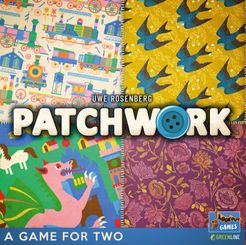
Buy fabric with buttons, fit patches onto a quilt, and balance income, empty spaces, and the time that determines who acts next.
Patchwork supports 2 players; community best: 2 players; playing time: 15–30 minutes. A WANGO browser trial has not been confirmed.
Background & introduction
Patchwork turns a two-player contest into a quilting puzzle. Each player arranges differently shaped patches on a personal quilt board, paying buttons to buy them while keeping remaining buttons for the final score.
The shared patches form a circle, and only the next three clockwise from the neutral token are available. Buying a patch costs time as well as buttons. The player behind on the time track acts, so turns need not alternate.
Income markers pay for button symbols already sewn onto your quilt, while special single-square patches fill small gaps. You need both saved buttons and few empty spaces; the first complete seven-by-seven square also earns a bonus.
Core rules & scoring
Setup: Each player takes a quilt board, time token, and five buttons. Arrange ordinary patches in a circle, put the neutral token between the smallest 1-by-2 patch and the next clockwise patch, place special patches on their marked track spaces, and set aside the bonus tile.
Turn order: The player behind on the time track acts; on a shared space, the top token acts. Choose either advancing for buttons or buying and placing a patch. A player may therefore take several consecutive turns.
Advance for buttons: Move to the space immediately ahead of the opposing token and gain one button per space actually moved. Movement beyond the final space earns nothing.
Choose a purchase: Select one of the next three patches clockwise from the neutral token, move that token to the selected patch, and pay its button cost. The particular cross-shaped patch with no printed button cost costs zero buttons but still costs time.
Place and spend time: Fit the purchased patch on your quilt, rotating or flipping it as desired, without overlap or extending beyond the board. Advance by its time cost and stack on top if you meet the other token. Sewn patches stay in place.
Button income: With either action, reaching or passing an income marker pays the total button symbols on your quilt. A patch just placed is already included.
Special patches: The first player to reach or pass a marked space that still holds a leather patch takes and places that single-square patch immediately. It is separate from the ordinary purchase and cannot be bought from the circle.
Seven-by-seven bonus: The first player to fill a complete 7-by-7 square earns the unique bonus tile, worth seven final points. Filling the whole quilt is unnecessary.
End and scoring: Finish when both tokens reach the final space; overshooting stops there. Score remaining buttons plus seven for the bonus tile, minus two per empty square. Highest score wins; ties favor the player who reached the end first.
Rules & gameplay questions
Why can my opponent act repeatedly?
Turn order follows time position: the player behind acts again, and the top token acts on a shared space. Turns do not alternate automatically.
Is a patch showing time but no button price a misprint?
No. The official FAQ confirms that the base game has a cross-shaped patch costing zero buttons and three time. Special editions may explicitly print a 0.
Does a newly purchased patch count for income crossed on that purchase?
Yes. Place the patch before moving the time token, so its button symbols already count when income is resolved.
Must I fill the entire quilt for the seven-by-seven bonus?
No. Be first to fill a complete 7-by-7 square to earn the seven-point tile. Each remaining empty square still costs two points.
What if an older board places the first leather patch differently?
The publisher offers an optional correction sticker moving the first leather patch later and says the original board can still be used. Newer printings already incorporate it. Agree on a board version before play; the sticker does not add another patch.
Rules & introduction sources
- Edition
- 2014 base game for two players, using the official English base rules and current product FAQ. Notes the older/newer first-leather-patch placement and optional correction; excludes the 5-by-5 promo, Automa, Express, Doodle, and other standalone editions.
- Rule references
- Introduction source
- BoardGameGeek
WANGO editorial
| Parameter | Recorded value |
|---|---|
| BGG overall rank (snapshot) | #149 |
| Complexity Weight | 1.60 / 5 |
| Best player count (community) | 2 |
| Player range | 2 |
| Playing time (minutes) | 15–30 |
| Core mechanisms | Grid Coverage · Income · Open Drafting · Rondel · Square Grid · Tile Placement · Turn Order: Stat-Based · Turn Order: Time Track · Victory Points as a Resource |
| Chinese publication | Unconfirmed |
| WANGO browser play | No confirmed WANGO trial |
| Year published | 2014 |
| Suggested age | 8+ |
BGG statistics are stored snapshots, not live rankings. Source checked:2026-09-27
Player questions
What is the best player count for Patchwork, and can I play online?
Patchwork supports 2 players; community best: 2 players; playing time: 15–30 minutes. A WANGO browser trial has not been confirmed.
How complex is Patchwork, and which mechanisms does it use?
Weight: 1.60 / 5. Mechanisms: Grid Coverage · Income · Open Drafting · Rondel · Square Grid · Tile Placement · Turn Order: Stat-Based · Turn Order: Time Track · Victory Points as a Resource. Chinese publication: Unconfirmed.
Where can I learn Patchwork?
No rule guide, strategy article or WANGO trial has been confirmed for this record.