Trickerion: Legends of Illusion
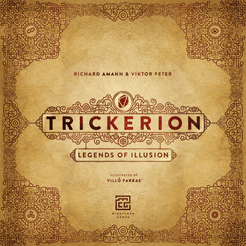
Run a stage-magic company in Magoria: learn tricks, acquire props, rehearse and secure a place in the Theater. Fame rewards the team that turns preparation into successful performances.
Trickerion: Legends of Illusion supports 2–4 players; community best: 4 players; playing time: 60–180 minutes. A WANGO browser trial has not been confirmed.
Background & introduction
Trickerion: Legends of Illusion turns worker placement into a weekly production schedule. Secretly assign your Magician, Specialists and Apprentices to destinations, then place them one at a time. Their action points and the spaces they claim determine how much work each visit accomplishes.
A learned trick is only the beginning. You must own its reusable components, prepare trick markers in your Workshop and move those markers onto public Performance cards. Several players can contribute tricks to the same show, creating opportunities to benefit from a rival’s performance.
The Theater brings the week’s plans together: performing earlier can secure a preferred show, while later weekdays alter the rewards. Wages come due after performances, tying hiring and purchasing to the timing of your income. This guide uses the five-week configuration without the Dark Alley.
Core rules & scoring
Scope and sequence: play five weeks without the Dark Alley. Each week proceeds through rolling Downtown dice, setting initiative, optional advertising, secret assignment, alternating character placement, performances and end-turn upkeep. The optional Dark Alley configuration lasts seven weeks and introduces Level 3 tricks and additional rules.
Assignment and action points: simultaneously place facedown destination cards beneath characters, then reveal them together. In initiative order place one character at a time at its assigned location, or leave it idle. Apprentices, Specialists and the Magician have 1, 2 and 3 base action points, modified by their slot. Spend points immediately on local actions; outside the Theater you may pay one shard for one extra point per placement.
Downtown: learning a trick, hiring a character or taking money normally costs three action points and turns the chosen die to X. Learn from an available category or your Magician’s favorite category. You may pay coins for a shortfall against the trick’s Fame threshold. Components are not required to learn; newly hired characters join at week end.
Market and Workshop: a Buy action costs one point and purchases up to three available components of one type, with their coin prices paid separately. Normal orders enter stock next week. Prepare a trick by meeting its component requirements and paying its printed action cost, provided no markers remain on its card. Components are reusable across tricks; at most four markers of one symbol can be in play.
Theater setup: all your characters there must use one weekday, which cannot already be occupied by an opponent. Backstage characters spend one point per prepared marker moved to a Performance card. Two markers of the same color and symbol cannot share a Performance. Matching category symbols create links and immediate Fame or coin bonuses based on the newly placed trick’s level; rescheduling does not earn link bonuses.
Perform: place your Magician on a Performance slot, forfeiting its three immediate action points. In Thursday-to-Sunday order, each performer chooses one card containing at least one of their own markers and performs every trick on it. Contributors earn their own tricks’ yields; the performer adds link, present-Specialist and Performance-card bonuses. Performed markers return to supply and must be prepared again.
Wages and upkeep: pay one coin per non-idle Apprentice and two per non-idle Specialist; the Apprentice on the Assistant extension is exempt. The Magician has no wage. Pay as much as possible; each unpaid coin costs two Fame, to a minimum of zero. Return characters, add new hires, deliver orders and advance Performance cards and the week counter.
Final score: after week five upkeep, gain one Fame per remaining shard, one per three coins, two per Apprentice and three per Specialist. Each end-game scoring category is capped at twenty additional Fame. Highest Fame wins; ties go to the player earlier in initiative order.
Rules & gameplay questions
Are components consumed when I prepare or perform a trick?
No. Preparing does not spend components. The same component stacks can satisfy several tricks and repeated preparations; action points and trick-marker availability are the constraints.
Can I learn a trick before owning its components?
Yes. Learning does not require components, but you need a free trick slot and must follow category and Fame-threshold rules. You can pay coins for missing Fame. Components are required when you prepare it.
Can my Magician both set up tricks and headline with one placement?
No. A Performance slot reserves it for the later show and forfeits its three immediate action points. A backstage Magician may set up or reschedule tricks but cannot perform that week. Only Magicians occupy Performance slots.
Do I get paid if an opponent performs a card containing my trick?
Yes. Each contributor receives their own tricks’ yields with applicable weekday modifiers. Link, Specialist and Performance-card performer bonuses go to the headlining player. All performed markers return to their owners’ supplies.
Is the game five or seven weeks long?
The revised 2019 rules specify five weeks without the Dark Alley, omitting Level 3 tricks, Prophecies and Special Assignments. Adding the Dark Alley makes it seven weeks and changes end-game character and Special Assignment scoring. This guide uses five weeks; do not combine the two scoring schemes.
Rules & introduction sources
- Edition
- Trickerion: Legends of Illusion, ©2019 revised English retail rules; 2–4 players, five-week configuration without Dark Alley. Dark Alley differences are identified only; excludes Dahlgaard’s Gifts, Academy, Heir solo, Dawn of Technology, Arcane Arts and Anniversary additions.
- Rule references
- Introduction source
- BoardGameGeek
WANGO editorial
| Parameter | Recorded value |
|---|---|
| BGG overall rank (snapshot) | #124 |
| Complexity Weight | 4.27 / 5 |
| Best player count (community) | 4 |
| Player range | 2–4 |
| Playing time (minutes) | 60–180 |
| Core mechanisms | Action Points · Action Queue · Catch the Leader · Dice Rolling · Simultaneous Action Selection · Tile Placement · Turn Order: Stat-Based · Worker Placement · Worker Placement, Different Worker Types |
| Chinese publication | Unconfirmed |
| WANGO browser play | No confirmed WANGO trial |
| Year published | 2015 |
| Suggested age | 14+ |
BGG statistics are stored snapshots, not live rankings. Source checked:2026-09-27
Player questions
What is the best player count for Trickerion: Legends of Illusion, and can I play online?
Trickerion: Legends of Illusion supports 2–4 players; community best: 4 players; playing time: 60–180 minutes. A WANGO browser trial has not been confirmed.
How complex is Trickerion: Legends of Illusion, and which mechanisms does it use?
Weight: 4.27 / 5. Mechanisms: Action Points · Action Queue · Catch the Leader · Dice Rolling · Simultaneous Action Selection · Tile Placement · Turn Order: Stat-Based · Worker Placement · Worker Placement, Different Worker Types. Chinese publication: Unconfirmed.
Where can I learn Trickerion: Legends of Illusion?
No rule guide, strategy article or WANGO trial has been confirmed for this record.