Spirit Island
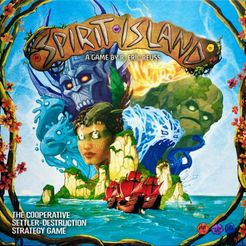
Become a Spirit protecting the island, work with the Dahan, and drive off colonists through carefully timed Powers and growing Fear.
Spirit Island supports 1–4 players; community best: 2 players; playing time: 90–120 minutes. A WANGO browser trial has not been confirmed.
Background & introduction
Spirit Island is a cooperative strategy game in which players become Spirits defending their island against colonists who continually Explore, Build, and Ravage. Each Spirit has distinct Growth choices, Unique Powers, and Innate Powers. Spirits must work with one another and the island’s native Dahan to protect the land and repel the Invaders.
Each turn begins with the Spirit Phase: choose Growth, gain Energy, and play Power Cards. Fast Powers resolve next. The Invaders then Ravage, Build, and Explore according to their visible action cards, before Slow Powers resolve. This makes immediate defence and preparation for the following turn part of the same plan.
Destroying Towns and Cities and using certain Powers generates Fear. Higher Terror Levels reduce the types of Invaders that must be cleared to win, and enough Fear can bring victory directly. Meanwhile, Blight, lost Presence, and the finite Invader Deck create continuing pressure, making Growth and cooperation essential.
Core rules & scoring
Base setup uses one Island Board per player. Place starting Presence as directed on each Spirit’s back, with the rest covering its Presence tracks. Perform an initial Explore and move that card to Build. A first game may omit the Blight Card, Adversary, and Scenario. Official errata adds exactly one extra Blight to the whole pool during setup: 5 × players + 1 without a Blight Card, or normally 2 × players + 1 on a Healthy Island card. Printed island Blight comes separately from the box.
In the shared Spirit Phase, Grow, gain Energy, then play and pay for cards. Normally choose one Growth option and perform everything in it. Add Presence from tracks left to right to uncover better income or Card Plays. Gain Energy equal to the highest uncovered track number and play within your Card Play and Energy limits, paying immediately even for Slow cards. Unspent Energy carries over but cannot be freely transferred; unused Card Plays do not carry over.
The phases are Spirit, Fast Powers, Invaders, Slow Powers, and Time Passes. Resolve cards and Innate Powers at their appropriate speed, checking Range and Target when using them. Players may agree on the order, but one Power cannot interrupt another. Fast Powers cannot simply be saved for Slow. Cards grant Elements as soon as played; thresholds check Elements without spending them. Innate Powers normally cost neither Energy nor Card Plays.
During the Invader Phase, resolve applicable Blighted Island instructions, earned Fear cards, Ravage, Build, Explore, then advance Invader cards. Build occurs only in matching lands containing Invaders: add a City if Towns outnumber Cities, otherwise a Town. Explore adds one Explorer in each matching land containing a Town or City, or adjacent to a Town, City, or Ocean. Explorers themselves are not sources for Explore.
During Ravage, Explorers, Towns, and Cities deal one, two, and three Damage respectively. Subtract Defend, then apply the same result simultaneously to the land and Dahan. At least two Damage to the land adds one Blight, regardless of greater Damage. Every two Damage destroys one Dahan; do not spread Damage to keep all Dahan alive. Afterwards, surviving Dahan each deal two Damage in retaliation. Dahan do not absorb Damage for the land. They retaliate even if Defend reduces Damage to zero, but not if Ravage is skipped.
Each Blight added during play destroys one Presence from every Spirit present in that land. Destroyed Presence goes beside the island, not back onto tracks. If the land already had Blight, also add one Blight to a single adjacent land, cascading again if necessary; do not add it to every neighbour. Printed starting Blight causes neither destruction nor cascades. Removed Blight returns to the current supply, but a flipped Blight Card does not return to Healthy.
Destroying a Town generates one Fear and a City two; removing or replacing them does not automatically generate this Fear. Every 4 × players Fear earns one Fear card, with excess continuing toward the next. Resolve earned cards in order during the Invader Phase; revealing a Terror Level divider changes the level immediately. During Time Passes, move played Powers to personal discard piles and clear Damage, Elements, and single-turn effects. Discards do not automatically return to hand.
Check victory and defeat after the current action and all actions it triggers have fully resolved. Win if the current Terror Level condition is met: no Invaders at Level I, no Towns or Cities at II, and no Cities at III; earning every Fear card also meets a victory condition. Lose if any Spirit has no Presence on the island, the Blight supply runs out as specified by the current board or card, or Explore requires an Invader card when none remains. If both victory and defeat conditions are met at that check, it is a sacrifice victory. A Ravage is one action per land: finish its Damage, Blight consequences, and Dahan retaliation before checking, but do not continue to other lands after the game ends.
Rules & gameplay questions
When do Fast and Slow Powers choose targets and grant Elements?
Play and pay during the Spirit Phase, gaining the cards’ Elements immediately. Fast effects resolve before Invaders, Slow effects after them; choose a legal target when resolving. Fast Powers cannot simply wait for Slow, but a Slow card’s Elements can already meet a Fast Innate Power’s threshold. Elements are checked, not spent.
Do Dahan prevent Blight, and who takes Damage before retaliation?
Dahan do not absorb Damage for the land. After Defend, apply the same Damage to the land and Dahan: at least two to the land adds one Blight, and every two destroys one Dahan. Surviving Dahan then retaliate for two Damage each. They can retaliate after Damage is reduced to zero, but not when Ravage is skipped entirely.
Is starting Blight two per player, or do I add one more?
All core printings use the official correction: add exactly one extra Blight to the entire pool during setup, not one per player. A normal Healthy Island card starts with 2 × players + 1; without a card, use 5 × players + 1. Printed island Blight comes separately from the box. After flipping a card, use only its printed amount, without another extra Blight.
Does Blight spread to every neighbour, and does destroyed Presence return to its track?
No. Adding Blight destroys one Presence from each Spirit in that land, placing it beside the island. Only if the land already had Blight do you add one more to a single adjacent land, cascading if needed. Printed starting Blight does not trigger these consequences. Destroyed Presence does not cover tracks again or remove already uncovered benefits.
How do I choose new Powers, and can I keep them all?
Normally choose the Minor or Major deck, draw four, keep one, and discard the rest to that deck’s discard pile. Taking a Major also requires Forgetting one of your Powers, which may be the Major just chosen. The new card enters your hand. Forgetting is different from discarding and cannot be reversed by Reclaiming discards. With a beginner Power Progression, take the indicated card instead.
Rules & introduction sources
- Edition
- Original Spirit Island (2017) core game, played cooperatively by 2–4 players, using the publisher-linked 32-page CORE rules and the official setup-Blight correction for all printings. Also applies the current official FAQ timing update: check victory and defeat after a complete action tree. Covers the general game without an Adversary or Scenario; a first game may omit the Blight Card. Blight Card notes clarify core components only. Excludes expansion Events and tokens such as Beasts, Horizons, and other standalone versions.
- Rule references
- Greater Than Games: official Spirit Island CORE rulebook
- Official designer FAQ: one extra starting Blight erratum
- Greater Than Games: core game and rules download page
- Official designer FAQ: current action-tree timing for victory and defeat (Core game)
- Official designer FAQ: sacrifice victory and completing each land’s Ravage
- Introduction source
- BoardGameGeek
WANGO editorial
| Parameter | Recorded value |
|---|---|
| BGG overall rank (snapshot) | #11 |
| Complexity Weight | 4.08 / 5 |
| Best player count (community) | 2 |
| Player range | 1–4 |
| Playing time (minutes) | 90–120 |
| Core mechanisms | Action Retrieval · Area Majority / Influence · Automatic Resource Growth · Campaign / Battle Card Driven · Cooperative Game · Deck, Bag, and Pool Building · Hand Management · Modular Board · Simultaneous Action Selection · Solo / Solitaire Game · Tags · Variable Player Powers · Variable Set-up |
| Chinese publication | Unconfirmed |
| WANGO browser play | No confirmed WANGO trial |
| Year published | 2017 |
| Suggested age | 13+ |
BGG statistics are stored snapshots, not live rankings. Source checked:2026-09-26
Player questions
What is the best player count for Spirit Island, and can I play online?
Spirit Island supports 1–4 players; community best: 2 players; playing time: 90–120 minutes. A WANGO browser trial has not been confirmed. Recorded mechanism tags: Solo / Solitaire Game.
How complex is Spirit Island, and which mechanisms does it use?
Weight: 4.08 / 5. Mechanisms: Action Retrieval · Area Majority / Influence · Automatic Resource Growth · Campaign / Battle Card Driven · Cooperative Game · Deck, Bag, and Pool Building · Hand Management · Modular Board · Simultaneous Action Selection · Solo / Solitaire Game · Tags · Variable Player Powers · Variable Set-up. Chinese publication: Unconfirmed.
Where can I learn Spirit Island?
Available resources: Strategy https://wangogame.com/wiki/analysis/spirit-island