Alchemists
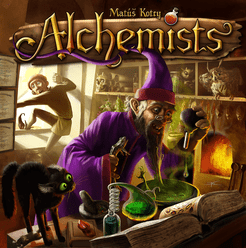
Alchemists investigate the hidden identities of eight ingredients while competing for academic prestige. Discovering the truth helps, but deciding when to commit, publish, and expose a rival matters just as much.
Alchemists supports 2–4 players; community best: 4 players; playing time: 120 minutes. A WANGO browser trial has not been confirmed.
Background & introduction
Alchemists combines private deduction with public action planning. Each game assigns eight alchemicals to eight ingredients afresh. Players mix two different ingredients, observe the resulting potion, and eliminate impossible identities. The app supplies experimental results; players still maintain their own deductions and make their own judgments.
Over six rounds, players choose order spaces, declare their planned actions, and resolve action areas in a fixed sequence. Gathering ingredients, transmuting them, and buying artifacts support research, while selling potions and publishing or endorsing theories turn partial knowledge into money and reputation. Later positions can provide preparation benefits while leaving fewer attractive opportunities.
A published theory is a claim rather than certification. Players may publish before being certain, choosing seals that express confidence or hedge against a particular color. Rivals can try to disprove the claim. When the truth is revealed at game end, starred seals on correct theories earn points and incorrect theories can impose losses, keeping research and timely publication in tension.
Core rules & scoring
The base game supports two to four competitors. Randomize the eight ingredient identities each game; use a shared app setup or an additional noncompeting gamemaster with the included board.
Mix two different ingredients. Matching color and sign between a large and a small aspect circle determines the potion; no matching aspect produces a neutral potion. Record results to narrow possible identities.
Play six rounds. Each round, choose an order space and its benefits, declare actions from the later player toward the earlier player, then resolve action areas in the board’s fixed sequence.
Available action cubes depend on player count and round; everyone uses only three in round one. Selling, debunking, and publishing are unavailable in that first round. Follow each action area’s cube costs and repetition limits.
Foraging supplies ingredients, transmutation exchanges one ingredient for one gold, and artifacts cost their printed price. Tests consume two ingredient cards; testing on a student and drinking yourself handle negative potions differently.
To sell, choose a potion wanted by the adventurer and a guarantee level; discounts may change selling order. Payment depends on meeting the promise, and an unsuitable result can also cost reputation.
Normally pay one gold to publish a new theory, place an alchemical on the ingredient’s book, add a face-down seal, and gain one reputation. Alternatively endorse an existing theory under its rules and pursue grants.
Apprentice debunking reveals an ingredient’s sign in a chosen color. Master debunking tests whether two ingredients make a specified potion, establishing an error or a new conflict between theories. Debunking consumes no ingredient cards.
Apprentices begin with three ingredients and masters with two; conference standards and debunking procedures also differ. Round six includes a final exhibition, followed by scoring reputation, artifacts, grants, gold, and seals after the truth is revealed.
At revelation, correct theories award five points for a gold-starred seal and three for a silver-starred seal; unstarred seals score none. Incorrect theories normally cost four points per seal, except an unstarred seal properly hedged against the sole incorrect color.
Rules & gameplay questions
Can we play without a smartphone?
Yes. The official web tool is an alternative, or an additional noncompeting gamemaster can use the included board as the reader. Competitors must not see the full solution in advance.
Do Apprentice and Master differ only in starting resources?
No. Apprentices start with three ingredients rather than two, conferences use different standards, and Master debunking requires a proposed potion experiment rather than directly querying one aspect’s sign.
Does suffering one negative potion make me immune to all of them that round?
No. The official base-game FAQ says each negative potion can affect you only once in a round; different negative colors can still each affect you.
Must I spend ingredient cards to debunk?
No. Debunking selects ingredients and a test in the reader without consuming cards from hand. Ordinary potion experiments do require and discard ingredients.
Does a disproven theory punish every supporter identically?
Not necessarily. A seal may hedge against one color, so resolve the proven error under the seal rules. Final scoring also checks how many aspects are actually wrong; an unstarred seal is not blanket protection.
Rules & introduction sources
- Edition
- 2014 Alchemists base game, including Apprentice and Master variants and official base-game FAQ; no modules from The King’s Golem and no Little Alchemists rules.
- Rule references
- Introduction source
- BoardGameGeek
WANGO editorial
| Parameter | Recorded value |
|---|---|
| BGG overall rank (snapshot) | #179 |
| Complexity Weight | 3.92 / 5 |
| Best player count (community) | 4 |
| Player range | 2–4 |
| Playing time (minutes) | 120 |
| Core mechanisms | Action Drafting · Constrained Bidding · Deduction · End Game Bonuses · Events · Hand Management · Open Drafting · Turn Order: Progressive · Worker Placement |
| Chinese publication | Unconfirmed |
| WANGO browser play | No confirmed WANGO trial |
| Year published | 2014 |
| Suggested age | 12+ |
BGG statistics are stored snapshots, not live rankings. Source checked:2026-09-27
Player questions
What is the best player count for Alchemists, and can I play online?
Alchemists supports 2–4 players; community best: 4 players; playing time: 120 minutes. A WANGO browser trial has not been confirmed.
How complex is Alchemists, and which mechanisms does it use?
Weight: 3.92 / 5. Mechanisms: Action Drafting · Constrained Bidding · Deduction · End Game Bonuses · Events · Hand Management · Open Drafting · Turn Order: Progressive · Worker Placement. Chinese publication: Unconfirmed.
Where can I learn Alchemists?
No rule guide, strategy article or WANGO trial has been confirmed for this record.