Fields of Arle
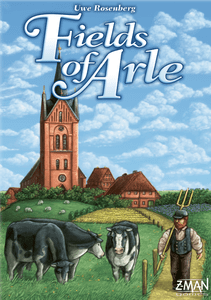
Develop an East Frisian farm across nine summer and winter half-years, turning tools, reclaimed land and transport into prosperity.
Fields of Arle supports 1–2 players; community best: 2 players; playing time: 60–120 minutes. A WANGO browser trial has not been confirmed.
Background & introduction
Fields of Arle, designed by Uwe Rosenberg, is set in the East Frisian village of Arle. The base game supports one or two players, with development routes including flax farming, livestock, peat cutting, workshops and inns.
Play begins in summer and lasts nine alternating half-years. Each player has only four workers per half-year, with different actions available in summer and winter. Better tools improve related work, while shared action spaces create competition in two-player games.
Vehicles process materials into timber, bricks and clothing, and carry goods to nearby towns for food and travel experience. Harvesting, breeding and sustenance follow seasonal schedules, and final scoring combines land, buildings, tools, goods and animals.
Core rules & scoring
Half-year sequence: alternate summer and winter for nine half-years, each with preparation, work and inventorying. In two-player play, take turns by month placing one worker at a time, four each. Resolve an empty seasonal action space immediately, or forgo that worker’s action.
Seasons and initiative: only one worker between both players may use the opposite season per half-year; that player’s opponent starts the next half-year. If nobody does so, starting player changes automatically. Pay the Laborer cost to imitate an occupied current-season space using your own tools and possessions.
Tools and construction: action yields and processing limits often depend on your relevant tools. Actions such as Master improve tool tracks by paying their costs. Fields, forests, stalls and buildings require available empty land and the relevant cost; placed landscape tiles cannot be freely relocated.
Reclamation and peat: moving dikes unlocks land only when a new complete horizontal line of three dikes forms above the old line. Dehydrate a moor section and add four peat, then cut the peat. Removing its last peat immediately removes the moor tile and opens the land.
Vehicles and travel: loading during work costs no worker and must fit vehicle spaces. Process wood and clay, paying one peat for clay, or turn fabrics into clothing. Processed goods remain unavailable until inventorying. A destination immediately sells at least one listed item for food, and each destination is usable once per game.
Summer inventorying: empty vehicles, milk, harvest and pay sustenance, in that order. Each field yields one grain or flax, each forest one wood; sheep and cattle yield food according to their numbers. Pay three food and two peat. Missing food uses grain, then animals; missing peat uses wood or timber. Each unresolved shortage costs two points.
Winter inventorying: empty vehicles, breed, shear and pay three food. A stall with exactly two matching animals produces one; a stable with two, three or five produces one, and four produces two. Outdoor animals do not breed. Newborn sheep count for shearing; food shortages use the same substitutions and penalties as summer.
Final scoring: after the ninth summer inventory, total processed goods, barn equipment, travel, tools, goods-track and home-board points, subtracting undeveloped-land and shortage penalties. No large vehicle costs three points. Animal types score two, one and zero points each from least to most numerous. Highest score wins; a tie goes to the hypothetical tenth-half-year starting player.
Rules & gameplay questions
Do animals breed in both seasons?
No. Breeding happens only during May inventorying after winter, and requires the appropriate animal counts inside stalls or stables. The last half-year is summer, so there is no extra final breeding.
Can I immediately transport clothing I just processed on a vehicle?
No. Processed goods become available only when vehicles empty during inventorying. A travel sale happens immediately when its destination is loaded, so the food is usable that half-year; the destination still occupies vehicle space until unloading.
Does moving one dike always unlock one land space?
No. A higher complete row of three adjacent dikes is needed to reclaim the corresponding three tidal-flat spaces. One or two isolated dikes do not change the mainland boundary.
Can grain always replace food, and wood always replace peat?
For sustenance, use grain only after food runs out, then animals only after grain runs out. Likewise, use wood as fuel only after peat runs out. Other actions follow their own rules; sustenance substitutions are not a general exchange ability.
How does solo play differ?
Under the base rulebook’s solo rules, place your workers consecutively and pursue a high score. There is no special opposite-season action. The book calls 110 points remarkable; it is not a mandatory victory threshold.
Rules & introduction sources
- Edition
- 2014 base game for one or two players, including its printed solo mode. Excludes Tea & Trade, its third player, tea and trade additions, and separately published solo variants.
- Introduction source
- BoardGameGeek
WANGO editorial
| Parameter | Recorded value |
|---|---|
| BGG overall rank (snapshot) | #101 |
| Complexity Weight | 3.85 / 5 |
| Best player count (community) | 2 |
| Player range | 1–2 |
| Playing time (minutes) | 60–120 |
| Core mechanisms | Automatic Resource Growth · Highest-Lowest Scoring · Income · Set Collection · Solo / Solitaire Game · Turn Order: Claim Action · Turn Order: Progressive · Worker Placement |
| Chinese publication | Unconfirmed |
| WANGO browser play | No confirmed WANGO trial |
| Year published | 2014 |
| Suggested age | 13+ |
BGG statistics are stored snapshots, not live rankings. Source checked:2026-09-27
Player questions
What is the best player count for Fields of Arle, and can I play online?
Fields of Arle supports 1–2 players; community best: 2 players; playing time: 60–120 minutes. A WANGO browser trial has not been confirmed. Recorded mechanism tags: Solo / Solitaire Game.
How complex is Fields of Arle, and which mechanisms does it use?
Weight: 3.85 / 5. Mechanisms: Automatic Resource Growth · Highest-Lowest Scoring · Income · Set Collection · Solo / Solitaire Game · Turn Order: Claim Action · Turn Order: Progressive · Worker Placement. Chinese publication: Unconfirmed.
Where can I learn Fields of Arle?
No rule guide, strategy article or WANGO trial has been confirmed for this record.