Five Tribes: The Djinns of Naqala
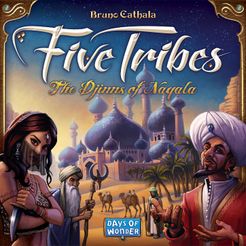
Bid for turn order, distribute five tribes of meeples across Naqala, gather resources and claim tiles while using Djinn powers to build the highest final score.
Five Tribes: The Djinns of Naqala supports 2–4 players; community best: 2 players; playing time: 40–80 minutes. A WANGO browser trial has not been confirmed.
Background & introduction
After the old Sultan’s death, outsiders compete for influence in Naqala by directing five local tribes. Thirty tiles form a changing shared board, each starting with three meeples; the pieces available for an action belong to the common puzzle rather than to individual players.
Each round begins with bidding for turn order. Pick up every meeple from one tile and drop them along an orthogonally connected route. The last meeple’s color determines which group you collect and which tribe acts; emptying an unclaimed destination lets you mark it with a camel.
Yellow Viziers, white Elders, green Merchants, blue Builders and red Assassins offer different benefits, followed by the destination’s tile action. Coins both buy initiative and score at the end, so securing an attractive move has a direct cost in potential victory points.
Core rules & scoring
Start each player with 50 coins. Randomly arrange thirty tiles in a 5×6 board with three random meeples each; randomize initial bid order and display nine resources and three Djinns. In bid order, choose an initiative space and immediately pay its coin cost; higher bids act earlier. Nonzero spaces cannot be shared. At most three markers can bid zero, with each later zero bidder placed ahead of earlier zero bidders. When acting, return your marker to the first empty bid-order space.
Pick up all meeples from one tile and drop one on each orthogonally adjacent tile along your route. No diagonal move or immediate backtracking is allowed, although a long enough loop may revisit a tile. The last meeple must join at least one meeple of its color; collect all meeples of that color there.
If collection empties an unclaimed destination, place a camel to control it. A tile already bearing a camel never changes owners. Whether or not you claimed the destination, resolve the collected tribe, then that tile’s action, then optionally sell sets of different merchandise.
Keep yellow Viziers and white Elders; Elders can also pay for Djinns or their powers. Return green Merchants to the bag and take that many resources from the front of the display. Return blue Builders and gain coins equal to their number multiplied by the number of blue-valued tiles in the destination’s surrounding eight spaces and the destination itself; each discarded Fakir adds one to the Builder multiplier.
Return red Assassins and kill one meeple on a tile within their range, or one yellow or white meeple held by an opponent. Orthogonal range equals the number of Assassins, plus one per discarded Fakir. Emptying another unclaimed tile grants control if you still have a camel. Claim the destination first, and do not perform the assassinated tile’s action.
An Oasis must receive a palm tree and a Village a palace; ignore this when the supply runs out. Paid Market and Sacred Place actions are optional. A Sacred Place costs two Elders or one Elder plus one Fakir for a displayed Djinn. A paid Djinn power can be used once during each of its owner’s turns, including immediately after acquisition if affordable. Refill resource and Djinn displays to nine and three only after all turns finish.
The game ends after the round in which someone places their last camel or no legal meeple move remains, allowing all scheduled turns to finish; a player unable to move can still use applicable Djinn powers. Score one per coin and Vizier, plus ten per opponent with strictly fewer Viziers; score two per Elder, printed Djinn and controlled-tile values, three per controlled palm tree and five per controlled palace, modified by applicable Djinns.
At the end of your own turn you may sell sets of different merchandise for coins. Unsold sets also score at game end: one through nine different goods yield 1, 3, 7, 13, 21, 30, 40, 50 or 60 points. Fakirs are not ordinary merchandise; a specific Djinn may give them an additional use. Highest total wins; tied players share victory.
Rules & gameplay questions
Does each player act only once per round with two players?
No. Each has eleven camels and two turn markers, so each takes two turns per round; their two bid positions may produce consecutive turns. With three or four players, each has eight camels and one marker.
May my route pass through empty tiles or tiles bearing a camel?
Yes, dropping a meeple as you pass. Before placing your last meeple, however, the destination must already contain its color. Emptying a tile with a camel does not transfer control.
Does spending coins on initiative reduce my final score?
Yes. Bid payments go to the bank. You score only the face value of coins you still hold at game end, at one point per coin; bid payments are not refunded.
Can I take another tile action after Assassins claim a second tile?
No. Only the movement destination supplies the tile action. An assassination can grant control of another tile. If both tiles qualify but you have only one camel, you must claim the movement destination first.
Can any number of markers share the zero bid?
No. There are only three zero spaces. A later zero bidder acts before earlier zero bidders; once all three are occupied, the remaining marker must bid at least one coin.
Rules & introduction sources
- Edition
- Five Tribes: The Djinns of Naqala base game, Days of Wonder official English 8401-FT-Rules-EN ©2014–2018, 8 pages, with the 2-page 2016-04 Djinn summary. Covers 2–4 players using Fakirs; excludes expansions such as Artisans and the older Slave resource artwork/rules.
- Rule references
- Introduction source
- BoardGameGeek
WANGO editorial
| Parameter | Recorded value |
|---|---|
| BGG overall rank (snapshot) | #98 |
| Complexity Weight | 2.84 / 5 |
| Best player count (community) | 2 |
| Player range | 2–4 |
| Playing time (minutes) | 40–80 |
| Core mechanisms | Auction / Bidding · Constrained Bidding · End Game Bonuses · Hidden Victory Points · Mancala · Modular Board · Set Collection · Square Grid · Take That · Turn Order: Auction · Variable Player Powers · Variable Set-up · Victory Points as a Resource · Worker Placement |
| Chinese publication | Unconfirmed |
| WANGO browser play | No confirmed WANGO trial |
| Year published | 2014 |
| Suggested age | 13+ |
BGG statistics are stored snapshots, not live rankings. Source checked:2026-09-27
Player questions
What is the best player count for Five Tribes: The Djinns of Naqala, and can I play online?
Five Tribes: The Djinns of Naqala supports 2–4 players; community best: 2 players; playing time: 40–80 minutes. A WANGO browser trial has not been confirmed.
How complex is Five Tribes: The Djinns of Naqala, and which mechanisms does it use?
Weight: 2.84 / 5. Mechanisms: Auction / Bidding · Constrained Bidding · End Game Bonuses · Hidden Victory Points · Mancala · Modular Board · Set Collection · Square Grid · Take That · Turn Order: Auction · Variable Player Powers · Variable Set-up · Victory Points as a Resource · Worker Placement. Chinese publication: Unconfirmed.
Where can I learn Five Tribes: The Djinns of Naqala?
No rule guide, strategy article or WANGO trial has been confirmed for this record.