Arcadia Quest
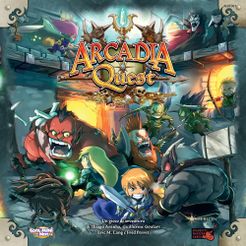
Arcadia Quest is a 2–4 player fantasy campaign adventure. Rival guilds each control three heroes, compete for scenario quests, fight monsters and one another, then upgrade their gear before the showdown with Lord Fang.
Arcadia Quest supports 2–4 players; community best: 4 players; playing time: 60 minutes. A WANGO browser trial has not been confirmed.
Background & introduction
Arcadia Quest begins with a fantasy city seized by a dark power. The vampire lord Fang and his monsters occupy Arcadia, while rival hero guilds enter the city to complete quests, gather treasure, and weaken his control. Heroes face orcs, goblins, trolls, and other monsters, but they also compete with the other players’ guilds for objectives and rewards.
Each player manages one guild and chooses three heroes with different abilities. Scenario maps use tiles, doors, portals, exploration tokens, and monsters. Heroes can attack at close range or from a distance, clear threats, and move toward the quests laid out across the map. Players must decide when to pursue their guild’s victory condition, when to strengthen a hero, and when to remove an obstacle.
The game combines dungeon adventure with direct player competition. A hero’s actions exhaust attack cards, so resting the guild at the right moment can restore options and reorganize the team. Monsters may strike back after a hero attacks them. Winning depends on reading the map, equipment, and dice as well as watching how close the rival guilds are to completing their quests.
The base campaign is a sequence of six scenarios rather than a single isolated adventure. It uses three scenarios from the Outer Circle, two from the Inner Circle, and a final showdown. Different routes let campaigns visit different locations; guilds also buy upgrades and deal with consequences such as Death Curses between scenarios. Quests and rewards earned along the way shape each group’s preparation for the finale.
Core rules & scoring
Players and guilds: CMON’s base rulebook supports 2–4 players. Each player selects a Guild and chooses three different Heroes; those heroes remain the guild’s team throughout the campaign unless a new campaign begins. Players control their own figures and resources while facing scenario monsters and rival guilds. The current Tycoon Games base product description also highlights guild heroes, quests, dice combat, and equipment upgrades.
Scenario setup: Choose the current Scenario from the Campaign Book, then follow its map to place double-sided tiles, doors, starting areas, Quest cards, Monsters, and Exploration tokens. Each scenario specifies the components, monster levels, and board orientation it uses. Place the guild’s three heroes in its assigned starting area and give the guild its campaign starting equipment. For a first campaign, follow the rulebook’s suggested opening scenario.
Player turn: Players take turns clockwise. On a turn, choose exactly one option: Activate a Hero or Rest the Guild. The player may not do both in the same turn. When activating, choose one Hero and perform Movement and one Attack in either order, or perform only one of those actions. The Hero’s Movement must be completed all at once, and each activation provides three Movement points.
Movement and board spaces: Each Movement point can move a Hero to an edge-adjacent space, use a portal of the same color, or open or close a door at the edge of the current space. Diagonal movement is not allowed, and walls or closed doors block movement. Space capacity creates Full or Blocked conditions. Check adjacency, line of sight, doors, and the target space before moving or attacking.
Attacks and defense: The attacking Hero chooses an available Attack card, gathers the number of black Attack dice shown on it, and exhausts the card. The targeted Character gathers white Defense dice from its Defense value and equipment. Hit symbols count according to whether the attack is Melee or Ranged; Critical results count as successes and add another die. Damage accumulates toward a Character’s Life value, at which point the Character is killed and handled as the rules prescribe.
Resting and monster reactions: Rest the Guild to unexhaust cards, reorganize equipment or Exploration tokens, and resolve matters such as resurrecting killed Heroes as described in the rules. After a Hero attacks a Monster, that Monster may make a Payback Reaction. The player to the active player’s right usually controls the Monster and applies its movement, attack, and target rules. Defeating a Monster can earn the coin reward printed on its card or contribute to a quest.
Quests and scenario victory: Scenarios include PvE Quests and PvP Quests. A PvE Quest concerns the environment, monsters, or a task specific to that scenario; a PvP Quest relates to defeating rival Heroes. Mark a completed quest with a Guild token. The first player to complete a quest may receive its coin bonus, and some quests also award equipment. In a three- or four-player game, the first Guild to complete three quests, including at least one PvE quest, wins; in a two-player game, two quests are enough.
Campaign and modes: The standard campaign plays six of the eleven scenarios: three in the Outer Circle, two in the Inner Circle, and the Final Showdown. The previous scenario’s winner usually chooses what comes next. Between scenarios, players upgrade their Heroes, buy equipment, and resolve Death Curses while recording campaign information. The base book also has an Optional Episodic Mode for a standalone multiplayer scenario; CMON’s Solo Mode v1.3 is a separate optional rules release, not part of the standard multiplayer turn sequence.
Rules & gameplay questions
How many players does the base game support?
CMON’s base rulebook describes a standard game for two to four players, each controlling a guild of three Heroes. CMON later released a separate optional Solo Mode v1.3, but the core turn sequence here follows the multiplayer base rules. The rulebook’s Episodic Mode lets players choose a standalone scenario; it is still a multiplayer option and is not the solo mode.
How many Heroes does each Guild control?
At the beginning of a campaign, each player chooses three unique Heroes to form a Guild. Their Defense, Life, and natural abilities differ, and the weapons and equipment they carry affect attacks and support. The base rules keep these Heroes with the Guild for the entire campaign, so they cannot simply be exchanged between scenarios. Team composition and inventory choices matter from the outset.
What can a player do on a turn?
Each turn, choose either Activate a Hero or Rest the Guild; the two choices cannot be combined. An activated Hero may move and make one attack in either order, or may choose to move or attack alone. Resting readies exhausted cards, reorganizes equipment, and resolves matters such as bringing killed Heroes back, helping the Guild prepare for later actions.
How far can an activated Hero move?
An activated Hero receives three Movement points. Each point can move to an edge-adjacent space, use a portal of the same color, or open or close a nearby door. Diagonal movement is forbidden, and walls or closed doors block movement. The Movement action must happen entirely before or entirely after the Attack; a Hero cannot move partway, attack, and then spend the remaining movement.
How does combat work?
The attacker selects an eligible Attack card, rolls the number of black Attack dice shown, and exhausts that card. The target rolls white Defense dice from its printed value and equipment. Success symbols depend on whether the attack is Melee or Ranged, while Critical results count as hits and grant another die. Damage is tracked against Life; when it reaches the Character’s Life value, the Character is killed and handled under the applicable rules.
What is the difference between PvE and PvP Quests?
PvE Quests concern the current scenario’s environment, monsters, or a specific task. PvP Quests relate to defeating Heroes from rival Guilds. Mark a completed Quest with a Guild token; the first player to complete each Quest may receive a coin, and some objectives also award a piece of equipment. The mix encourages players to pursue map objectives as well as combat against opponents.
How does a Guild win a scenario?
In a three- or four-player game, the first Guild to complete three Quests wins immediately if at least one of them is a PvE Quest; three PvP Quests alone are insufficient. In a two-player game, a player wins by completing two Quests. The exact objectives come from the scenario’s Quest cards and Campaign Book, so the best route changes from map to map.
How does the base campaign progress?
The standard campaign chooses six scenarios from the eleven listed in the Campaign Book: three Outer Circle scenarios, two Inner Circle scenarios, and the final showdown. The previous scenario’s winner usually chooses the next one, and Guilds upgrade equipment and resolve Death Curses between games. Solo Mode v1.3 was published as separate optional rules; its detailed single-player procedures are not included in this base-game summary.
Rules & introduction sources
- Edition
- This entry follows CMON’s Arcadia Quest base rulebook, including its standard six-scenario campaign, turn sequence, and quest rules. Official Solo Mode v1.3 was released separately and its detailed PDF was not accessible for verification here, so it is not folded into the base multiplayer rules. Episodic Mode is a one-scenario multiplayer option, not the solo mode.
- Rule references
- Introduction source
- BoardGameGeek
WANGO editorial
| Parameter | Recorded value |
|---|---|
| BGG overall rank (snapshot) | #377 |
| Complexity Weight | 2.53 / 5 |
| Best player count (community) | 4 |
| Player range | 2–4 |
| Playing time (minutes) | 60 |
| Core mechanisms | Action Retrieval · Dice Rolling · Grid Movement · Line of Sight · Modular Board · Scenario / Mission / Campaign Game · Square Grid · Take That · Variable Player Powers |
| Chinese publication | Unconfirmed |
| WANGO browser play | No confirmed WANGO trial |
| Year published | 2014 |
| Suggested age | 13+ |
BGG statistics are stored snapshots, not live rankings. Source checked:2026-09-27
Player questions
What is the best player count for Arcadia Quest, and can I play online?
Arcadia Quest supports 2–4 players; community best: 4 players; playing time: 60 minutes. A WANGO browser trial has not been confirmed.
How complex is Arcadia Quest, and which mechanisms does it use?
Weight: 2.53 / 5. Mechanisms: Action Retrieval · Dice Rolling · Grid Movement · Line of Sight · Modular Board · Scenario / Mission / Campaign Game · Square Grid · Take That · Variable Player Powers. Chinese publication: Unconfirmed.
Where can I learn Arcadia Quest?
No rule guide, strategy article or WANGO trial has been confirmed for this record.