Ticket to Ride: Europe
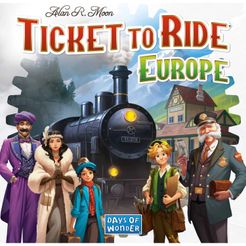
Collect colored train cards, claim rail links between European cities, and complete secret tickets. Tunnel surcharges, ferry locomotive requirements, and stations that borrow routes add choices to every network plan.
Ticket to Ride: Europe supports 2–5 players; community best: 4 players; playing time: 30–60 minutes. A WANGO browser trial has not been confirmed.
Background & introduction
Ticket to Ride: Europe puts two to five railway builders on a shared map. A turn offers one action: draw train cards, claim a route, draw tickets, or build a station. Claimed routes score immediately, while secret tickets add or subtract their value at the end depending on whether their cities are connected.
A matching set of cards pays for a route; gray links allow any single color and locomotives are wild. Ferries require a minimum number of locomotives, whereas tunnels reveal cards that can increase the price. Saving a comfortable reserve reduces construction risk but gives rivals time to occupy crucial links.
Each player has three stations that can borrow adjacent opposing routes for tickets, offering a response to blocked connections. Every unused station is also worth four points. The longest continuous path earns another bonus, but borrowed links do not contribute, forcing a choice between preserving station points and rescuing valuable tickets.
Core rules & scoring
The original European base game supports two to five players. Each uses 45 trains and three stations, starts with four train cards, and receives one long plus three regular tickets, keeping at least two.
Choose one action per turn: draw train cards, claim one route, draw tickets, or build one station. Drawing cards does not also allow route construction that turn.
Normally draw two train cards from the five face-up cards or the deck, refilling exposed cards immediately. A face-up locomotive must be your only pick; a blind-drawn locomotive counts as one card. Refresh all five if three are locomotives.
Claim a whole route at once with enough matching cards and trains. Gray routes take any single-color set and locomotives substitute. Claim only one route per turn; it need not connect to your existing network.
One player cannot claim both sides of a double-route. With two or three players, claiming either side closes the other side to everyone.
For ferries, pay one locomotive per printed locomotive icon and a matching set for the remaining spaces; more locomotives may substitute. For tunnels, offer the basic cost, then reveal three cards; each matching color or locomotive adds one card to the cost.
Pay tunnel surcharges with the chosen color or locomotives. If the original offer is entirely locomotives, only revealed locomotives count and only locomotives pay the extra cost. Decline or fail to pay to retrieve your offered hand cards and end your turn.
When drawing tickets, normally draw three and keep at least one, returning rejected new tickets to the bottom. Previously kept tickets cannot be discarded this way. Completed tickets add their value; incomplete ones subtract it.
Stations cost sets of one, two, then three cards of any one color, allowing locomotives. Each city holds at most one station. Each station borrows one adjacent opposing route for tickets; all tickets using that station must use that same route.
When a player ends a turn with two or fewer trains, everyone including that player gets one final turn. Score four per unbuilt station and ten for the longest continuous path, excluding borrowed links. Break total-score ties by completed tickets, fewer used stations, then the European Express bonus.
Rules & gameplay questions
Must I keep the long ticket dealt at setup?
No. Keep at least two of the four starting tickets; rejected tickets may include the long one and go back in the box.
Can a station bridge an unclaimed route?
No. It borrows an existing route owned by another player and incident to the station city; it does not construct missing track.
Does a station’s borrowed route count toward my longest path?
No. Borrowing helps complete tickets only. The longest path uses continuous trains of your own color.
Are ferry icons a maximum number of locomotives?
No. They set the minimum. Locomotives may also replace the matching colored cards used for the remaining spaces.
Do I lose the cards offered for an unsuccessful tunnel?
No. If you do not pay the surcharge, take back the hand cards offered for the attempt, but your turn is spent. Discard the revealed checking cards.
Rules & introduction sources
- Edition
- Original Ticket to Ride: Europe base set using the official 2019 printing: 45 trains and three stations per player. Excludes Europa 1912, the 15th Anniversary edition, and edition changes in the 2026 refresh.
- Rule references
- Introduction source
- BoardGameGeek
WANGO editorial
| Parameter | Recorded value |
|---|---|
| BGG overall rank (snapshot) | #180 |
| Complexity Weight | 1.91 / 5 |
| Best player count (community) | 4 |
| Player range | 2–5 |
| Playing time (minutes) | 30–60 |
| Core mechanisms | Connections · Contracts · End Game Bonuses · Hand Management · Network and Route Building · Open Drafting · Push Your Luck · Set Collection |
| Chinese publication | Unconfirmed |
| WANGO browser play | No confirmed WANGO trial |
| Year published | 2005 |
| Suggested age | 8+ |
BGG statistics are stored snapshots, not live rankings. Source checked:2026-09-27
Player questions
What is the best player count for Ticket to Ride: Europe, and can I play online?
Ticket to Ride: Europe supports 2–5 players; community best: 4 players; playing time: 30–60 minutes. A WANGO browser trial has not been confirmed.
How complex is Ticket to Ride: Europe, and which mechanisms does it use?
Weight: 1.91 / 5. Mechanisms: Connections · Contracts · End Game Bonuses · Hand Management · Network and Route Building · Open Drafting · Push Your Luck · Set Collection. Chinese publication: Unconfirmed.
Where can I learn Ticket to Ride: Europe?
No rule guide, strategy article or WANGO trial has been confirmed for this record.