La Granja
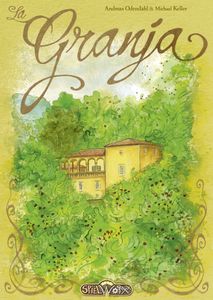
La Granja is a farming strategy game in which players grow crops and pigs, develop a farm, and deliver goods to market carts or craft buildings over six rounds to earn Victory Points.
La Granja supports 1–4 players; community best: 3 players; playing time: 90–120 minutes. A WANGO browser trial has not been confirmed.
Background & introduction
La Granja places each player on a small farm near Esporles on the Spanish island of Mallorca. With limited time, land, and transport, players decide what to produce, when to expand, and how to turn farm goods into value. Fields, farm extensions, storage, pig pens, market carts, and craft buildings in town form a connected operation: goods may support further growth or become the basis for deliveries and points.
A major choice comes from the farm cards, which have four possible uses. When played, a card can be inserted as a field, farm extension, market cart, or helper, but only one orientation is chosen. Each use changes the farm and its future options. Players then select income dice, grow olives, grain, or grapes, manage pigs, and choose a Donkey card that controls free deliveries and movement on the Siesta track. Card use, resource upgrades, delivery planning, and turn order therefore affect one another.
The game lasts six rounds, each divided into Farm, Revenue, Transportation, and Scoring phases. Players can deliver goods to their own carts for points and Trade Goods, or gradually complete town craft buildings for immediate and continuing benefits. Partially filled destinations may wait across rounds. Each round also scores market markers and the Siesta track. After round six, eligible remaining goods are converted into Silver, then five Silver is worth one Victory Point. The highest score wins; Silver breaks a tie, and an exact tie after that is shared.
Core rules & scoring
Edition and objective: This entry covers the La Granja base-game scope of the 2014 Spielworxx first edition, using PD-Verlag's official 2015 German reprint and card glossary. The game supports one to four players and lasts six rounds. The original rulebook contains a solo section, but this summary focuses on the core farm and multiplayer flow; later Deluxe Master Set modules and Automa rules are excluded.
Four phases: Each round proceeds through Farm, Revenue, Transportation, and Scoring. Players complete the current step before the group moves to the next phase. In the first round each player plays two Farm cards; in each later round the player plays one card. Playing cards, receiving income, producing goods, and buying Roof tiles develop the farm. Plan storage and field space before gaining more goods, since a resource that has no legal place cannot simply be placed wherever convenient.
Four uses for a farm card: When playing a card, choose one edge to insert into the farm. The left edge makes a Field that grows olives, grain, or grapes; the top edge creates a Market Cart for a delivery pattern; the right edge expands the farm and may provide a lasting benefit; the bottom edge hires a Helper with a special ability. Only the selected orientation is active. A single card cannot function simultaneously as a Field, Cart, Extension, and Helper.
Farm phase and resources: Players play cards and refill their hands as instructed, collect farm income, grow crops in Fields, check pig breeding, and buy Roof tiles. At least two pigs and an empty pen are required to breed one additional pig; breeding does not create unlimited capacity, and a piglet cannot be sold to bypass that limit. Players may buy basic resources, upgrade them, or use free upgrade effects. Upgraded goods cannot be bought or sold directly. Crops normally remain in their Fields until upgraded, spent on a farm extension, or delivered; card 35 Field Worker is the rules' specific exception to the normal crop-sale restriction.
Revenue dice: Use five dice in a two-player game, seven with three players, and nine with four. In turn order, each player chooses two dice and resolves their income, then every player resolves the final remaining die. Die faces can provide a pig, a card or crop, two crops, Silver, a free upgrade plus Siesta movement, or a delivery/Silver option. Follow the pictured income effect rather than treating a die as a general action-point value. Earlier choices also determine which income combinations remain for later players.
Transportation and the Siesta track: Each player selects an available Donkey card. Its hats move the player on the Siesta track, while its donkeys set the number of free deliveries; extra deliveries may be purchased for Silver as permitted by the rules. Siesta position affects both scoring and the next round's order. If markers share a space, their stack position decides priority. Donkey-card availability changes during play, including a reset in round four, so do not carry unused delivery capacity automatically from one round to the next.
Deliveries to carts and buildings: Deliver farm goods to a craft building or one of your Market Carts, meeting the destination's resource requirement each time. The required goods may be delivered in any order and over multiple rounds. Completing a craft building grants its marker and printed reward; some markers provide an ongoing ability. A building blocked by a sequence marker opens when any player first completes the preceding building. Completing a Cart grants its printed points and a Trade Good, then places or removes market markers according to its market value; removed lower markers can score points.
Scoring and the end: During each Scoring phase, gain zero to three points according to the Siesta track and one point for each of your markers in the market. A marker on a craft building does not itself score every round. After round six, sell or convert eligible resources and Trade Goods into Silver at the listed values; crops still in Fields and upgraded goods cannot be sold. Convert each five Silver to one Victory Point. The highest total wins; ties go to the player with more remaining Silver, and a tie after Silver is shared.
Rules & gameplay questions
Can one farm card provide all four of its uses?
No. When a card is played, choose one edge and insert it as a Field, Market Cart, farm Extension, or Helper. The card functions only in the chosen orientation; it does not also count as the other three uses. Compare crop needs, delivery space, extension benefits, and helper text before playing it, because the choice changes both your farm layout and the options available in later rounds.
Can I sell crops directly from a Field or move them into storage?
Normally no. Olives, grain, and grapes remain in their Fields until upgraded, spent on a farm extension, or delivered to a destination; they are not ordinary stored resources that can be sold. The official rules identify card 35, Field Worker, as an exception that permits crop sales. Do not generalize that special ability to every Field. Upgraded goods also cannot be bought or sold directly.
How many Revenue dice does each player choose?
Prepare five dice for two players, seven for three, or nine for four. In turn order, each player chooses two dice and immediately resolves the income shown; then every player resolves the final die left over. Possible faces include a pig, a card or crop, two crops, Silver, a free upgrade with Siesta movement, or a delivery/Silver choice. Earlier picks change the options available to later players.
Must Cart or building goods be delivered in the printed order?
No. As long as each delivery satisfies the resource requirements of that Cart or craft building, the player may deliver goods in any order and may complete the destination over multiple rounds. The reward is taken when the required delivery is finished. If a Donkey card does not provide enough deliveries, the remaining goods wait at the destination; flexible order does not waive resource types or the delivery limit.
When does a blocked craft building become available?
A sequence marker is removed and the next blocked building opens when any player first completes the preceding craft building. Once it opens, a player may deliver there later in that same round; there is no need to wait for the next round. The player must still deliver all required goods to finish it. If the prerequisite has not been completed, having the right goods is not enough to use the blocked space.
Will two pigs always breed, and can the piglet be sold immediately?
Breeding requires at least two pigs and an empty pen, and it produces only one additional pig. If there is no free space, the herd does not grow. A newborn pig cannot be sold immediately to bypass the capacity requirement. Plan an expansion or a legal way to manage the existing herd before relying on breeding; the official rules and card glossary clarify the piglet and pen limits.
How do the Siesta track and market markers score each round?
During Scoring, the Siesta position awards zero, one, two, or three points, and each of your markers in the market is worth one point. A marker in the craft-building area does not automatically score each round. Siesta position also affects next round's turn order, and stacked markers are compared by their position in the stack, so Transportation can matter for both immediate points and later choices.
Does everything convert into points after round six?
No. First sell or convert the remaining resources and Trade Goods allowed by the rules into Silver, then exchange five Silver for one Victory Point. Crops in Fields and upgraded goods cannot be sold directly, and building or market markers are not saleable resources. The highest Victory Point total wins; remaining Silver breaks a tie, and players still tied after that share the victory.
Rules & introduction sources
- Edition
- BGG 146886: the La Granja base game designed by Andreas Odendahl and Michael Keller. This entry uses PD-Verlag's official 2015 German reprint of the 2014 Spielworxx first-edition base rules and its official card glossary. It is not the 2022 La Granja Deluxe Master Set and excludes its modules and Automa rules. The FAQs below are editorial answers grounded in the original rules, not a separately published publisher FAQ. English terms are explanatory translations from the German source.
- Rule references
- Introduction source
- BoardGameGeek
WANGO editorial
| Parameter | Recorded value |
|---|---|
| BGG overall rank (snapshot) | #281 |
| Complexity Weight | 3.57 / 5 |
| Best player count (community) | 3 |
| Player range | 1–4 |
| Playing time (minutes) | 90–120 |
| Core mechanisms | Area Majority / Influence · Automatic Resource Growth · Contracts · Dice Rolling · Hand Management · Hidden Victory Points · Income · Market · Multi-Use Cards · Open Drafting · Simultaneous Action Selection · Solo / Solitaire Game · Variable Player Powers · Victory Points as a Resource |
| Chinese publication | Unconfirmed |
| WANGO browser play | No confirmed WANGO trial |
| Year published | 2014 |
| Suggested age | 12+ |
BGG statistics are stored snapshots, not live rankings. Source checked:2026-09-27
Player questions
What is the best player count for La Granja, and can I play online?
La Granja supports 1–4 players; community best: 3 players; playing time: 90–120 minutes. A WANGO browser trial has not been confirmed. Recorded mechanism tags: Solo / Solitaire Game.
How complex is La Granja, and which mechanisms does it use?
Weight: 3.57 / 5. Mechanisms: Area Majority / Influence · Automatic Resource Growth · Contracts · Dice Rolling · Hand Management · Hidden Victory Points · Income · Market · Multi-Use Cards · Open Drafting · Simultaneous Action Selection · Solo / Solitaire Game · Variable Player Powers · Victory Points as a Resource. Chinese publication: Unconfirmed.
Where can I learn La Granja?
No rule guide, strategy article or WANGO trial has been confirmed for this record.