T.I.M.E Stories
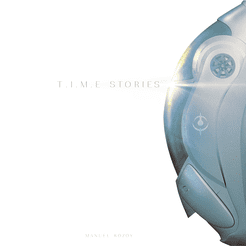
T.I.M.E Stories is a cooperative narrative board game in which players act as temporal agents. They project their minds into era-appropriate characters, explore locations, share clues, resolve tests, and try to repair a temporal anomaly before their allotted time runs out. The base box includes the Asylum mission.
T.I.M.E Stories supports 2–4 players; community best: 4 players; playing time: 90 minutes. A WANGO browser trial has not been confirmed.
Background & introduction
In the world of T.I.M.E Stories, the T.I.M.E Agency monitors the timeline and prevents harmful interference with the past, future, or alternate realities. Agents do not simply travel into another era in their modern bodies. Instead, their minds are projected into receptacles: characters suited to the world and period they are visiting. This premise lets each mission reveal a distinct setting, cast, and set of abilities through its cards while keeping the players together as one team.
Players receive a mission briefing at the Agency base, then open the matching mission deck and follow its instructions to set up locations. The base box contains the Asylum mission, while later decks introduce other worlds and may include scenario-specific details. In each location, the team reads the narrative, discusses what it has learned, and decides which spaces to investigate. The cards reveal information gradually, so careful handling and communication are part of the experience.
Every attempt takes place under a limited supply of Temporal Units. The team moves between locations, examines unlocked scene cards, gathers items, shares discoveries, and uses character attributes to face combat, strength, persuasion, or dexterity tests. An action may uncover a clue, but it can also cost time, health, or resources. Players therefore balance curiosity against the mission clock and decide when to investigate further and when to pursue the main objective.
If the team runs out of time before completing the mission, the agents return to base and begin another run from the start; certain Agency-marked items can persist between attempts. Knowledge from a previous run may help the group choose a faster route or avoid a known risk. Story cards, locations, tests, and shared decisions make each mission a cooperative adventure in which the entire team succeeds or fails together according to the scenario's conditions.
Core rules & scoring
Objective: All players form one team of temporal agents and try to complete the objective specified by the current mission deck. There is no individual victory or competitive score. Each scenario can add its own goal, components, or special instructions, so begin by reading the briefing at base and follow the mission cards. The base box supplies the Asylum mission; other mission decks are outside this entry's scope.
Mission setup: Place the timeline, mission deck, location board, dice, life points, state tokens, and resources within reach. Read the scenario briefing at base, choose the required receptacles and starting resources, and prepare the scene as directed. The deck contains narrative, locations, items, and tests. Do not reveal cards that the mission has not unlocked, because doing so can expose story information or spoil a puzzle.
Choose receptacles: Each player selects a character suited to the mission's world. A receptacle card shows attributes, life points, the number of action dice it can use, and any special ability. In a two-player game, each person controls two receptacles. Players with more people assign characters according to the scenario and the rulebook. Before a test, compare the relevant attributes and decide which receptacle should take the risk.
Group and Time Captain: After the briefing, the team enters the first location. The group token represents the party's shared position, and the agents cannot split into separate groups. A Time Captain manages scene cards, reads location introductions, and rolls the Time Captain die when required. The role passes to the next player as instructed, giving everyone a turn managing the board and the flow of information.
Temporal Units and a run: Each mission grants a limited number of Temporal Units, or TU, tracked on the timeline. Whenever the Time Captain spends one TU, each player takes one action: resolve a characteristic test, move to an accessible space, or do nothing. Players choose the order of actions. One complete run starts when the team leaves base and ends when its TU are exhausted or the mission is resolved. Entering a location and reading a card at a space just reached cost no extra TU; the Time Captain rolls the die and pays the indicated TU when the team changes location.
Locations and exploration: A location consists of a set of scene cards. The Time Captain finds the cards by their backs, lays them out as a panorama, and reads the location's A card. The team discusses which spaces to investigate. Players may inspect a card or place a receptacle above it only when they meet the conditions printed on the card. Before changing location, collect the current scene cards in order and follow the scenario's movement rules.
Tests and dice: Combat, strength, persuasion, dexterity, and other tests use the relevant attribute on a receptacle card to determine how many action dice to roll. Hits remove shields from the test. Skulls can trigger a riposte when skull shields remain, while unresolved heart, time, or special shields cause the effects specified by the rules or scenario. Passing a test may grant an item, state token, or information; the card text determines the actual reward.
Life, items, and state: Each receptacle has its own life points. Reaching zero temporarily removes that receptacle from the adventure; it can re-enter according to the timeline rules. The run may fail if all receptacles are unable to act at once or if the mission triggers a failure condition. Items are carried by receptacles and can be handed to another agent only when the rulebook's location conditions are met; one item cannot be used by two receptacles during the same TU. State tokens record completed actions or discoveries and may provide access to new cards.
Failure and another run: If the team has not completed its objective when the allotted TU are exhausted, the current run ends and the agents return to base to start again. Reset temporary scene cards and states as directed. Certain items marked with the Agency logo persist between runs and can give the team an advantage. Players may use information already learned to avoid repeating investigations, while still obeying the mission deck's instructions.
Completion, saving, and mission scope: The whole team succeeds when it meets the conditions on the current mission cards; any failure condition is also determined by that scenario. If play pauses mid-run, the rulebook explains how to store the current location and plan cards so the same attempt can continue later. Keep every location deck in order and hidden as directed. Rules introduced by other mission decks do not automatically apply to Asylum or to one another.
Rules & gameplay questions
What kind of game is T.I.M.E Stories?
It is a cooperative narrative adventure board game. Players act as temporal agents who investigate the locations and clues in a mission deck, share theories, choose where to explore, and use character abilities to resolve tests. Space Cowboys describes it as a narrative game with both roleplaying atmosphere and structured board game actions, so each group can decide how much character performance to add.
Which mission comes in the base box?
Space Cowboys states that the base box contains the T.I.M.E Stories system and the Asylum mission. Other mission decks tell different adventures and can introduce their own scenario rules, but they are separate products. This entry explains the base system and Asylum only; it does not combine later missions or the separate T.I.M.E Stories Revolution line.
Can two people play T.I.M.E Stories?
Yes. The publisher lists the game for two to four players. In a two-player game, the rulebook has each person choose and control two receptacles, which gives the team access to different attributes for tests. Players still investigate together, discuss clues, and coordinate movement and item use as one party.
What is a run in T.I.M.E Stories?
A run is one complete attempt at a mission, starting when the team leaves the Agency base and ending when its allotted Temporal Units are exhausted. During the run, players explore locations, move, resolve tests, and spend TU as required. If time runs out before the objective is complete, the agents return to base and begin another attempt, keeping only what the rules allow to persist.
How do players explore a location?
Each location is made from a group of scene cards. The Time Captain finds the group by its card backs, lays it out in the prescribed order, and reads the location's A card. The team then decides which spaces to inspect. A card can be revealed or occupied only when its printed conditions are met, and the cards must be put away in order before the team changes location.
How are combat and other tests resolved?
For each TU spent, agents present in the test space can each roll the number of action dice allowed by the relevant receptacle attribute. Hits remove shields; a skull can trigger a riposte if skull shields remain, and unresolved time, heart, or scenario-specific shields apply their listed effects. A successful test may reward an item, state token, or clue, as specified by the card.
Does a receptacle dying end the whole mission?
A receptacle that reaches zero life points temporarily leaves the adventure and can re-enter according to the timeline rules. The rest of the team may still continue investigating. The run can fail if all receptacles are unable to act at once or if the mission triggers another failure condition, so check the current mission deck for its exact end conditions.
Is roleplaying required?
No. The publisher presents roleplaying as optional. Each player controls a character native to the mission's world and may speak in character, but the rules focus on exploring locations, managing resources and time, and resolving tests with dice. A group that prefers puzzles can simply discuss clues and plans without inventing dialogue or additional character histories.
Can a mission be paused and continued later?
Yes. The rulebook includes a procedure for storing a scenario in the middle of a run. It tells players to place the current location and plan cards in the log area and preserve the other components as instructed. Keep the cards ordered and avoid revealing anything that has not been unlocked so the same attempt can resume without losing information or spoiling later scenes.
How is victory decided at the end of a mission?
The whole team succeeds or fails together according to the current mission deck, rather than by comparing personal points. The scenario specifies its objective and any failure conditions, which may differ between missions. If the team's available time ends before it meets the objective, that run usually ends and the group returns to base for another attempt.
Rules & introduction sources
- Edition
- This entry covers the original Space Cowboys T.I.M.E Stories base box and its Asylum mission. The publisher lists 2–4 players, ages 12+, and about 90 minutes. Each mission deck may add its own instructions and rules. Other separately released mission decks and the T.I.M.E Stories Revolution line are outside this entry.
- Rule references
- Introduction source
- BoardGameGeek
WANGO editorial
| Parameter | Recorded value |
|---|---|
| BGG overall rank (snapshot) | #368 |
| Complexity Weight | 2.58 / 5 |
| Best player count (community) | 4 |
| Player range | 2–4 |
| Playing time (minutes) | 90 |
| Core mechanisms | Cooperative Game · Dice Rolling · Move Through Deck · Narrative Choice / Paragraph · Storytelling · Variable Player Powers |
| Chinese publication | Unconfirmed |
| WANGO browser play | No confirmed WANGO trial |
| Year published | 2015 |
| Suggested age | 12+ |
BGG statistics are stored snapshots, not live rankings. Source checked:2026-09-27
Player questions
What is the best player count for T.I.M.E Stories, and can I play online?
T.I.M.E Stories supports 2–4 players; community best: 4 players; playing time: 90 minutes. A WANGO browser trial has not been confirmed.
How complex is T.I.M.E Stories, and which mechanisms does it use?
Weight: 2.58 / 5. Mechanisms: Cooperative Game · Dice Rolling · Move Through Deck · Narrative Choice / Paragraph · Storytelling · Variable Player Powers. Chinese publication: Unconfirmed.
Where can I learn T.I.M.E Stories?
No rule guide, strategy article or WANGO trial has been confirmed for this record.