Eldritch Horror
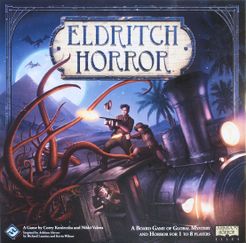
Travel the world together, gather clues and solve mysteries while gates and Mythos crises threaten to awaken an Ancient One.
Eldritch Horror supports 1–8 players; community best: 4 players; playing time: 120–240 minutes. A WANGO browser trial has not been confirmed.
Background & introduction
Eldritch Horror is a cooperative investigation adventure for 1–8 players. Investigators with different abilities travel across a world map, gather supplies and confront supernatural threats. The group wins or loses together rather than competing for individual victory points.
Each round gives every investigator up to two actions, then an encounter, before one Mythos card escalates the crisis. Clues, gates, expeditions and rumors create different destinations. Sharing a space with several opportunities does not allow an investigator to resolve them all.
The four base-game Ancient Ones bring their own mysteries and research decks. Solving three Mystery cards is the usual objective, but the team must also manage Doom and other loss conditions. An awakened Ancient One imposes its reverse-side rules and Final Mystery; Azathoth's awakening ends the game outright.
Core rules & scoring
Setup: Choose investigators and one base-game Ancient One. Receive listed possessions, Health and Sanity; build the three-stage Mythos deck and set Doom, Omen, associated decks and the first Mystery. Use the investigator-count Reference card for starting gates and clues. Each newly spawned gate also spawns a monster. Display four Assets in the reserve. A single-investigator game removes Teamwork components; one player may instead control two investigators using the two-player Reference card.
Round: Resolve Action, Encounter and Mythos phases in order. During actions and encounters, start with the Lead Investigator and proceed clockwise; each investigator finishes before the next acts. At Mythos phase end, the Lead Investigator may pass the token to another investigator.
Actions: Normally perform up to two, using each action at most once per round. Options are Travel, Rest, Trade, Prepare for Travel, Acquire Assets and component actions. Actions on different components can be used separately. Additional actions do not remove the once-per-round restriction.
Travel and supplies: Travel one adjacent path first, then spend train or ship tickets for extra spaces along matching paths. Prepare for Travel is city-only, requires the matching path and allows at most two tickets. Rest restores one Health and one Sanity; Acquire Assets is a city Influence test. Neither Rest nor Acquire Assets is allowed with a monster present.
Tests: Form a pool from skill, modifier, improvements, the single highest applicable bonus and cumulative additional dice; roll at least one die. Normally each five or six is a success and one success passes. Spend a Clue to reroll one die. Ordinary rolls that are not tests cannot use effects restricted to rerolling tests.
Encounters: If monsters are present, encounter each once in your chosen order. After clearing them all, you may choose an additional encounter. Otherwise choose one legal option, such as a location, research clue, gate, expedition or rumor. Reaching a clue does not collect it automatically; resolve the research card. Closing a gate likewise requires an instructing effect.
Combat: Check monster effects, then resolve its Will and Strength tests. Lose Sanity equal to horror minus Will successes and Health equal to damage minus Strength successes, with no loss if successes meet the relevant value. The monster simultaneously loses Health equal to Strength successes. Defeat it when accumulated damage reaches toughness; surviving monsters retain damage.
Mythos: Resolve only the current card's icons and text, in order. After Omen advances, each gate matching the new Omen advances Doom one toward zero. Resolve Reckoning for monsters, the Ancient One, ongoing Mythos cards, then investigator possessions and Conditions. Use the Reference card for gates, monster surges and clues; a Mythos surge with no matching gate spawns one gate instead.
Loss and victory: Zero Health or Sanity defeats an investigator and advances Doom one. Before awakening, normally choose an unused investigator at Mythos phase end; after awakening, defeat or devouring eliminates that player. Solve the three required base-game Mysteries to win, with the Final Mystery also required after awakening. If no Mythos card can be drawn, end that phase and lose unless victory has been achieved. All players eliminated or a specified loss effect also ends the game.
Rules & gameplay questions
Can I add the bonuses from two weapons?
Do not add ordinary skill bonuses together; apply the highest applicable one. Other effects remain usable, such as another item's reroll. Effects explicitly granting additional dice can accumulate.
Does reaching a clue or gate collect or close it?
No. A clue normally requires a research encounter and a gate an Other World Encounter with a closing effect. Monsters on that space must normally be dealt with first.
Does defeat immediately eliminate me from the whole game?
Usually not before awakening. At Mythos phase end, choose an investigator who has not already been defeated. With none available, the player is eliminated. After a base-game Ancient One awakens, defeat or devouring eliminates the player without a replacement.
May I inspect the backs of Spells or Conditions in advance?
No. Inspect them only when an effect permits or requires it. Their decks are normally faceup, random cards come from the bottom and discarded cards are shuffled back into the corresponding deck. Conditions cannot be traded.
Can the third Mystery save us after a Mythos card makes us lose?
If the Mystery resolves at Mythos phase end, a loss while resolving the card ends the game first. The 2017 official FAQ distinguishes this from truly simultaneous win and loss effects, which result in victory.
Rules & introduction sources
- Edition
- Eldritch Horror, Fantasy Flight Games 2013 base game for 1–8 players, using the official Rulebook, Reference Guide and base-game-applicable corrections in the August 11, 2017 FAQ. Uses original player-count Reference cards. Excludes optional FAQ Reference cards, Focus, Preludes, Adventures, expansion Ancient Ones and other expansion content.
- Rule references
- Introduction source
- BoardGameGeek
WANGO editorial
| Parameter | Recorded value |
|---|---|
| BGG overall rank (snapshot) | #140 |
| Complexity Weight | 3.32 / 5 |
| Best player count (community) | 4 |
| Player range | 1–8 |
| Playing time (minutes) | 120–240 |
| Core mechanisms | Action Points · Cooperative Game · Dice Rolling · Events · Pick-up and Deliver · Point to Point Movement · Resource to Move · Role Playing · Solo / Solitaire Game · Stat Check Resolution · Variable Player Powers · Variable Set-up |
| Chinese publication | Unconfirmed |
| WANGO browser play | No confirmed WANGO trial |
| Year published | 2013 |
| Suggested age | 14+ |
BGG statistics are stored snapshots, not live rankings. Source checked:2026-09-27
Player questions
What is the best player count for Eldritch Horror, and can I play online?
Eldritch Horror supports 1–8 players; community best: 4 players; playing time: 120–240 minutes. A WANGO browser trial has not been confirmed. Recorded mechanism tags: Solo / Solitaire Game.
How complex is Eldritch Horror, and which mechanisms does it use?
Weight: 3.32 / 5. Mechanisms: Action Points · Cooperative Game · Dice Rolling · Events · Pick-up and Deliver · Point to Point Movement · Resource to Move · Role Playing · Solo / Solitaire Game · Stat Check Resolution · Variable Player Powers · Variable Set-up. Chinese publication: Unconfirmed.
Where can I learn Eldritch Horror?
No rule guide, strategy article or WANGO trial has been confirmed for this record.