Russian Railroads
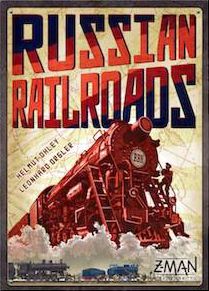
Place workers to develop three railways, upgrade locomotives and industrialize, turning track quality, reach and engineer abilities into recurring victory points.
Russian Railroads supports 2–4 players; community best: 4 players; playing time: 120 minutes. A WANGO browser trial has not been confirmed.
Background & introduction
Russian Railroads is a worker-placement game for 2–4 players. Each player develops a personal Trans-Siberian, St. Petersburg and Kiev railway. The contested shared resources are action spaces, locomotives and engineers rather than delivery routes on a common map.
Colored track markers represent construction quality, while locomotives determine which spaces can score. Advancing black track alone does not automatically produce a strong income of points: higher-value colors must be unlocked and advanced behind it, with locomotives reaching important bonuses.
The industry track offers another growth path. Factories bridge its gaps and trigger abilities when an industry marker enters them. Engineers provide private actions and compete for an end-game majority bonus, linking immediate placement choices to recurring scoring and final bonuses.
Core rules & scoring
Setup and player counts: With four players, each starts with 5 workers, 1 rouble, a number-1 locomotive, black track on all three railways and an industry marker; distribute starting bonuses by turn order. Two or three players start with 6 workers each; two players also start with 2 roubles. Remove locomotives and adjust engineers for player count. Play 7 rounds with four players or 6 with two or three.
Turns and placement: Follow the turn-order track, choosing one empty action space, placing its required workers and immediately resolving the whole action. A public action that cannot be completed is unavailable. The bottom single black-or-gray advancement space is reusable. Passing ends your actions for the round and scores the points on the back of your turn-order card.
Track: Advance in the fixed order black, gray, brown, natural, white. A trailing marker cannot catch or pass the marker ahead and must enter an empty space; allowed advancements may be split across railways. Trans-Siberian black track at spaces 2, 6, 10 and 15 unlocks gray, brown, natural and white track respectively. Each railway permits the colors shown on its board.
Locomotives and factories: Normally take from the lowest-numbered supply pile and use the tile as a locomotive or flip it into a factory; available face-up factories are also selectable. The Trans-Siberian holds up to two locomotives with combined values, and each other route holds one. Replace only with a higher number; displaced locomotives may be legally relocated, and returned locomotives become factories. Fill the five factory slots left to right.
Industry: Advance industry markers as directed, never crossing an unfilled factory gap. Entering a factory immediately resolves its ability. After gaining a second marker, split advancements between them if desired; they cannot share a space and can normally each activate a factory, but a question-mark bonus space triggers only once.
Auxiliaries and engineers: Roubles substitute for workers and may be mixed with them, but workers cannot replace specifically required roubles. Temporary workers last only this round. Place doublers left to right above the Trans-Siberian. Spend 1 rouble to hire the rightmost engineer; its action becomes private and normally usable once each round. Public engineers remain shared spaces; private engineers allow partial resolution.
Order and bonuses: Reserve next round’s first or second position, normally neither your current position nor both spaces; two players may reserve their current position. After everyone passes, adjust order, then relocate the second-position worker before the first-position worker to an empty action requiring exactly one worker, without adding workers or roubles. Special route bonuses require their indicated track and, where applicable, locomotive reach. Black track reaching a terminus immediately scores 10; question-mark tokens grant chosen one-time bonuses.
Round scoring and reset: Score track spaces only within locomotive reach. Each colored marker and the empty spaces behind it up to the next marker score at that color’s value, modified by doublers and route bonuses. Industry markers score their space or the preceding point-valued space. Recover personal workers, return spent roubles and temporary workers to supply, and shift engineers right. In the last round, replace turn-order actions with a three-step industry action.
End: Score the final round normally, then acquired End Bonus cards. Most engineers scores 40 points and second-most 20; tied counts are broken by each tied player’s highest engineer number. Players with no engineers receive no majority points. Highest total wins; tied players share victory.
Rules & gameplay questions
Can track advance beyond locomotive reach?
Yes. Locomotive reach does not limit track advancement, but railway scoring only counts reachable spaces, and some special bonuses also require the locomotive to reach their space.
Are roubles only for hiring engineers?
No. One rouble also substitutes for one worker and can be mixed into multi-worker payments. Workers cannot replace an explicitly required rouble. Roubles on action spaces return to the common supply at round end, not to their spender.
Are hired engineers free to use?
No. Hiring gives you a private action space that still requires a worker or legal substitute, normally once per round. Others cannot occupy it, and you may use it even when unable to resolve every part of its effect.
Can a copied action take the temporary workers again?
No. The FAQ limits the temporary-worker action to once per round, leaving only two temporary workers available each round. Copying is restricted to your previously used actions that meet its single-worker-space requirements.
Can I perform only part of a public action?
No. Public actions and contested question-mark cards must be fully executable. Private engineers and noncompetitive effects such as industry triggers follow their exceptions; those exceptions do not extend to public spaces.
Rules & introduction sources
- Edition
- Original 2013 Russian Railroads, 2–4-player base rules and applicable base-game clarifications in FAQ v3. Excludes Ultimate Railroads revisions, German, American and Asian Railroads, coal and other expansions, and solo rules.
- Rule references
- Introduction source
- BoardGameGeek
WANGO editorial
| Parameter | Recorded value |
|---|---|
| BGG overall rank (snapshot) | #153 |
| Complexity Weight | 3.40 / 5 |
| Best player count (community) | 4 |
| Player range | 2–4 |
| Playing time (minutes) | 120 |
| Core mechanisms | End Game Bonuses · Tech Trees / Tech Tracks · Turn Order: Claim Action · Worker Placement |
| Chinese publication | Unconfirmed |
| WANGO browser play | No confirmed WANGO trial |
| Year published | 2013 |
| Suggested age | 13+ |
BGG statistics are stored snapshots, not live rankings. Source checked:2026-09-27
Player questions
What is the best player count for Russian Railroads, and can I play online?
Russian Railroads supports 2–4 players; community best: 4 players; playing time: 120 minutes. A WANGO browser trial has not been confirmed.
How complex is Russian Railroads, and which mechanisms does it use?
Weight: 3.40 / 5. Mechanisms: End Game Bonuses · Tech Trees / Tech Tracks · Turn Order: Claim Action · Worker Placement. Chinese publication: Unconfirmed.
Where can I learn Russian Railroads?
No rule guide, strategy article or WANGO trial has been confirmed for this record.