Rococo
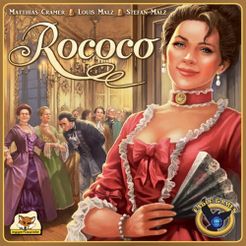
Rococo, published as Rokoko in its original rules, is a seven-round worker-management game. Hire employees of different ranks, make gowns, decorate the royal ball, and compete for prestige.
Rococo supports 2–5 players; community best: 3 players; playing time: 60–120 minutes. A WANGO browser trial has not been confirmed.
Background & introduction
Rococo, titled Rokoko in its original rules, puts players in charge of tailoring shops serving a royal ball. Each player hires employees with different abilities, buys silk, yarn, and lace, and makes elegant gowns. A finished gown can be rented to a ball guest or sold for cash. Players can also fund fireworks, music, fountains, and statues, placing their ownership markers around the ballroom and turning those investments into prestige at the end of seven rounds.
The game combines employee-card selection, turn-by-turn actions, and resource management. At the start of each round, players secretly choose three employees, then play their cards one at a time. An employee’s rank determines which main actions are available, and the card may provide an additional bonus. Players can claim the Queen’s favor, acquire warehouse resources, make or sell a gown, hire an employee, depute an employee for money, or fund a decoration. A newly hired employee enters the current hand immediately, so the number of actions in a round can exceed the three initially selected.
Every choice connects money, textiles, employee abilities, and scarce ballroom spaces. Gowns may be rented into different halls or sold, while decorations provide immediate benefits and affect endgame majorities or income. After round seven, players score cash, employee bonuses, the Queen’s favor, hall majorities, decorations, balcony multipliers, and ballroom rewards. The original base game has no solo or cooperative mode; the solo module listed in Rococo Deluxe belongs to a separate product edition.
Core rules & scoring
Objective and mode: Run a tailoring shop for seven rounds, make gowns, and decorate the royal ball to earn the most prestige. Employees, gowns, money, and decorations all contribute to final scoring. The original rules list 2–5 players and ages 12+. The original rulebook does not state a duration. The base game is competitive.
Setup and resources: Choose the board side for 2–3 or 4–5 players. Each player takes a personal board, 16 ownership markers, five starting employee cards, 15 Livre, one lace, and one yarn. Set up the employee market, warehouse resources, gown display, decoration areas, and bag. Employees are Masters, Journeymen, or Apprentices; rank controls action eligibility, while card bonuses may resolve immediately or score at the end.
Round preparation and income: Play seven rounds. At the start of a new round, remove leftover employees from the market and reveal four new ones, refill the warehouse and gown display, and reshuffle discarded gowns if the bag is empty. At the end of each round, every player receives 5 Livre plus any fountain income earned from ownership markers and the board’s conditions.
Choose employees and take actions: Each round, all players simultaneously and secretly select three cards from their employee supply. Starting with the first player, players take turns playing one employee card, performing one permitted main action, and optionally using its printed bonus. The player may also skip the main action or bonus. Played employees go to a personal discard pile. If an employee is hired during the round, it enters the current hand and may be played later, so action counts can vary. If the Employee supply has fewer than three cards, take them all and turn the discard pile over as a new supply to complete the hand. If exactly three remain, take those and wait until the next round to turn the discard pile.
Employee ranks: Masters may perform all six main actions. Journeymen cannot hire a new employee. Apprentices cannot claim the Queen’s favor, make a gown, or hire. Check the played employee’s rank before taking an action, then resolve its printed bonus if desired. Deputing an employee removes it from future supply in exchange for cash, but its card bonus remains available when played. You may not depute an Employee when only four cards remain in your Employee deck; this also applies to similar card bonuses.
Six main actions: Claiming the Queen’s favor grants 5 Livre, makes its holder first player next round, and is worth 3 prestige at the end. Acquiring resources takes a warehouse tile; prices fall as a section empties and the last tile is free. Making a gown pays its displayed cost and then rents or sells it. Hiring buys a market employee. Deputing pays 10/7/4 Livre by employee rank. Funding a decoration pays its cost and places an ownership marker on a fireworks, music, statue, or fountain space.
Make, rent, or sell gowns: Only a Master or Journeyman may make a gown; a gown with a Master icon requires a Master. Pay the displayed Livre, silk, and any yarn or lace cost, then either rent the gown in an eligible empty hall space, placing an ownership marker and taking that space’s immediate reward, or sell it for its printed cash value. A free warehouse resource is a bonus on certain rental guest spaces. Only a Master-made gown can occupy a Master Guest space. If there is no eligible empty guest space, the gown must be sold.
Resources and decorations: A purchased resource tile may be kept face down as silk or discarded for its yarn or lace. Funding a decoration requires the printed cost and an empty space. Fireworks affect balcony gown multipliers and majority scoring; music can break ties in a hall; fountains may increase income in later rounds; statues score sets of gowns in different colors. Ownership markers connect these actions to final scoring, so follow the board’s occupancy limits.
Final scoring: After income in round seven, hold the Ball Night scoring. Convert each 10 Livre into one prestige and keep leftover money for tiebreaks. Score employee endgame bonuses and 3 points for the Queen’s favor, then evaluate hall gown majorities, fireworks, balcony multipliers, statue sets, decoration markers, and the All Halls reward. Hall and fireworks spaces use majority awards printed on the board; statues score sets by gown color.
Ties and two-player rules: Highest prestige wins; a tie is broken by remaining Livre. In a hall tie, compare Master Guest gowns and then that hall’s music decoration; if still tied, tied players receive the top award and no second-place award is given. In a two-player game, only the majority player scores in each hall and in fireworks. Rococo Deluxe’s Madame Du Barry Solo and the separate Jewelry Box module are not part of BGG 144344’s original base game. Fireworks ties go to the tied player occupying the more expensive fireworks space. Each of your fireworks markers may move one of your King’s hall dresses to its associated terrace space, where its dress score receives that space’s multiplier.
Rules & gameplay questions
What is the goal of Rococo (Rokoko)?
Players run tailoring shops, hire employees, acquire textiles, make gowns, and fund decorations for a royal ball, aiming for the most prestige. A gown may be rented into a hall to contest its majority or sold for money; fireworks, music, fountains, and statues provide different immediate or endgame benefits. The game lasts seven rounds, then scores cash, employee bonuses, halls, and decorations. The highest prestige wins.
How do I choose employees and take actions each round?
At the start of each round, everyone secretly chooses three employee cards from their supply. Players then take turns, beginning with the first player, and play one employee at a time. The employee performs one main action allowed by its rank, and its printed bonus may also be used. The action phase continues until cards are played. Hiring a new employee adds it to your current hand, so you may take more than three actions in a round. If fewer than three remain in the supply, take them and turn over the discard pile to choose the rest; with exactly three, take those and do not turn the discard pile until the next round.
What is the difference between a Master, Journeyman, and Apprentice?
A Master can perform all six main actions. A Journeyman cannot hire a new employee. An Apprentice cannot claim the Queen’s favor, make a gown, or hire. Check rank before choosing the action; having the resources does not let an ineligible employee perform it. Some employee cards also provide bonuses at a stated time. If an employee is deputed, it leaves future supply but its printed bonus can still be used. A player with only four Employee cards left in their deck may not depute another, including through a similar bonus.
Can I choose whether to rent or sell a gown?
Making a gown costs the displayed Livre and textiles, and a gown bearing the Master icon must be made by a Master. After it is made, you may rent it in an eligible empty hall space, place an ownership marker, and gain that space’s immediate reward, or sell it for its printed cash value. Some rental guest spaces instead grant a free warehouse resource as their reward. If no eligible empty guest space is available, the rules require you to sell the gown rather than place it in an occupied or unsuitable space.
What are the six main actions?
The six actions are Claim the Queen’s favor, Acquire Resources, Make a Dress, Hire a new Employee, Depute your Employee, and Fund a Decoration. They provide turn order and money, materials, gowns, more action cards, cash, or endgame decoration points. Employee rank limits some actions: for example, only a Master may hire, while making a gown requires a Master or Journeyman. Check eligibility, cost, and available spaces before resolving the action.
What do the Queen’s favor and hiring a new employee do?
Taking the available Queen’s favor grants 5 Livre immediately and makes you first player in the next round; if you still hold it at the end, it scores 3 prestige. A Master may hire an employee from the display, with its price depending on the remaining market cards. The new employee enters your hand immediately and can be played later in the current round. The favor is limited to one player per round, so both actions can affect long-term tempo.
How do decorations affect the final score?
Decorations have different jobs. Fireworks support affects the multiplier for matching balcony gowns and also contests the fireworks majority. Music can break a hall tie. Fountains can increase income in later rounds. Statues score sets of gowns in different colors. Funding a decoration costs the printed amount and occupies an empty space; at the end, resolve its marker, set, majority, or income effect according to the board and rulebook.
Are majority awards the same in a two-player game?
No. In a two-player game, only the majority player scores in each hall, and only the majority player scores in the fireworks area; the second-place award is not given. In games with more players, the board can award both majority and second-majority points. For a hall tie, compare Master Guest gowns and then the hall’s music decoration; if neither breaks the tie, tied players receive the top award and there is no second-place award.
Can I play the original base game solo, and do Rococo Deluxe rules apply?
The original BGG 144344 base game lists 2–5 players and has no official solo or cooperative rules in its rulebook. Rococo Deluxe is a separate edition entry, and Madame Du Barry Solo is a module specifically listed for that Deluxe product. Jewelry Box is also a separate expansion that requires the base game. Do not describe those components as built-in solo play or rules for the original box unless you are using the corresponding product and rules.
Rules & introduction sources
- Edition
- This entry covers the original Rococo base game (BGG 144344) using the designer-hosted English Rokoko rulebook published by eggertspiele. The cover specifies two to five players and ages 12+, with a double-sided board for player count and seven rounds. The base rules provide no solo or cooperative mode; later editions and expansion modules are outside scope.
- Rule references
- Introduction source
- BoardGameGeek
WANGO editorial
| Parameter | Recorded value |
|---|---|
| BGG overall rank (snapshot) | #346 |
| Complexity Weight | 3.09 / 5 |
| Best player count (community) | 3 |
| Player range | 2–5 |
| Playing time (minutes) | 60–120 |
| Core mechanisms | Action Retrieval · Area Majority / Influence · Deck, Bag, and Pool Building · Delayed Purchase · Hand Management · Open Drafting · Set Collection · Turn Order: Claim Action |
| Chinese publication | Unconfirmed |
| WANGO browser play | No confirmed WANGO trial |
| Year published | 2013 |
| Suggested age | 12+ |
BGG statistics are stored snapshots, not live rankings. Source checked:2026-09-27
Player questions
What is the best player count for Rococo, and can I play online?
Rococo supports 2–5 players; community best: 3 players; playing time: 60–120 minutes. A WANGO browser trial has not been confirmed.
How complex is Rococo, and which mechanisms does it use?
Weight: 3.09 / 5. Mechanisms: Action Retrieval · Area Majority / Influence · Deck, Bag, and Pool Building · Delayed Purchase · Hand Management · Open Drafting · Set Collection · Turn Order: Claim Action. Chinese publication: Unconfirmed.
Where can I learn Rococo?
No rule guide, strategy article or WANGO trial has been confirmed for this record.