Commands & Colors: Ancients
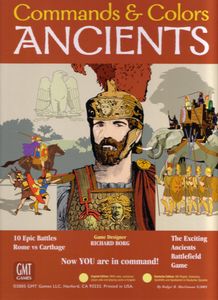
Commands & Colors: Ancients uses command cards to direct ancient armies. Eliminate enemy units or leaders and meet the scenario’s banner target to win immediately.
Commands & Colors: Ancients supports 2 players; community best: 2 players; playing time: 60 minutes. A WANGO browser trial has not been confirmed.
Background & introduction
Commands & Colors: Ancients is a two-player battle game driven by command cards. Players direct infantry, cavalry, elephants and leaders across a hex battlefield. The core box focuses on Rome and Carthage; the scale varies by scenario, so a unit does not have one fixed historical formation size. Victory normally comes from eliminating whole enemy units or leaders, not counting every block lost as a separate point.
Your hand determines which sections or troop types can act. The battlefield has left, center and right sections, with boundary hexes belonging to both adjoining sections. Dice resolve combat uncertainty, while leaders and supporting formations can help units hold their ground. An attack must account for possible retreat and battle back as well as the chance of casualties.
Different troops have distinct movement, ranged, melee and evade rules. Most reduced units retain their normal combat dice, making damaged formations dangerous. Consult the chosen scenario for terrain and additional banner conditions. This overview covers the base system; elephants, special terrain and particular cards retain their specific exceptions.
Core rules & scoring
Setup and victory: deploy terrain, complete units and leaders exactly as the scenario shows. A unit symbol represents the whole unit. Deal each side its listed command hand and use the specified first player and banner target. A wholly eliminated enemy unit or leader normally gives one banner; scenario objectives may add others. Victory is immediate when the required final banner is gained.
Turn: play one command card, announce eligible orders, finish all ordinary movement, resolve battles one at a time, then discard the card and draw a replacement. Only ordered units or leaders may perform the allowed actions. A unit normally receives one order, and unused section orders are lost rather than reassigned freely. Moving into another section does not cancel its existing order.
Movement: move whole units sequentially; never split blocks or merge reduced units. Units normally cannot move through other units or an enemy leader, apart from explicit light-troop card exceptions. Medium and heavy infantry normally move one hex; light infantry may move two and battle. Auxilia cannot battle after moving two, while a warrior’s two-hex charge requires adjacent close combat. Light, medium and heavy cavalry normally move up to four, three and two hexes respectively. Terrain can stop or restrict these moves.
Battle: an ordered unit normally makes one ranged or close-combat attack against one target, not a split dice pool. Finish each combat and its consequences before another. Casualties normally do not reduce combat dice, but full-strength warriors and other specified exceptions must be checked. Battles are generally optional, except for conditions such as a warrior’s two-hex charge.
Ranged combat: require a nonadjacent target in range and line of sight. A unit next to an enemy cannot fire at a more distant target. Normally roll two dice when stationary or one after moving; auxilia moving two and moving heavy war machines cannot fire. Basic ranges are two for light infantry, light cavalry and auxilia, three for bow infantry and slingers, and six for heavy war machines. Matching target symbols hit; swords and helmets do not. Flags can retreat the target, which cannot battle back or evade ranged fire.
Close combat: attack an adjacent enemy using troop, card and terrain rules. Matching target symbols generally hit, as do swords subject to troop exceptions. An attached or adjacent friendly leader makes helmets hit for eligible non-elephant units in close combat only. Ordinary light units and war machines do not score sword hits; chariots ignore one sword and elephants ignore all swords. Excess ordinary hits do not transfer to another unit.
Retreat: remove hit losses first, then resolve flags not ignored. Each flag normally requires the unit’s maximum movement toward its own baseline; warriors retreat two per flag, auxilia and elephants one. Ordinary units lose one block per required hex they cannot retreat. Two adjacent friendly units provide one ignored flag; an attached leader can provide another, with applicable sources cumulative. Elephants can support others but do not receive unit or leader support and have separate rampage and blocked-retreat rules.
Battle back and evade: a surviving defender that stayed in its original hex may normally battle back; actual retreat prevents it even if it remains adjacent. A blocked ordinary defender can still battle back after taking losses if it survives in place. Eligible light or mounted troops may declare evade before suitable close combat; eligibility depends on troop matchup and legal space. The attacker rolls first, generally scoring only matching symbols, then a surviving evader moves two hexes toward its own baseline, or one only when that is the sole available option. Evaders cannot battle back; war-machine evade is a special case.
Momentum: eligible active attackers that eliminate or force back the defender in close combat may enter its vacated hex. Warriors, qualifying mounted units and non-war-machine foot units with attached leaders can make one bonus close combat after advancing, possibly against a different adjacent enemy. No advance means no bonus. Evading defenders, lone-leader attacks and battle backs do not grant this advance. Cavalry can add one hex to its first advance, unlike chariots and elephants. A successful bonus may allow another advance, but not unlimited attacks.
Leaders and cards: a lone leader cannot fight as a unit. When its attached unit loses blocks but survives, normally check with two dice and lose the leader only on two helmets. If the unit is eliminated, check with one die; a surviving leader evades. Direct attacks on lone leaders have their own procedure. At turn end draw a replacement command card; reshuffle discards when the deck runs out. Do not delay a scenario’s immediate banner victory to give the opponent an extra turn.
Rules & gameplay questions
Does a one-block unit roll only one combat die?
Usually no. Blocks measure durability, while combat dice normally depend on troop type, terrain and cards. A one-block heavy infantry unit can still fight at normal strength. Full-strength warriors have a specific extra-die rule, so check their exception rather than assuming damage can never change any troop’s dice.
Can I move, attack, then move another unit?
Not in the normal sequence. Finish all ordered ordinary movement before resolving battles. Complete one battle and its follow-on effects before beginning the next. Momentum advances and bonus combats are specific combat consequences, not permission to interleave arbitrary movement. Follow an explicit command-card exception where applicable.
Does a nearby leader make helmets hit in ranged fire?
No. Leader helmet hits apply to eligible non-elephant units in close combat. Ranged fire normally hits matching target symbols; helmets and swords miss, while flags can force retreat. Targets cannot battle back or evade ranged attacks. Range alone is insufficient without line of sight, and an adjacent enemy prevents shooting farther away.
Is every flag one retreat hex, with no penalty if blocked?
No. A flag normally means the troop’s maximum movement, with listed exceptions such as warriors, auxilia and elephants. Ordinary units lose one block for every required retreat hex they cannot fulfill. Take a legal loss-free route where available. Elephant rampage and blocked retreat use separate rules.
Do two friendly neighbors cancel every flag?
No. Two adjacent supporting units allow one ignored flag. Other applicable sources, such as an attached leader, may add to it. You may choose to accept a flag and must then retreat its full distance. A lone adjacent leader can count as one support unit, but is not an attached leader. Elephants give support without receiving it.
Can I occupy an evader’s hex and keep attacking?
No. Evade is distinct from a normal retreat: the attacker cannot enter the original hex even if the evasion attack eliminates the defender. Ordinary momentum advances also grant a bonus only to eligible troops after an advance, normally once. Winning a battle back does not grant an active attacker’s advance.
Rules & introduction sources
- Edition
- Commands & Colors: Ancients base system, GMT third-edition rules (2009). Scenario notes set deployment, hand size, first player, banner target and exceptions. Excludes separate Epic and expansion modes.
- Introduction source
- BoardGameGeek
WANGO editorial
| Parameter | Recorded value |
|---|---|
| BGG overall rank (snapshot) | #257 |
| Complexity Weight | 2.69 / 5 |
| Best player count (community) | 2 |
| Player range | 2 |
| Playing time (minutes) | 60 |
| Core mechanisms | Campaign / Battle Card Driven · Command Cards · Dice Rolling · Hand Management · Hexagon Grid · Modular Board · Scenario / Mission / Campaign Game · Simulation |
| Chinese publication | Unconfirmed |
| WANGO browser play | No confirmed WANGO trial |
| Year published | 2006 |
| Suggested age | 12+ |
BGG statistics are stored snapshots, not live rankings. Source checked:2026-09-27
Player questions
What is the best player count for Commands & Colors: Ancients, and can I play online?
Commands & Colors: Ancients supports 2 players; community best: 2 players; playing time: 60 minutes. A WANGO browser trial has not been confirmed.
How complex is Commands & Colors: Ancients, and which mechanisms does it use?
Weight: 2.69 / 5. Mechanisms: Campaign / Battle Card Driven · Command Cards · Dice Rolling · Hand Management · Hexagon Grid · Modular Board · Scenario / Mission / Campaign Game · Simulation. Chinese publication: Unconfirmed.
Where can I learn Commands & Colors: Ancients?
No rule guide, strategy article or WANGO trial has been confirmed for this record.