Lewis & Clark: The Expedition
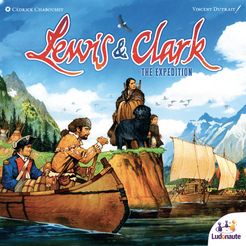
Lewis & Clark: The Expedition is a resource and hand-management race across North America. Players lead an expedition west, recruit companions, manage supplies and camp time, and win by checking their Scout’s position and Time tokens when camping.
Lewis & Clark: The Expedition supports 1–5 players; community best: 3 players; playing time: 120 minutes. A WANGO browser trial has not been confirmed.
Background & introduction
Lewis & Clark: The Expedition takes the real 1804–1806 expedition as its historical setting, then imagines several parties racing across North America instead of one. Each player leads an expedition toward the Pacific, managing boats, supplies, characters, and Native American guides. The theme is not simply rolling to move: provisions, labor, and the time needed to make camp all become parts of the route-planning puzzle.
Each player has an Expedition board, and Character cards represent crew members as well as action powers and action strength. Players gather wood, fur, food, and equipment, then transform resources into canoes and horses to meet the demands of transport and terrain. New characters can be recruited into a player’s deck to expand future options. Native Americans can strengthen actions or work in the public village, but carrying more people affects the time required to camp.
The central tension is between advancing and recovering. Playing cards can move an expedition forward, but those characters remain on the table until the player camps. Camping returns used characters to hand and gives Time tokens based on the hand and the load on time-marked boats. Those tokens limit later Scout movement, but camping itself does not move the Scout backward. Victory is checked when camping: the Scout must be at or beyond Fort Clatsop and the player’s Time tokens must not exceed the number shown on the Scout’s space.
Core rules & scoring
Objective and finish: Each player races west from St. Louis toward Fort Clatsop on the Pacific side. The Scout marks expedition progress. When a player camps, they win immediately if the Scout is at or beyond Fort Clatsop and their Time tokens do not exceed the number printed on the Scout’s space. Reaching the finish does not itself end the game; the player must satisfy the time threshold at a camping check.
Setup and starting crew: Prepare the shared stocks of wood, fur, food, equipment, canoes, horses, and Indians according to player count. Each player takes an Expedition board, Scout, and six starting Character cards, then places starting goods and an Indian on the boats as directed. Put each Scout at St. Louis. Shuffle the Encountered Character deck and arrange five available characters by Strength for recruitment. The rules recommend two to four players for learning; five-player games are intended for experienced groups.
Turn structure: On a turn, a player must perform one action. Recruitment and camping are optional phases and may both occur in the same turn, before or after the required action, but they must be performed separately rather than simultaneously. The required action can come from playing a Character card or sending Indians to an action in the shared Village. Choose with the effect, required resources, action strength, and the card’s later recovery in mind.
Character actions and strength: A Character cannot power its own action with its own Strength. Use the back of another Character, one to three Indians from your Expedition, or another card plus one or two Indians, for a total Strength of one to three. Repeat the active Character’s action up to that many times. The supporting card’s action is unavailable while it remains face down, and both cards stay in the Playing Area until recovered by camping.
Village actions and Indians: A player may send Indians from the expedition to the shared Village board to perform its available actions, such as collecting basic resources, transforming resources, or using a village ability. Each space and the available Indian supply have limits. Indians sent to the Village are no longer on the player’s boats and must later be obtained or returned through the relevant rules. They provide an alternative to Character cards, but carrying them also affects camping time.
Resources and transport: Wood, fur, food, and equipment are primary resources. Canoes and horses are transformed resources used for the route and transport. Goods sit on boat spaces on the Expedition board, which has limited capacity; some boats provide spaces for goods or people, and occupied spaces marked with time affect the next camp. Players may reorganize people and goods during the expedition to reduce unnecessary time loss when they camp.
Recruiting a Character: Once per turn, choose a Character in the Encounter Journal and pay Fur equal to its journal-position cost and Equipment equal to its Strength. You may discard at most one hand card to the shared discard pile to reduce the Equipment cost by its printed recruitment discount. Add the recruited Character directly to your hand. Slide the other Journal cards down and add a new card beside the deck; do not reorder the display by Strength when refilling.
Recovering cards by camping: First return Indians from your Character cards to your boats. Calculate Camp Time from the cards still in hand at that moment plus the time costs of loaded boats, and take that many Time tokens. Only then return all cards from your Playing Area to your hand. Newly recovered cards do not add to this camp’s hand-card cost. Existing Time tokens remain; later movement clears them before advancing the Scout. Camping does not move the Scout backward and is also the point at which victory is checked.
Route and terrain: Character and Village actions provide movement. Route spaces have different terrain and obstacles, and players pay the required resources or use the appropriate transport ability to cross them. Canoes, horses, and character effects help with specific demands. Movement first spends its terrain value to remove existing Time tokens; once those are cleared, remaining movement advances the Scout and may pass other Scouts. Coordinate progress, recruitment, resource conversion, and camping.
End, variants, and solo: In multiplayer, victory is checked when a player camps. The Scout must be at or beyond Fort Clatsop and Time tokens must be no greater than the value printed on that space; otherwise play continues. The solo variant uses the same 2020 time-marker rules and races Alexander Mackenzie: camp at or beyond Fort Clatsop with a qualifying Time-token count before Mackenzie arrives. Optional route changes and solo setup follow page 15.
Rules & gameplay questions
What is the game about, and who wins?
The historical setting is the 1804–1806 Lewis and Clark expedition, but the game imagines several expeditions competing for the Pacific. Players depart St. Louis and manage boats, characters, resources, and guides while following the route west. Once the Scout reaches Fort Clatsop, a player must camp with no more Time tokens than the number shown on that space to win immediately.
How many players does it support, and is there solo play?
Ludonaute lists one to five players. Official duration sources disagree: the English product page and 2020 rules cover say about thirty minutes per player, while the current French product page says fifty minutes, so it should not be presented as a fixed guarantee. The 2020 rules recommend two to four players for newcomers, call five-player play more suitable for experienced players, and include a solo variant on page 15; follow that variant for solo play.
What must I do on a turn?
On a turn, perform one required action, usually by playing a Character card or sending Indians to a Village action. Recruitment and camping are optional phases; both may happen in the same turn, before or after the required action, but must be done separately. Character actions may need another card or Indians to provide enough strength. Remember that played characters remain on the table until you camp to recover them.
How do Character cards and support work together?
A Character needs one to three Strength from another Character’s back, Indians travelling with the Expedition, or both. Its own printed Strength cannot activate itself. A support card contributes its Strength and each Indian contributes one; perform the active action up to the total Strength provided. Both cards remain in the Playing Area, so a supporting card’s face-up action is unavailable until the next camp. Choosing support therefore commits a future option as well as powering the current action.
What are resources for, and why do boat spaces matter?
Wood, fur, food, and equipment are primary resources; players can transform them into canoes and horses for route and transport needs. Resources and Indians occupy boat spaces on the Expedition board, which has limited capacity. Occupying spaces marked with time can increase Camp Time, so players should plan how goods and people are loaded and rearrange them before camping when the rules allow.
How do I recruit a new Character?
You may recruit once per turn, paying Fur according to the Character’s position in the Encounter Journal and Equipment equal to its Strength. Discard at most one card from hand to apply its printed recruitment discount to the Equipment cost. The recruit goes directly to your hand. Refill by sliding the remaining cards down and adding a new one beside the deck; do not sort the display by Strength again. Recruitment is an optional phase that may precede or follow the required action.
What happens to Time tokens when I camp?
Return Indians from Character cards to your boats first. Next calculate the time cost of cards still in hand and loaded boats, take that many Time tokens, and only then recover played Character cards. Newly recovered cards are excluded from this camp’s hand-card cost. Tokens restrict later Scout progress and are removed through appropriate movement before the Scout advances; camping does not move the Scout backward. At or beyond Fort Clatsop, the camping check also requires the token count to be no higher than the space’s value.
Does the Scout reaching Fort Clatsop mean I have won?
Not automatically. The 2020 rules check victory when the player camps: the Scout must have reached Fort Clatsop or gone farther, and the player’s Time tokens must not exceed the value printed on the Scout’s space. If too many tokens remain, the player must manage them and seek another qualifying camp. The reprint uses the Scout position and time-marker check, not the first edition’s camp-marker track.
Is the solo variant an automated opponent race?
The 2020 official rulebook’s page 15 solo variant is not a multiplayer game with an improvised extra player. It races the player against Alexander Mackenzie. The player still manages resources, actions, Scout position, and Time tokens, then must camp at or beyond Fort Clatsop with a qualifying token count before Mackenzie reaches it. Follow the solo setup and opponent movement on that page rather than inventing a separate timer.
Rules & introduction sources
- Edition
- This entry follows Ludonaute’s 2020 reprint rules for the base game Lewis & Clark: The Expedition (BGG 140620), rather than mixing in component differences from the 2013 first edition. The publisher lists 1–5 players. Duration sources disagree: the English product page and 2020 rules cover say about 30 minutes per player, while the current French page says 50 minutes. The rules suggest 2–4 players for learning and reserve five-player games for experienced groups. A solo variant appears on page 15. Under the 2020 rules, victory is checked when camping by Scout position and Time tokens; do not use the first edition’s camp-marker track. The article covers the resource, card-action, recruitment, camp, and route systems in the official 2020 English rules.
- Rule references
- Introduction source
- BoardGameGeek
WANGO editorial
| Parameter | Recorded value |
|---|---|
| BGG overall rank (snapshot) | #338 |
| Complexity Weight | 3.32 / 5 |
| Best player count (community) | 3 |
| Player range | 1–5 |
| Playing time (minutes) | 120 |
| Core mechanisms | Action Retrieval · Deck, Bag, and Pool Building · Delayed Purchase · Hand Management · Multi-Use Cards · Open Drafting · Race · Resource to Move · Solo / Solitaire Game · Track Movement · Worker Placement |
| Chinese publication | Unconfirmed |
| WANGO browser play | No confirmed WANGO trial |
| Year published | 2013 |
| Suggested age | 14+ |
BGG statistics are stored snapshots, not live rankings. Source checked:2026-09-27
Player questions
What is the best player count for Lewis & Clark: The Expedition, and can I play online?
Lewis & Clark: The Expedition supports 1–5 players; community best: 3 players; playing time: 120 minutes. A WANGO browser trial has not been confirmed. Recorded mechanism tags: Solo / Solitaire Game.
How complex is Lewis & Clark: The Expedition, and which mechanisms does it use?
Weight: 3.32 / 5. Mechanisms: Action Retrieval · Deck, Bag, and Pool Building · Delayed Purchase · Hand Management · Multi-Use Cards · Open Drafting · Race · Resource to Move · Solo / Solitaire Game · Track Movement · Worker Placement. Chinese publication: Unconfirmed.
Where can I learn Lewis & Clark: The Expedition?
No rule guide, strategy article or WANGO trial has been confirmed for this record.