Bora Bora
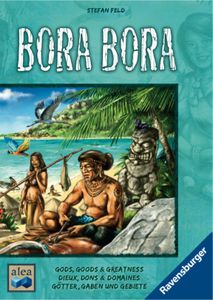
Bora Bora is a dice-placement strategy game. Over six rounds, players expand islands, use men and women tiles, worship gods, build, and complete tasks; the highest final VP total wins.
Bora Bora supports 2–4 players; community best: 4 players; playing time: 60–120 minutes. A WANGO browser trial has not been confirmed.
Background & introduction
Bora Bora places players on a group of five South Pacific islands. Each player manages a settlement, assigns men and women, builds huts and buildings, gathers resources, and seeks influence in the temple. Dice are not simply a random movement result: players roll first, then choose when and where to place each die. Lower values can often fit into action spaces already occupied by opponents, making timing and value management part of the strategy.
Island expansion opens new regions and fish rewards. Men and women tiles provide their own actions, helping players gather resources, complete rituals, or meet tasks. God cards provide ways to adjust restrictions or gain extra benefits, but their colors and costs matter. Players also send priests to the temple and settle status, jewelry, and task scoring during each round.
The six-round structure asks players to coordinate limited action spaces, die values, and people tiles. Each round follows the same phases, but the available actions change with player count and dice placement. Final scoring considers tasks, jewelry, buildings, rituals, and six long-term goals. The highest total wins; island size or temple majority alone does not determine the overall game.
Core rules & scoring
Objective and rounds: The base game supports two to four competitors and lasts six rounds. Each has Phase A dice actions, Phase B people actions, and Phase C assessment. Expansion, buildings, status, priests, and tasks provide points during play; remaining tasks and endgame bonuses follow round six. The highest total wins. The six long-term goals award bonuses rather than ending the game early. The base rulebook gives no solo or cooperative procedure.
Setup and player count: Use seven action tiles for four players, six for three with land/water combined, or five for two with men/women also combined. Display twelve fish tiles, six men, six women, player count plus two tasks, and six jewelry columns. Each player receives a board, twelve huts, six unbuilt buildings, three dice, four priests, one God tile, two God cards, two offerings, and a turn-order tile. Starting scores run from zero to three by order. In reverse order, place a starting hut on an empty building space beside a one-point fish tile and take that region’s material or offering.
Phase A placement: Everyone rolls three dice together, then takes turns placing one and immediately resolving it until all three have been used. A new die on an ordinary action tile must be strictly below its lowest die, regardless of owner. With five and three already there, only one or two is legal. A Blue God permits this placement to be equal or higher, with its offering cost. Fishing is a separate exception: any die may go there for two points without the decreasing-value restriction.
Expansion and people acquisition: Expand along an adjacent land or water path from one of your huts, with path value at most the die value; diagonal expansion is forbidden. Put a hut from your board on the new building space and move any previous hut aside within that region. Each player may have only one hut per region. Take its material or offering and free a people space on your board. To acquire a man or woman, take a displayed tile numbered at most your die and place it in an empty space; do not activate its ability immediately.
Helper exchanges: Spend the die value as exchange points. Tattooing one eligible man, collecting shells with one eligible woman, or gaining one VP costs one point each. An offering, God card, material, or moving a hut on your board to space twelve costs two each. Tattooing advances status; shell collection gives the amount on the woman’s left side. Shifted tiles cannot give their tattoo or shell-collection benefit again. Hut movement here applies only to huts on your player board, not those already on the central board.
Temple, building, and Fire Bonus: Place a priest in a temple space numbered at most the die, shifting existing priests along the arrows and potentially returning the last one to its owner. Build a tile numbered at most the die by paying materials from two horizontally or vertically adjacent ceremony spaces and covering them with that building. Diagonal materials cannot be paired. A building earns ten, seven, or four points according to the round. A new priest or building also gives a Fire Bonus: choose a God card or offering, then choose one status step or one shell.
Phase B people abilities: In turn order, use one man type and one woman type, in either order. Identical tiles of the same sex can combine into one stronger action, but men and women cannot combine and the stronger action cannot split into several actions. Two male Pathfinders can cross one path of up to four, not two paths of up to two. Tiles are neither discarded nor shifted by activation. At most one Green God may be used in Phase B, either doubling one action’s effect or activating an additional different people type.
Phase C status and temple: Score zero to fifteen points according to status position, then return markers to zero as a stack with the leader on top and assign new turn order. Each priest scores one point in rounds one and two, two in rounds three and four, and three in rounds five and six. Most priests earn the round’s God tile; a tie goes to the tied player with the leftmost priest. If there are no priests, remove that tile. Jewelry and tasks then use this new order.
Jewelry and tasks: In the new order, each player may buy one jewelry tile from the current round’s column with shells; skip if declining and discard leftovers. Resolve one of your three tasks for six points, four with a Yellow God replacing one requirement, or surrender one for zero if none can be met. After everyone resolves a task, each chooses a replacement from the display, including in round six. Task quantities are minimums and require showing possessions rather than spending them. Yellow reduces a requirement by one, such as three wood to two; it does not waive the entire task.
God cards versus tiles: Playing a God card normally costs one offering. Two same-color cards plus one offering can provide any God ability, subject to that ability’s phase restrictions. White treats the action effect as six without changing the physical die; Blue instead overrides placement eligibility. A God tile substitutes for any card ability without an offering and is removed after use; an unused tile is worth two points. Red scores the destination fish only when expanding and placing a new hut, at most once per player per region, leaving the fish in place.
Final tasks and ordinary scoring: After round six’s task replacement, resolve the three remaining tasks for six, four, or zero each. Each may use its own Yellow God with its offering cost. Score two per unused God tile and the printed one-to-nine points per jewelry tile. A region’s fish gives one-to-six points only to the player whose hut occupies its building space at game end; huts displaced beside that space do not receive this fish score. Leftover materials, shells, offerings, and God cards do not score directly.
Six goals and ties: Score six points separately for nine completed tasks, six jewelry tiles, all twelve ceremony spaces filled, all six buildings built, huts in all twelve regions, and all twelve people spaces occupied by people. Ceremony spaces may contain materials, buildings, or a mixture; filling them and building all six buildings are separate goals. The all-regions goal includes your huts displaced aside but still in their regions. Highest total wins; tied players use the earlier turn order from the final Phase C.
Rules & gameplay questions
How many people can play Bora Bora, and how many rounds are there?
The base rules support two to four players and always use six rounds: A dice actions, B people abilities, then C assessment. Use five action tiles for two players, six for three, and seven for four. Smaller games combine some actions rather than shortening the game. Resolve the three remaining tasks and final bonuses after round six; the highest total wins. The rulebook provides no solo or cooperative procedure.
Why must a die be lower than the dice already on an action space?
An ordinary action tile requires a die below its current lowest value, regardless of color. With five and three there, only one or two is legal. Blue can exempt that placement, normally for an offering. Fishing is inherently exempt and accepts any die for two points. White treats the action effect as six without changing the actual die and cannot replace Blue to make an otherwise illegal placement legal.
What happens in phases A, B, and C?
In A, roll three dice, place them one at a time, and immediately resolve actions such as island expansion, people tiles, helpers, temple, buildings, or fishing. In B, each player uses one men action and one women action; matching same-sex tiles strengthen one use. In C, resolve the status track, temple priests, jewelry purchases, and a task. The order is fixed, and each board or tile’s costs and effects still apply.
Do stacked people tiles let me perform several actions?
Identical people of the same sex strengthen a single action; they do not create several actions, and men cannot combine with women. Two male Pathfinders may cross one path of up to four, not two paths of up to two. A female Pathfinder can be a separate woman action. Activating tiles does not move or discard them. At most one Green God in Phase B may double one ability or activate an additional different type.
How are the temple and jewelry resolved in Phase C?
After status scoring sets a new order, each priest scores one point in rounds one–two, two in rounds three–four, and three in rounds five–six. Most priests earn the God tile; ties use the leftmost priest, and with no priests the tile is removed. Then, in the new order, each player may buy one jewelry tile from that round’s column. Discard leftovers. Jewelry scores its printed value at game end, not again when purchased.
How do tasks work, and what does a yellow God card do?
Resolve one of your three tasks each round: six points normally, four if Yellow reduces a requirement by one, or surrender one for zero if none can be completed. Three wood becomes two, not zero. Tasks check possessions without spending the materials. Choose a replacement afterward, including in round six, then resolve the remaining three at game end. Each final task may use its own Yellow card and offering.
What extra points are available at the end?
Unused God tiles give two points each, jewelry one–nine, and fish one–six. Fish score only for the hut occupying a region’s building space; a displaced hut still counts as present in the region but gets no endgame fish score. Each of six goals gives six points. All twelve ceremony spaces may be filled by materials, buildings, or both; building all six buildings is a separate goal. Leftover cards, offerings, shells, and materials give no direct score.
Do two- and three-player games use different rules?
They change the number and combination of action spaces. Two players use five spaces, three players use six, and four players use seven; the smaller configurations combine some men/women or land/water actions. Page 11 of the rulebook says the rest of the main rules remain in effect. Prepare the correct board configuration for player count instead of copying the four-player spaces into a two-player game. For example, after a three is placed on the combined people action in a two-player game, a later player choosing the other sex must still place one or two; the choices do not have separate placement thresholds.
How do God cards differ from God tiles, and do both cost offerings?
A God card normally requires an offering and follows its color’s phase restriction. Two same-color cards with one offering can supply any God ability, within its permitted phase. A God tile substitutes for any card ability without an offering, leaves the game when used, and is worth two points if unused. For tasks requiring particular God cards, neither a tile nor two same-color cards can replace the required cards: ability substitution does not replace possession requirements.
Rules & introduction sources
- Edition
- This entry covers Stefan Feld’s 2013 alea/Ravensburger Bora Bora base game (BGG 127060), using its two-to-four-player, six-round competitive rules. The English PDF carries the ©2013 Ravensburger credit and is hosted by Tesera, a third party rather than a current publisher download server. Other editions, reimplementations, and additional god components are outside scope. The base rulebook does not provide solo or cooperative play.
- Rule references
- Introduction source
- BoardGameGeek
WANGO editorial
| Parameter | Recorded value |
|---|---|
| BGG overall rank (snapshot) | #339 |
| Complexity Weight | 3.72 / 5 |
| Best player count (community) | 4 |
| Player range | 2–4 |
| Playing time (minutes) | 60–120 |
| Core mechanisms | Dice Rolling · Set Collection · Worker Placement · Worker Placement with Dice Workers |
| Chinese publication | Unconfirmed |
| WANGO browser play | No confirmed WANGO trial |
| Year published | 2013 |
| Suggested age | 12+ |
BGG statistics are stored snapshots, not live rankings. Source checked:2026-09-27
Player questions
What is the best player count for Bora Bora, and can I play online?
Bora Bora supports 2–4 players; community best: 4 players; playing time: 60–120 minutes. A WANGO browser trial has not been confirmed.
How complex is Bora Bora, and which mechanisms does it use?
Weight: 3.72 / 5. Mechanisms: Dice Rolling · Set Collection · Worker Placement · Worker Placement with Dice Workers. Chinese publication: Unconfirmed.
Where can I learn Bora Bora?
No rule guide, strategy article or WANGO trial has been confirmed for this record.