Kemet
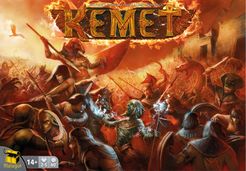
An aggressive area-control game in mythic Egypt, combining pyramid development, permanent power purchases and tactical battles for temples and victory points.
Kemet supports 2–5 players; community best: 4–5 players; playing time: 90–120 minutes. A WANGO browser trial has not been confirmed.
Background & introduction
Your city is a launch point rather than a safe route to victory. Pyramid levels unlock power tiles, and teleporting from pyramids to obelisks puts distant temples within reach. A compact army can therefore threaten several parts of the board without marching across every intervening space.
The action pyramid gives each day a shape. Five tokens must cover all three ordinary rows, so prayer, recruitment, movement, construction and power purchases compete for limited spaces. Buying a power changes later choices immediately, while a creature gives its accompanying troop a particular tactical role.
Battle rewards initiative without making casualties irrelevant. Only a victorious attacker with survivors earns a battle point, and both armies can suffer losses regardless of the result. Temporary temple points can disappear when a troop leaves, whereas permanent points provide a more durable foundation for the final race.
Core rules & scoring
Use the original 2–5-player setup and the board area for that count. Agree on an 8-point short game or 10-point long game. Each player begins with 5 prayer points, one Divine Intervention card, ten deployed units and three pyramid levels distributed as 1/1/1 or 2/1/0.
Each cycle begins with Night: gain 2 prayer points, draw a Divine Intervention card and resolve night powers. Except for the initial random order, the player with fewest victory points chooses the complete turn order; a tie favors the player earlier in the previous order.
During Day, take turns placing one of your five action tokens on an empty space of your action pyramid and immediately resolving it. Across the day, place at least one token in each of its first three rows; special power tokens have their own rules.
Prayer gives 2 prayer points, with a maximum stock of 11. Upgrading a pyramid costs the sum of the new levels reached in that action. A level-4 pyramid grants a temporary victory point while controlled.
Buy a power of a color supported by a pyramid you control, at no higher level than that pyramid, paying its level in prayer points before discounts. Effects apply immediately unless their timing says otherwise. You may not own identical powers, even across colors.
Recruit units into your own city for one prayer point each; a troop normally holds at most five units. A movement action moves one troop, normally one space, with permitted splitting or pickups. Moving from a controlled pyramid to an obelisk costs 2 prayer points and does not use the movement allowance.
Entering an occupied enemy space starts battle and ends movement, unless an applicable effect changes this. An enemy city wall normally requires the troop to begin its movement next to the district before entering it.
Each combatant chooses one battle card to play and another to discard, and may add eligible Divine Intervention cards. Compare units plus combat bonuses and card strength; ties favor the defender. Apply casualties on both sides from opposing damage minus protection, independently of who wins.
Only an attacking winner with at least one surviving unit earns a permanent battle victory point. Losing troops may retreat to an eligible adjacent empty space chosen by the winner or recall; either side may recall its whole troop for one prayer point per unit instead of leaving it on the board.
Temple control grants temporary points. At Day’s end resolve temple rewards and the Sanctuary’s two-unit sacrifice for a permanent point; controlling at least two temples also grants a permanent point. Check the agreed victory threshold at Day’s end: highest points wins, then battle points, then earlier position in that day’s order.
Rules & gameplay questions
Can a creature hold a temple alone?
No. A creature must accompany units and does not itself count as a unit. When its last escort disappears, follow its return procedure rather than leaving it to control the space.
Does the defender gain a battle point for winning?
No. Battle points reward a victorious attacker with surviving units. A defender may win the strength comparison and still suffer casualties, without receiving that point.
Does Priest of Ra discount every level of a multi-level pyramid upgrade?
No. Its construction discount is applied once to that construction action, not separately to every level. Sum the levels first, then apply the discount.
Can Veto cancel a Divine Intervention card used in battle?
No. The original included FAQ specifically excludes battle Divine Intervention cards from Veto. Observe each card’s own timing and any prayer-point cost.
Does reaching eight points immediately end the original short game?
No. In this original printed ruleset, check at the end of Day. Temporary points may change before then, and multiple qualifying players compare total points, battle points and the day’s turn order.
Rules & introduction sources
- Edition
- Original Kemet printed base rules for 2–5 players, using the eight-page manual and its included FAQ. This explicitly retains the original Night-first cycle and end-of-Day 8/10-point victory check. Excludes the 2019 v1.5 revision, Ta-Seti and other expansions, and Kemet: Blood and Sand. The rule PDF is publisher-authored material read through a third-party mirror.
- Rule references
- Introduction source
- BoardGameGeek
WANGO editorial
| Parameter | Recorded value |
|---|---|
| BGG overall rank (snapshot) | #206 |
| Complexity Weight | 3.01 / 5 |
| Best player count (community) | 4–5 |
| Player range | 2–5 |
| Playing time (minutes) | 90–120 |
| Core mechanisms | Action Points · Area Majority / Influence · Area Movement · Card Play Conflict Resolution · Hand Management · Open Drafting · Tech Trees / Tech Tracks |
| Chinese publication | Unconfirmed |
| WANGO browser play | No confirmed WANGO trial |
| Year published | 2012 |
| Suggested age | 13+ |
BGG statistics are stored snapshots, not live rankings. Source checked:2026-09-27
Player questions
What is the best player count for Kemet, and can I play online?
Kemet supports 2–5 players; community best: 4–5 players; playing time: 90–120 minutes. A WANGO browser trial has not been confirmed.
How complex is Kemet, and which mechanisms does it use?
Weight: 3.01 / 5. Mechanisms: Action Points · Area Majority / Influence · Area Movement · Card Play Conflict Resolution · Hand Management · Open Drafting · Tech Trees / Tech Tracks. Chinese publication: Unconfirmed.
Where can I learn Kemet?
No rule guide, strategy article or WANGO trial has been confirmed for this record.