Tzolk'in: The Mayan Calendar
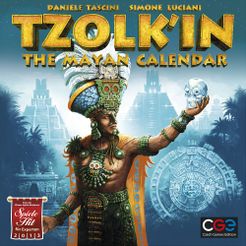
Place workers on rotating gears, balancing the wait for stronger actions against bringing workers back in time to build and earn temple rewards.
Tzolk'in: The Mayan Calendar supports 2–4 players; community best: 4 players; playing time: 90 minutes. A WANGO browser trial has not been confirmed.
Background & introduction
In Tzolk'in: The Mayan Calendar, players develop different Mayan tribes. The central calendar drives workers around five locations; leaving a worker on a gear usually carries it toward a later, more valuable action.
Waiting has a cost: workers on gears cannot immediately be placed elsewhere, and corn pays for both placements and feeding. Harvesting, resources, technology, buildings, and temples all matter, but your plans must fit within one full turn of the calendar.
Core rules & scoring
Each round, players take one turn clockwise from the starting player. On your turn, either place at least 1 available worker or pick up at least 1 worker from the gears. You cannot pass or both place and pick up in the same turn. Placing a worker does not immediately perform that space's action.
Place each worker in the lowest-numbered empty action space on its chosen gear. Pay corn for the space numbers plus the cost for the number of workers placed that turn, using the total-cost table on your board. Each player starts with 3 workers and can obtain up to 6.
When picking up a worker, perform its current action, pay 1 corn per step back to perform a lower-numbered action on the same gear, or take no action. Resolve multiple workers individually in any order you choose, paying costs as you go. Free-choice spaces let you choose any action on that gear without the step-back charge.
After everyone has acted, the calendar normally turns 1 day counterclockwise, advancing workers 1 space. Workers pushed beyond the highest-numbered space return without performing an action. Dummy workers used in two- and three-player setup remain on the gears as directed by the rules.
The Starting Player Space is a worker placement with a space cost of 0, but it still counts toward the number-of-workers placement cost. Take the accumulated corn at the end of your placement turn. During calendar advancement, retrieve that worker and take the starting marker; if you already had it, pass it to the player on your left. Your board's state may permit a 2-day advance, but the extra day cannot push off a worker that would otherwise stay. If this crosses a Food Day, the next round still includes that Food Day's feeding and rewards.
There are 4 Food Days. After all player turns and before the calendar advances, each worker in play normally needs 2 corn, including workers in front of you and on gears; farms can reduce this cost. Feed as many as you can, losing 3 points per unfed worker. Mid-age temple rewards include the goods shown at your current step and below it. End-of-age scoring uses only your current step's points, plus the leading-player bonus.
Construction requires the appropriate action and payment of the printed cost. Refill buildings only at the end of your turn; monuments are not replaced. A Chichen Itza offering requires 1 crystal skull and an offering oval without a skull already in it. Each offering space can be used only once per game.
The game ends after the fourth Food Day. Advance the calendar once more as directed before final scoring: exchange resources for corn at market rates, score ¼ point per corn and 3 points per unused crystal skull, then score monuments. Most points wins. Ties go to the player with more workers remaining on gears; if still tied, share the victory.
Rules & gameplay questions
Can I place a worker, then pick one up to pay for that placement?
No. A player turn allows either placement or retrieval. You need the corn before placing workers. Corn accumulated at the Starting Player Space is collected only after that placement turn, so it cannot fund the same placement.
Can a retrieved worker use a lower-numbered action that another worker occupies?
Yes. Pay 1 corn for each step back on the same gear; another worker occupying that action does not prevent you from using it. Pay before resolving it. A free-choice space waives the step-back charge, but not the chosen action's own cost.
Do workers waiting in front of me also need food?
Yes. All your workers already taken from the bank must be fed, whether beside your board or on a gear. Only workers still in the bank are excluded. Paying half a worker's food requirement does not avoid the penalty.
Can I refill a building immediately so a second construction in the same turn has a new choice?
No. Buildings are replaced only after your entire turn, not between two constructions. Monuments are never replaced, and architecture technology benefits do not apply to monuments.
Rules & introduction sources
- Edition
- The 2012 Tzolk'in: The Mayan Calendar base game for 2–4 players, checked against CGE's current official English TZ_rules_EN_13.pdf, 16 pages, on 2026-10-26. Covers base player-count setup and normal feeding and scoring. Excludes Tribes & Prophecies and other mini-expansions. Explicit technology, building, and starting-wealth abilities take precedence over the general descriptions.
- Rule references
- Introduction source
- BoardGameGeek
WANGO editorial
| Parameter | Recorded value |
|---|---|
| BGG overall rank (snapshot) | #77 |
| Complexity Weight | 3.66 / 5 |
| Best player count (community) | 4 |
| Player range | 2–4 |
| Playing time (minutes) | 90 |
| Core mechanisms | Bias · End Game Bonuses · Once-Per-Game Abilities · Track Movement · Turn Order: Claim Action · Worker Placement |
| Chinese publication | Unconfirmed |
| WANGO browser play | No confirmed WANGO trial |
| Year published | 2012 |
| Suggested age | 13+ |
BGG statistics are stored snapshots, not live rankings. Source checked:2026-09-27
Player questions
What is the best player count for Tzolk'in: The Mayan Calendar, and can I play online?
Tzolk'in: The Mayan Calendar supports 2–4 players; community best: 4 players; playing time: 90 minutes. A WANGO browser trial has not been confirmed.
How complex is Tzolk'in: The Mayan Calendar, and which mechanisms does it use?
Weight: 3.66 / 5. Mechanisms: Bias · End Game Bonuses · Once-Per-Game Abilities · Track Movement · Turn Order: Claim Action · Worker Placement. Chinese publication: Unconfirmed.
Where can I learn Tzolk'in: The Mayan Calendar?
No rule guide, strategy article or WANGO trial has been confirmed for this record.