Nations
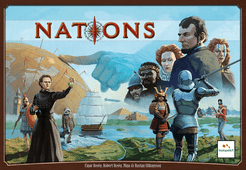
Nations is an eight-round civilization game spanning four ages. Buy progress cards, deploy workers and build wonders while balancing production, military strength and stability to score heritage and final achievements.
Nations supports 1–5 players; community best: 3–4 players; playing time: 40–200 minutes. A WANGO browser trial has not been confirmed.
Background & introduction
Nations follows civilizations from antiquity toward the eve of the First World War. A nation represents a historical cultural or political community rather than exclusively a modern nation-state. Players put population to work, maintain a food, gold and stone economy, and manage military strength and stability. Advisors, colonies and wonders create development opportunities, but acquiring a card does not always activate all its benefits: buildings need workers and wonders need construction.
The game has four ages, each lasting two rounds. Maintenance refreshes opportunities, offers growth and reveals the round's events. Players then alternate actions before production, war, events and famine are resolved. The visible event gives time to prepare, but growth brings food upkeep or a stability burden. Military investment affects war safety, colony access and future player order as well as competing for event benefits.
Books represent accumulated heritage. At each age's end, a nation scores for every other nation with fewer books; the books are not automatically converted into points each round. Final scoring adds colonies, completed wonders, deployed workers and a combined resource total. Competition therefore involves both public opportunities and maintaining a functioning civilization. Individual difficulty, asymmetric board sides and the solo shadow opponent are separately defined formats.
Core rules & scoring
Scope and structure: These rules use the 24-page base-game rulebook bearing Lautapelit.fi's 2013 copyright, for 1–5 players. The main structure is a full multiplayer game; solo and five-player adjustments are identified separately. Exclude Dynasties, Nations: The Dice Game and unverified variants. Each of four ages lasts two rounds. Complete round eight's resolution and book comparison before final scoring.
Setup: Use the progress-board columns specified for the player count and separate progress and event decks by age. Beginners may use A-side boards and base cards; advanced cards, expert cards and B-side abilities are additional choices. Randomize order, with initial book positions of one, two and so on. Begin military strength and stability at zero and take starting resources and workers from the nation board. Each player selects a difficulty affecting growth bonuses. Five players require advanced and/or expert cards for sufficient supply.
Maintenance: Skip round-marker advancement and repeat market refill in the first round after setup. Subsequently remove cards remaining in rows one and two, move row-three cards to the left of row one, and refill empty active spaces from the current age. Top, middle and bottom rows cost three, two and one gold. In reverse order choose growth or bonus resources, then reveal the age's event and refresh architects according to player count plus the event's indicated number.
Growth: Take a worker from either population section into your resource area, or take a bonus in exactly one of food, stone or gold according to difficulty. Each worker removed from the food section adds three food upkeep in production; each from the stability section immediately reduces stability by three. A worker in the resource area is not deployed and does not produce building benefits. Do not move a population-track worker directly to a building while ignoring growth costs.
Actions and passing: In player order take one action at a time: buy a progress card, deploy one worker, hire one architect, or use an available card's special action. Alternatively pass. Mark limited special actions as used. Passing ends your participation in the round's action phase, even if someone later buys a war. There is no fixed single turn per player; continue until everyone has passed. You cannot buy several cards consecutively as one normal action.
Purchases and spaces: Pay the row's gold price and use the card immediately rather than saving it in a hand. Buildings and military share their board spaces; advisors, colonies and wonders use their designated spaces. Replace an old card if no suitable space remains. Workers on a replaced building or military return undeployed to your resource area, not free onto the replacement. Covered preprinted cards cannot be used again. Normally allow one advisor, two colonies and five completed wonders, subject to explicit card exceptions.
Deployment: Pay the destination card's stone deployment cost and place one worker from your resource area or another building or military. Moving between cards still costs the destination's price. Several workers can occupy a card and normally multiply production and upkeep, but one action deploys one worker. Empty buildings and military have no effect. During your turn you may freely undeploy several workers; you cannot wait until production after passing to remove upkeep. Strength and stability change immediately, while resource production and consumption wait for resolution.
Colonies, battles and wars: A colony's strength requirement must be met when buying, but falling below it later does not itself remove the colony. A battle requires a worker on a military and immediately gives one chosen resource type: books, food or stone, using the highest available raid value. Extra workers do not multiply a card's raid value. A war is different: only one may be bought per round, and its strength is fixed at its buyer's military strength when bought. It does not track that player's later changes.
Wonders: Buy a wonder into the single construction space. Hiring an available architect completes its leftmost unbuilt section after paying that section's stone cost. Without a wonder, an available architect or sufficient stone, this action is unavailable. Finish the last section to move the wonder into a completed space, activate its effects and return its architects to supply. Buying a different unfinished wonder abandons the old one, losing its progress and spent stone. Private architects supplied by cards follow their specific rules, not unlimited access to the general supply.
Golden ages and advisors: A bought golden age either grants its printed resources or allows one point to be purchased with the required resource amount, mixing gold, stone, food and books if desired. Remove the card afterward. Golden-age bonuses increase the resource reward or reduce the point's cost, but never below zero; one card cannot buy several points. A new advisor normally replaces the old advisor, and its conditions operate as written.
Production and order: Calculate net gold, food, stone and books, including per-worker building and military effects, population upkeep, advisors, completed wonders and colonies. Negative stability is revolt: lose books equal to its magnitude and one additional point. After production, rank player order by strength, then stability, retaining previous relative order if both tie. The general rule denying tied positive event rewards does not replace this specific ordering rule.
War and events: Strength at least the fixed war strength avoids defeat. Lower strength loses the war, potentially including its buyer. Positive stability reduces the printed resource loss, possibly to zero, but normally does not cancel the war's one-point penalty; explicit card exceptions apply. Then resolve events top to bottom. Normally ties for a highest positive condition receive no benefit, while all tied lowest suffer the full penalty. All negative-stability nations tie for lowest stability. Where several players must choose, choose in reverse order and then apply outcomes simultaneously.
Famine, shortages and books: After events, pay the event's famine food. Forced losses first consume available resources, then cost books equal to the shortfall and one point for that resource's shortage. That shortage point is limited to once per resource type per round, rather than once per missing unit. Books cannot go negative; a book shortfall requires another resource and follows the book-shortage point limit. Multiplayer points cannot go below zero. At rounds two, four, six and eight, gain one point for every nation with strictly fewer books; equal book totals do not score against each other.
Final scoring: After round eight's normal book scoring, total existing point tokens, colony points, completed-wonder points and bonuses, and worker points from buildings and military. Read each card's worker scoring positions left to right; workers beyond the printed positions score no extra points, and empty cards score no worker points. Finally combine gold, food, stone, books, current strength and stability, scoring one point per complete ten of the combined sum. Highest total wins; ties go to the earlier player in current order.
Five players: Include advanced and/or expert cards. Positive events also affect the second strongest unless tied; negative events affect the two weakest, including relevant ties. Related card conditions adjust similarly, with first-pass conditions covering the first two and last-pass conditions the last two. This is not a rule awarding the top two unconditionally. For example, an outright strength leader can benefit while two nations tied for second receive no second-strongest positive benefit.
Solo: Use four progress columns, start with one book against the shadow's two, and replace normal events with current-age solo event tiles setting shadow values and changes. Roll for the shadow after buying a progress card, deploying onto military or hiring an architect, and before your first action when second in order. Results one to four clear that column; if it contains wars the shadow buys its cheapest at its current strength. Results five or six use the tile's action. Ordinary building deployment is not automatically a roll trigger. Solo stability comparison gives one point if higher, otherwise loses one; more books at age end gives three points. Negative points lose the solo game. Follow the tile conditions and solo score table rather than comparing solo totals directly with multiplayer results.
Rules & gameplay questions
Does buying a building make it produce, and do replaced workers move onto it for free?
No. Buildings and military require deployed workers. Buying places the card, while workers on a replaced card return to the resource area. A later deployment action costs the new card's stone price and deploys one worker. Multiple workers normally multiply effects and upkeep; an empty card has no effect. Strength and stability change immediately, but resource production waits until resolution and cannot fund a purchase now.
Is population growth a free additional worker?
There is no separate purchase price at growth, but it adds a continuing burden. Taking from the food section adds three food upkeep each production; taking from the stability section reduces stability by three immediately. The worker enters the resource area and still needs an action and stone to deploy. Instead, choose the difficulty-based bonus in one resource type; you cannot divide that bonus between types.
How do battles differ from wars, and does war strength change with its buyer?
A battle resolves immediately using your best staffed military's raid value to gain one resource type. More workers on that card do not multiply its raid value. Only one war can be bought per round; its strength is locked to the buyer's strength at purchase and never follows later changes. Any nation below it at resolution can lose, including a buyer that later undeployed military. Equal strength is safe.
Does every missing resource unit cost a victory point?
No. Pay what you have, lose books equal to the missing amount and lose one point for that resource shortage. The shortage point is capped once per resource type per round. Paying five stone with only two therefore loses those two stone, three books and one shortage point. If books are also insufficient, apply their shortage rule. This handles forced losses; it does not authorize unaffordable purchases or deployments.
Are tied positive event rewards shared, and is player order decided the same way?
Normally a highest-value tie earns no positive reward, whereas all tied lowest take the full negative effect. Negative-stability nations tie for least stability. Player order has a separate rule: strength, then stability, then retain previous relative order. Final-score ties use current order. Five-player rules extend effects to second strongest and second weakest with their stated tie handling, not automatic awards to two players.
Can I freely move or undeploy workers at any time?
You may undeploy several workers for free during your own turn, returning them to the resource area. You cannot wait until production after everyone has passed to avoid upkeep. Moving a worker onto another building or military is a deployment action and costs its destination's stone price. Removing military immediately reduces its strength contribution and can expose you to an already fixed war strength.
Do books score every round, and what else scores at the end?
Books compare only at age ends: rounds two, four, six and eight. Score one point for every other nation with fewer books, with equal totals scoring nothing against each other. After the final comparison, add held points, colonies, completed wonders, printed worker scoring positions and combined resources. That combined total also includes strength and stability and scores per complete ten. Do not convert all books directly into points each round.
Can solo be played by simply removing the other players?
No. Solo uses event tiles and a die-driven shadow opponent, four market columns and specified book starts. Certain actions trigger a shadow roll that may remove a whole column or buy a war. Stability and end-of-age book comparisons have separate solo point rules, and negative points cause failure. Beginners may choose base cards and easier difficulty, but omitting shadow actions is not the official solo challenge.
Rules & introduction sources
- Edition
- Original Nations base game, 1–5 players. Based on the publisher-authored 24-page English rulebook bearing Lautapelit.fi's 2013 copyright, hosted by 1jour-1jeu, and the publisher's product page. Solo and five-player adjustments are identified separately. Excludes Dynasties, the dice game and later FAQ card rulings not actually checked. The mirror is not represented as the publisher's current official download.
- Rule references
- Introduction source
- BoardGameGeek
WANGO editorial
| Parameter | Recorded value |
|---|---|
| BGG overall rank (snapshot) | #276 |
| Complexity Weight | 3.54 / 5 |
| Best player count (community) | 3–4 |
| Player range | 1–5 |
| Playing time (minutes) | 40–200 |
| Core mechanisms | Contracts · End Game Bonuses · Events · Hidden Victory Points · Income · Open Drafting · Tags · Turn Order: Stat-Based · Variable Player Powers · Variable Set-up · Worker Placement |
| Chinese publication | Unconfirmed |
| WANGO browser play | No confirmed WANGO trial |
| Year published | 2013 |
| Suggested age | 14+ |
BGG statistics are stored snapshots, not live rankings. Source checked:2026-09-27
Player questions
What is the best player count for Nations, and can I play online?
Nations supports 1–5 players; community best: 3–4 players; playing time: 40–200 minutes. A WANGO browser trial has not been confirmed.
How complex is Nations, and which mechanisms does it use?
Weight: 3.54 / 5. Mechanisms: Contracts · End Game Bonuses · Events · Hidden Victory Points · Income · Open Drafting · Tags · Turn Order: Stat-Based · Variable Player Powers · Variable Set-up · Worker Placement. Chinese publication: Unconfirmed.
Where can I learn Nations?
No rule guide, strategy article or WANGO trial has been confirmed for this record.