The Gallerist
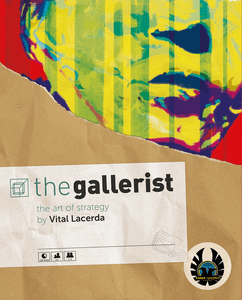
Run an art gallery by discovering artists, buying and exhibiting their work, cultivating visitors and turning fame into money before the art market closes.
The Gallerist supports 1–4 players; community best: 3–4 players; playing time: 60–150 minutes. A WANGO browser trial has not been confirmed.
Background & introduction
Each turn sends your Gallerist to one of four locations. Artist discovery, sales contracts, publicity and the international market form an interconnected economy: an inexpensive purchase can become valuable after promotion, but every sale also changes your gallery’s visitors and future opportunities.
Assistants extend your reach. Leaving one behind can earn a response when another player displaces it, while committing assistants to the international market builds reputation and bids for renowned art. Visitors matter both inside the gallery and in its lobby, so bringing everybody indoors can close a useful market opportunity.
The winner has the most money after final scoring, including the value of exhibited art and private collection goals. This guide follows the publisher’s 2022 base rulebook, with its separate Lacerda solitaire procedure; the Scoring Expansion and other extras sold in bundles are excluded.
Core rules & scoring
On your turn move to a different location and take one of its two location actions; from your gallery you may choose any location. You may also take one executive action before or after that action: spend tickets to move visitors, or place an assistant on a contract for its bonus.
Discovering an artist reveals them, grants their discovery bonus and reserves one signature token as your commission. You may hold only one commission. Buying art normally costs the artist’s current fame; your commission uses their initial fame. You need gallery space and an available signature token or your commission. Buying increases fame and awards the depicted tickets.
The Sales Office lets you take a contract or sell an exhibited work matching an unfulfilled contract’s art form. A sale pays the work’s tracked sales value, returns its signature token, sends one gallery visitor to the plaza if possible, and flips the contract. An assistant can later claim the reverse-side bonus through an executive action; flipping alone does not award it.
Tickets move a same-color visitor one step toward your gallery, including from another lobby to the plaza. You may spend several tickets on one visitor. Tickets cannot remove a visitor already inside a gallery. Your gallery can hold at most one Collector plus one per work you have sold. The first ticket-color stack to empty triggers the base game’s single intermediate scoring.
The Media Center hires assistants into available office desks or promotes an artist one level, paying the new promotion level in influence. Promotion grants the indicated bonus and increases fame. Influence also supports extra fame when an action raises fame, immediate payments and displaced location actions under the track’s rules; it is not a freely cashable bank balance.
When another player displaces your Gallerist or assistant, after that player’s turn you may take an executive action, or spend influence back to the previous fame icon to take an action at that location. The displaced piece then goes home, with the stated exceptions for an assistant used in the action. Displacing your own assistant gives no extra action.
International Market column access uses visitors in your lobby, not your gallery. Upper rows additionally require acquired art of the indicated form and give reputation tiles; lower rows take paid offers for the final art auction. Both commit an available assistant, which stays there for the game. Reputation spaces on your board give immediate placement bonuses; the tiles themselves score at the end.
In multiplayer, trigger the end after any two conditions hold: all box-office tickets gone, at least two celebrity artists, or an empty visitor bag. Finish the round, then each player gets one last turn with no kicked-out actions. Final scoring includes market majorities, reputation, exhibited art, the renowned-art auction, Curator and Art Dealer goals, and influence; most money wins. Solo uses the Lacerda movement and market procedure, ends on ticket depletion, then grants one more action; victory requires every goal of the chosen difficulty.
Rules & gameplay questions
Does another player occupying a location block me?
No. Moving there displaces their piece and lets you act. They may then take a kicked-out action; if you displace your own assistant, it returns without that benefit.
Is buying and selling based on the same number?
No. Normal purchase price uses current fame, or initial fame for your commission. A sale uses the signature token’s position on the art-value track, which follows fame tiers.
Can tickets take a visitor from another gallery?
No. Tickets move visitors from the plaza and lobbies toward your gallery, one step per matching ticket. Visitors already inside a gallery cannot be moved out with tickets.
Why keep visitors in my lobby?
The international market checks lobby visitors to unlock its columns; gallery visitors do not satisfy those requirements. Different visitor locations serve different purposes.
Is solitaire just multiplayer without opponents?
No. The dummy Lacerda moves clockwise, leaves assistants and fills market spaces under its own procedure. The solo ending uses tickets rather than the multiplayer two-condition trigger, and the selected difficulty sets several required goals.
Rules & introduction sources
- Edition
- The Gallerist base game, Eagle-Gryphon Games, The_Gallerist_rulebook_2022_v1_Public.pdf (20 pages); multiplayer and the rulebook’s solitaire overview. Excludes Scoring Expansion, expansion-pack content and other bundle extras.
- Rule references
- Introduction source
- BoardGameGeek
WANGO editorial
| Parameter | Recorded value |
|---|---|
| BGG overall rank (snapshot) | #86 |
| Complexity Weight | 4.21 / 5 |
| Best player count (community) | 3–4 |
| Player range | 1–4 |
| Playing time (minutes) | 60–150 |
| Core mechanisms | Commodity Speculation · Contracts · Investment · Open Drafting · Point to Point Movement · Resource to Move · Set Collection · Solo / Solitaire Game · Victory Points as a Resource · Worker Placement · Worker Placement, Different Worker Types |
| Chinese publication | Unconfirmed |
| WANGO browser play | No confirmed WANGO trial |
| Year published | 2015 |
| Suggested age | 13+ |
BGG statistics are stored snapshots, not live rankings. Source checked:2026-09-27
Player questions
What is the best player count for The Gallerist, and can I play online?
The Gallerist supports 1–4 players; community best: 3–4 players; playing time: 60–150 minutes. A WANGO browser trial has not been confirmed. Recorded mechanism tags: Solo / Solitaire Game.
How complex is The Gallerist, and which mechanisms does it use?
Weight: 4.21 / 5. Mechanisms: Commodity Speculation · Contracts · Investment · Open Drafting · Point to Point Movement · Resource to Move · Set Collection · Solo / Solitaire Game · Victory Points as a Resource · Worker Placement · Worker Placement, Different Worker Types. Chinese publication: Unconfirmed.
Where can I learn The Gallerist?
No rule guide, strategy article or WANGO trial has been confirmed for this record.