Android: Netrunner
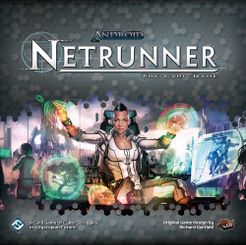
An asymmetric duel of hidden corporate projects and risky network intrusions: the Corporation advances agendas behind ice while the Runner assembles tools to steal them.
Android: Netrunner supports 2 players; community best: 2 players; playing time: 45 minutes. A WANGO browser trial has not been confirmed.
Background & introduction
The two sides share credits and cards but use them differently. The Corporation builds servers and conceals its intentions; the Runner decides which threats deserve preparation and which apparent openings are worth testing.
A run puts both players under pressure. The Corporation must decide whether revealing and paying for a defense is worthwhile, while the Runner balances credits, suitable icebreakers and cards in hand against the possibility of an agenda or a trap.
This introduction concerns Fantasy Flight Games’ Android: Netrunner, first released in 2012, using its Revised Core Set teaching book and final FFG Rules Reference v1.1. Null Signal Games continues Netrunner with its own current rules and products, including System Gateway; those updates and current tournament card pools are outside this guide.
Core rules & scoring
The Corporation goes first. Its normal turn includes a mandatory draw and three clicks; the Runner has four clicks and no automatic draw. Both can spend a click to draw a card or gain a credit, and discard down to their maximum hand size at turn end, normally five.
The Corporation installs agendas, assets, upgrades and ice facedown. A remote server can hold only one asset or agenda, alongside upgrades; ice protects servers. Installing ice costs one credit per piece already protecting that server, separate from its later rez cost. The Runner normally installs programs, hardware and resources faceup, paying their install costs; programs must fit available memory, initially four units.
Rezzing turns a corporate asset, upgrade or ice faceup and active by paying its rez cost, without a click. Use the permitted timing windows: ice normally rezzes as it is approached during a run. Agendas are advanced and scored, never rezzed. Spending one click and one credit adds an advancement token to a legal installed card; an agenda meeting its requirement may be scored in the Corporation’s scoring windows. In a legal paid-ability window, the active player has first opportunity and may use any number of permitted paid abilities, rezzes or scores before opportunities alternate. The window closes when both players decline in succession.
A basic run costs the Runner one click and targets a server. Approach its ice from outermost to innermost. Against rezzed ice, a suitable icebreaker needs at least that ice’s strength and must pay its ability costs to break chosen subroutines. Unbroken subroutines resolve top to bottom. Passing ice does not trash it, and the Runner may let harmless subroutines resolve.
After reaching a server and continuing, the run becomes successful and normally accesses cards: one random HQ card, the top R&D card, all Archives cards, or all cards in the attacked remote server, plus upgrades in a central server’s root. Accessed agendas are stolen, subject to card effects and additional costs; other cards with a trash cost may be trashed by paying it. Success alone does not guarantee an agenda.
The first side with at least seven agenda points wins. The Runner also wins when the Corporation must draw from empty R&D. Net, meat and brain damage trash random cards from the Runner’s grip; damage exceeding available cards flatlines the Runner, and brain damage also permanently reduces maximum hand size. An empty Runner stack alone does not lose the game. A negative maximum hand size at the end of the Runner’s turn also flatlines them.
Construct each deck for one identity and one side, observing its minimum size, influence limit and normally three copies per title. Out-of-faction cards spend influence; cards without an influence value cannot be imported. Corporation decks also need agenda points appropriate to deck size, such as 20–21 for 45–49 cards. Check the agreed edition, card text, errata and format rather than assuming a historical set list remains legal.
Rules & gameplay questions
Does the Runner draw for free each turn?
No. The Corporation has a mandatory draw before its normal three-click action phase. The Runner normally spends one of four clicks to draw, unless a card effect provides another way.
Must every ice subroutine be broken?
No. Resolve any unbroken subroutines in order. A subroutine that ends the run stops further progress; a different effect may be survivable. Merely passing ice leaves it installed.
Can the Corporation score an agenda on the Runner’s turn?
Normally no. Meeting the advancement requirement does not create an unrestricted scoring opportunity. Use the Corporation’s scoring windows and any explicit card exception.
Is a successful run the same as stealing an agenda?
No. It normally leads to access, which can reveal non-agendas or trigger traps. Central-server root upgrades are also accessed; additional costs and replacement effects can change the outcome.
Should current Null Signal rules be treated as FFG errata?
No. They belong to the continuing Netrunner rules lineage. Agree which rules and card pool you are using; this entry follows the FFG Revised Core teaching book with Rules Reference v1.1 and does not summarize current rotation or legality.
Rules & introduction sources
- Edition
- FFG Android: Netrunner (2012 game), Revised Core Set Learn to Play (2017), with FFG Rules Reference v1.1, effective September 6, 2018. FAQ v4.2 consulted for errata and clarifications. General two-player constructed play; no expansion-specific rulings, NAPD multiplayer, current tournament legality, or Null Signal/System Gateway rules updates.
- Rule references
- Fantasy Flight Games — Revised Core Set Learn to Play (2017)
- Fantasy Flight Games — Rules Reference v1.1, effective September 6, 2018
- Fantasy Flight Games — FAQ v4.2, effective September 6, 2018
- Null Signal Games — current Netrunner rules (separate rules lineage)
- Null Signal Games — System Gateway product and learning guide
- Introduction source
- BoardGameGeek
WANGO editorial
| Parameter | Recorded value |
|---|---|
| BGG overall rank (snapshot) | #85 |
| Complexity Weight | 3.42 / 5 |
| Best player count (community) | 2 |
| Player range | 2 |
| Playing time (minutes) | 45 |
| Core mechanisms | Action Points · Deck Construction · Hand Management · Race · Secret Unit Deployment · Take That · Variable Player Powers |
| Chinese publication | Unconfirmed |
| WANGO browser play | No confirmed WANGO trial |
| Year published | 2012 |
| Suggested age | 14+ |
BGG statistics are stored snapshots, not live rankings. Source checked:2026-09-27
Player questions
What is the best player count for Android: Netrunner, and can I play online?
Android: Netrunner supports 2 players; community best: 2 players; playing time: 45 minutes. A WANGO browser trial has not been confirmed.
How complex is Android: Netrunner, and which mechanisms does it use?
Weight: 3.42 / 5. Mechanisms: Action Points · Deck Construction · Hand Management · Race · Secret Unit Deployment · Take That · Variable Player Powers. Chinese publication: Unconfirmed.
Where can I learn Android: Netrunner?
No rule guide, strategy article or WANGO trial has been confirmed for this record.