Concordia
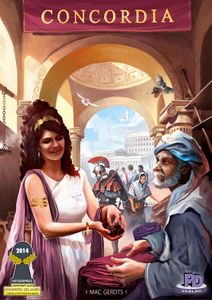
Build a Roman trading network through personality cards, matching colonists, houses and production to the gods that score your achievements.
Concordia supports 2–5 players; community best: 4 players; playing time: 100 minutes. A WANGO browser trial has not been confirmed.
Background & introduction
Concordia places competing trading networks in Roman times. Personality cards direct colonists, build houses, produce goods and add new actions. The original game has Imperium and Italia maps, with randomized city goods changing the layout between games.
Play one personality card each turn and leave used cards in your personal discard pile until the Tribune retrieves them. The Architect moves land and sea colonists before building in adjacent cities; a Prefect can make a province produce for every player with houses there.
Purchased personality cards provide both future actions and endgame scoring symbols. Spreading across provinces, producing different goods and deploying colonists become more valuable when supported by the matching gods in your cards; cash alone does not measure your position.
Core rules & scoring
Setup: Each player starts with seven cards: Tribune, Architect, two Prefects, Mercator, Diplomat and Senator, with no Consul or Colonist. Place one land and one sea colonist in Roma; four reserve colonists and six starting goods occupy the storehouse.
Turns and retrieval: Play proceeds clockwise, with one personality card played and resolved per turn. Tribune retrieves all played cards; counting itself, each card beyond three earns one sestertius. You may also pay one food and one tool to deploy one colonist in Roma.
Movement and building: Architect provides a shared movement allowance equal to your colonists on the board. Land and sea colonists use their respective lines; occupied lines may be crossed but cannot be final destinations. After movement, build in adjacent cities, at most one house of your color per city and none in Roma.
Building costs: A brick city requires one food; other cities require one brick plus their own good. Base cash costs are 1–5 for brick, food, tool, wine and cloth cities, multiplied by the number of houses the city will contain after building. Goods costs do not multiply.
Production and trade: Prefect chooses a province showing its goods bonus, takes that bonus and produces one good per house for all owners, then flips its marker to coins. Alternatively, collect the visible coins and reset those markers. Mercator grants cash, then allows fixed-price bank trades in up to two goods types; player-to-player trade is forbidden.
Purchases and colonists: Senator buys up to two cards for printed goods plus position costs; slide and refill only after the purchases. Consul buys one card without its position cost. Colonist either deploys colonists in Roma or cities containing your own houses for one food and one tool each, or grants five sestertii plus one per own colonist on the board.
Storage and Praefectus Magnus: Each of twelve storehouse spaces holds one good or reserve colonist; goods cannot simply be discarded to make room. Praefectus Magnus doubles only the province bonus when its holder triggers production, then passes right. Taking cash neither doubles it nor passes the card.
Ending and scoring: Buying the final personality card or building your fifteenth house earns the seven-point Concordia card; everyone else gets one final turn. Gather all personality cards and score their gods for cash plus stored-goods value, non-brick cities, provinces, goods types, colonists and specialist cities. Highest score wins; resolve ties by holding or next receiving Praefectus Magnus.
Rules & gameplay questions
Why does building in a brick city cost food?
Its goods cost is one food. Other cities cost one brick plus their own good. Only cash multiplies by the number of houses after building; goods do not.
Does production help opponents?
Yes. Every house in the chosen province produces for its owner. The acting player also gets the province bonus, and Praefectus Magnus doubles only that bonus.
Can a Diplomat copy another Diplomat or a Tribune?
No. It copies an eligible personality action visible on top of another player’s discard pile. A player who just used Diplomat or retrieved cards with Tribune cannot supply that action.
Does Colonist pay two sestertii per colonist?
No. The publisher’s correction and version 1.1 use five sestertii plus one per own colonist on the board. The English deck IV Diplomat also costs tools, following its symbol.
Why does buying cards change scoring?
Every purchased personality card counts at the end, including played cards. Multiple cards of a god each score its achievement; for example, each Mars card gives two points per own colonist on the board.
Rules & introduction sources
- Edition
- Concordia original 2013 base game; Imperium (3–5 players) and Italia (2–4 players), including version 1.1 and publisher corrections. Excludes Venus, Salsa, Solitaria and other map expansions.
- Rule references
- Introduction source
- BoardGameGeek
WANGO editorial
| Parameter | Recorded value |
|---|---|
| BGG overall rank (snapshot) | #29 |
| Complexity Weight | 2.98 / 5 |
| Best player count (community) | 4 |
| Player range | 2–5 |
| Playing time (minutes) | 100 |
| Core mechanisms | Action Retrieval · Advantage Token · Auction: Dutch · Deck, Bag, and Pool Building · End Game Bonuses · Hand Management · Hidden Victory Points · Investment · Movement Points · Network and Route Building · Open Drafting · Point to Point Movement · Set Collection · Variable Set-up |
| Chinese publication | Unconfirmed |
| WANGO browser play | No confirmed WANGO trial |
| Year published | 2013 |
| Suggested age | 13+ |
BGG statistics are stored snapshots, not live rankings. Source checked:2026-09-27
Player questions
What is the best player count for Concordia, and can I play online?
Concordia supports 2–5 players; community best: 4 players; playing time: 100 minutes. A WANGO browser trial has not been confirmed.
How complex is Concordia, and which mechanisms does it use?
Weight: 2.98 / 5. Mechanisms: Action Retrieval · Advantage Token · Auction: Dutch · Deck, Bag, and Pool Building · End Game Bonuses · Hand Management · Hidden Victory Points · Investment · Movement Points · Network and Route Building · Open Drafting · Point to Point Movement · Set Collection · Variable Set-up. Chinese publication: Unconfirmed.
Where can I learn Concordia?
No rule guide, strategy article or WANGO trial has been confirmed for this record.