Twilight Struggle
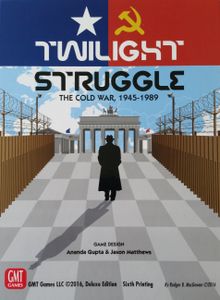
Take the American or Soviet side in a card-driven contest for global influence under the threat of nuclear war.
Twilight Struggle supports 2 players; community best: 2 players; playing time: 120–180 minutes. A WANGO browser trial has not been confirmed.
Background & introduction
Twilight Struggle is a two-player card-driven strategy game designed by Ananda Gupta and Jason Matthews. It compresses the decades from the end of the Second World War in 1945 to the fall of the Berlin Wall in 1989 onto a global board. Players control the United States and Soviet Union through the Early, Mid and Late War.
Cards combine Operations points with historical events. Spend points to place influence, launch coups or attempt realignments across Europe, Asia, the Middle East, Africa and the Americas, or trigger events such as the Marshall Plan and Cuban Missile Crisis. Using an opponent's card for ordinary Operations normally still triggers their event; Space Race use and unmet event conditions require separate treatment.
Changes in influence interact with scoring and nuclear tension. Regional cards compare Presence, Domination and Control. In ordinary play, reaching a net 20 VP or controlling Europe when it is scored can win early. Coups and events can worsen DEFCON. If it falls to 1, the phasing player loses, even when the opponent implements the effect that causes the drop.
Core rules & scoring
A standard game lasts at most ten turns. Improve DEFCON one level toward a maximum of 5, deal cards, reveal secretly selected Headlines, alternate Soviet then American Action Rounds, check Military Operations, flip the China Card face up and advance the turn. On turns 1–3, refill hands to eight and take six actions each; on turns 4–10, refill to nine and take seven. Add Mid War cards on turn 4 and Late War on turn 8. The China Card does not count toward these hand totals.
Headlines resolve events only: higher Operations value first, with the US first on a tie; scoring cards have Headline value zero. Normally choose an event or Operations. An opponent's event still resolves when used for Operations, with the phasing player choosing before or after the Operations. Follow exceptions for unmet prerequisites or events prohibited by another card. A legal Space Race attempt discards the card without triggering its event.
Control of a country requires your influence to meet its stability and exceed the opponent's influence by at least that stability. Placing influence normally costs one Op per point, or two in an enemy-controlled country. After breaking their control, later placements can cost one. Reach is based on countries with your influence at the start of that Action Round and their neighbors; newly placed influence cannot chain into unlimited new locations. In addition, countries directly adjacent to your superpower space are always eligible, even without existing friendly influence there.
Use all Operations from a card for just one purpose: influence, realignment, a coup or a Space Race attempt. Each realignment costs one Op and uses modified opposing die rolls only to remove enemy influence, never add yours. A coup requires enemy influence in its target. Roll plus Ops minus twice stability gives the successful amount: remove enemy influence first, then add yours with any remainder. Any Battleground coup attempt worsens DEFCON one level, whether it succeeds or fails.
At DEFCON 4, coups and realignments are forbidden in Europe; at 3, also Asia; at 2, also the Middle East. Other regions are not all prohibited. DEFCON 1 immediately causes nuclear war and defeats the phasing player, regardless of who rolls or implements the event. In Headlines, the player who played the card causing nuclear war bears responsibility. Check explicit card exceptions as well.
Normally, once per turn, discard a card meeting the minimum Ops requirement to attempt the next Space Race box, using its die target; special abilities can alter the limit. At turn end, required Military Operations equal current DEFCON, with one VP to the opponent per missing point. Coup attempts and War events count as specified; realignments do not. After play, pass the China Card face down to the opponent, who cannot use it that turn; flip it face up at turn end. It cannot be a Headline or an event-required discard.
A scoring card must be played in the turn drawn and cannot be held into the next. Presence requires control of at least one country. Domination requires more total countries and more Battlegrounds than the opponent, including at least one Battleground and one non-Battleground. Control requires more total countries and all Battlegrounds. Add the region's category points, Battlegrounds and adjacency to the opposing superpower, then apply the net difference.
After fully applying both sides' net VP from an ordinary event or scoring card, reaching 20 VP wins. A 20-point result from Military Operations penalties still requires the held-scoring-card check. Control of Europe wins only when Europe is scored. If nobody wins earlier, score every region after turn ten, with Southeast Asia included in Asia rather than scored separately. Reaching 20 during Final Scoring does not cut it short; European Control still wins automatically. Otherwise finish all regions and compare net VP, with zero a draw.
Rules & gameplay questions
Does using an opponent's event card for Operations trigger their event?
Normally yes. The phasing player chooses whether the event resolves before or after Operations. A qualifying Space Race attempt does not trigger it. Follow the card text if prerequisites are unmet or an explicit exception applies; do not present one avoidance method as the only exception-free option.
At DEFCON 2, are coups forbidden in every Battleground?
No. DEFCON progressively restricts Europe, Asia and the Middle East; coups can still be legal in other regions. However, a Battleground coup normally worsens DEFCON, so the risk of falling to 1 must be checked separately. A legal target is not necessarily a safe action.
How does European Control win?
When Europe is scored, controlling every European Battleground and strictly more European countries overall than the opponent satisfies the special European Control victory condition. Simply holding all Battlegrounds at some other moment does not skip the scoring timing and immediately win.
Must influence in an enemy-controlled country always cost two Ops, and can new influence extend my reach?
Recheck control after each placement. Once a point breaks enemy control, later points can cost one Op. Eligible locations are based on your influence and its neighbors at the start of the Action Round; influence placed this round cannot serve as a new stepping stone. Countries directly adjacent to your superpower space are always eligible as well, without requiring existing friendly influence there.
Does Final Scoring stop as soon as a player reaches 20 VP?
No. Finish scoring every region before determining the result; Southeast Asia counts within Asia, not separately. A net zero is a draw. European Control remains an automatic-victory exception during Final Scoring. In ordinary events or scoring cards, first calculate both sides' complete net VP, then check the 20-point victory threshold.
Rules & introduction sources
- Edition
- Twilight Struggle Deluxe Edition, standard two-player ten-turn full game; GMT's February 2015 Collector's Edition/Deluxe rules (32 pages) plus applicable clarifications in the publisher-linked FAQ v5 (2010). Excludes Chinese Civil War, Late War, tournament bidding and designer optional variants, mobile adaptations, Red Sea and other standalone games.
- Rule references
- Introduction source
- BoardGameGeek
WANGO editorial
| Parameter | Recorded value |
|---|---|
| BGG overall rank (snapshot) | #16 |
| Complexity Weight | 3.61 / 5 |
| Best player count (community) | 2 |
| Player range | 2 |
| Playing time (minutes) | 120–180 |
| Core mechanisms | Action / Event · Advantage Token · Area Majority / Influence · Campaign / Battle Card Driven · Dice Rolling · Events · Hand Management · Simulation · Simultaneous Action Selection · Stat Check Resolution · Sudden Death Ending · Tug of War · Variable Player Powers · Variable Set-up |
| Chinese publication | Unconfirmed |
| WANGO browser play | No confirmed WANGO trial |
| Year published | 2005 |
| Suggested age | 13+ |
BGG statistics are stored snapshots, not live rankings. Source checked:2026-09-27
Player questions
What is the best player count for Twilight Struggle, and can I play online?
Twilight Struggle supports 2 players; community best: 2 players; playing time: 120–180 minutes. A WANGO browser trial has not been confirmed.
How complex is Twilight Struggle, and which mechanisms does it use?
Weight: 3.61 / 5. Mechanisms: Action / Event · Advantage Token · Area Majority / Influence · Campaign / Battle Card Driven · Dice Rolling · Events · Hand Management · Simulation · Simultaneous Action Selection · Stat Check Resolution · Sudden Death Ending · Tug of War · Variable Player Powers · Variable Set-up. Chinese publication: Unconfirmed.
Where can I learn Twilight Struggle?
No rule guide, strategy article or WANGO trial has been confirmed for this record.