Keyflower
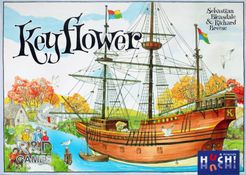
Use the same colored workers to bid for village tiles and activate production, building roads and moving resources across four seasons toward winter scoring goals.
Keyflower supports 2–6 players; community best: 4 players; playing time: 90–120 minutes. A WANGO browser trial has not been confirmed.
Background & introduction
In Keyflower, workers serve as both currency and labor. Place them beside a tile to bid for it or on a tile to activate it; the first color committed to a tile normally governs all later bids and uses there for that season.
Useful buildings extend beyond your own village. You can use production tiles still at auction and buildings in other villages, but workers on a tile go to its eventual owner at season end. Borrowing efficiency can strengthen another player next season.
The four seasons gradually shift attention from production to scoring. Resources occupy actual locations, so upgrades require materials delivered along roads. Players contribute private winter tiles to the public auction, then allocate workers, skills and resources among their final scoring opportunities.
Core rules & scoring
Setup: Two to six players play spring, summer, autumn and winter. Each receives a random home, eight secretly drawn ordinary workers and the player-count allocation of winter tiles. Configure boats, turn-order tiles and seasonal tiles using the player-count table. Green workers start in a separate supply, outside the bag.
Turns: In clockwise order, place one group at one location to bid for a village or turn-order tile, or use a village tile; alternatively pass. A season ends only when everyone passes consecutively. A player who passed can act again before that happens.
Bidding: Put workers beside your side of a tile and exceed its highest bid. A winning bid cannot be withdrawn, but can be increased. An outbid group can be relocated intact and supplemented; it cannot be split or returned behind the screen. Winning bids go to the bag at season end; losing bids return to their owners.
Colors: Workers using a tile and workers bidding beside it normally must share one color, set by the first workers placed there. Green is a separate color, not wild. Specific summer boats in the base box provide explicit exceptions.
Using tiles: You may use production tiles in your village, other villages and the current spring, summer or autumn auction. Each use requires more workers than the previous use, normally one, then two, then three. At most six usage workers can occupy a tile in a season. Overpaying is allowed within these limits.
Production and transport: Resources produced in your village stay on the producing tile; resources produced elsewhere go to your home. Skills and new workers go behind your screen. Using a home or transport tile moves resources along roads within your village and permits the indicated upgrades. One transport unit moves one resource across one adjacent connection.
Upgrades and expansion: Required resources must be on the tile being upgraded; pay skills from behind your screen. Flip it without changing orientation or removing unspent items. Add acquired tiles at season end with adjacent road, field and water edges matching. Placed tiles cannot be rearranged; specific boat abilities can alter some rules.
Season end: A successful bidder takes the tile and all usage workers on it; players also collect all usage workers from their own villages. In spring, summer and autumn, choose boat workers and skills in turn order, one boat per player. Winter supplies no ordinary boat cargo; instead choose boat tiles and take won turn-order tiles into your village.
Winter and scoring: Each player contributes at least one private winter tile to the public auction. After winter, score tiles and gold. The four autumn storage tiles require resources delivered during play; other goals normally allow eligible items to be allocated freely. Each item scores only once. Unallocated gold is worth one point each; the purple start marker can represent one resource, skill or worker of any color. Most points wins; equal scores remain tied.
Rules & gameplay questions
Does passing remove me from the season?
No. The season ends only after everyone passes consecutively. Until then, you can bid or use a tile on a later turn.
Are green workers wild?
No. Green normally follows the same single-color rule as red, blue and yellow. Only an explicit boat ability creates an exception.
Do workers used in another village return to me?
Those workers go to the tile owner at season end. Workers used on an auction tile accompany it to the successful bidder; if nobody bids, the tile is removed and its workers go into the bag.
Can I split an outbid group of four?
No. Move the group intact, optionally adding workers. Using it on a tile must still satisfy color, increasing-use and six-worker limits; a large group may have no legal production destination.
Can one resource score for two goals?
No. Each item scores once. Autumn storage goals need resources delivered to those tiles during play; other eligible resources, skills and workers can normally be allocated at game end without transport.
Rules & introduction sources
- Edition
- Keyflower (2012) base game for 2-6 players, using the twelve-page R&D Games English base rules. Includes base-box summer boat abilities; excludes The Farmers, The Merchants, promotional tiles and house variants.
- Rule references
- Introduction source
- BoardGameGeek
WANGO editorial
| Parameter | Recorded value |
|---|---|
| BGG overall rank (snapshot) | #137 |
| Complexity Weight | 3.33 / 5 |
| Best player count (community) | 4 |
| Player range | 2–6 |
| Playing time (minutes) | 90–120 |
| Core mechanisms | Auction / Bidding · Auction: Fixed Placement · Auction: Multiple Lot · Constrained Bidding · End Game Bonuses · Modular Board · Network and Route Building · Ownership · Pick-up and Deliver · Selection Order Bid · Set Collection · Tile Placement · Turn Order: Auction · Variable Set-up · Worker Placement · Worker Placement, Different Worker Types |
| Chinese publication | Unconfirmed |
| WANGO browser play | No confirmed WANGO trial |
| Year published | 2012 |
| Suggested age | 12+ |
BGG statistics are stored snapshots, not live rankings. Source checked:2026-09-27
Player questions
What is the best player count for Keyflower, and can I play online?
Keyflower supports 2–6 players; community best: 4 players; playing time: 90–120 minutes. A WANGO browser trial has not been confirmed.
How complex is Keyflower, and which mechanisms does it use?
Weight: 3.33 / 5. Mechanisms: Auction / Bidding · Auction: Fixed Placement · Auction: Multiple Lot · Constrained Bidding · End Game Bonuses · Modular Board · Network and Route Building · Ownership · Pick-up and Deliver · Selection Order Bid · Set Collection · Tile Placement · Turn Order: Auction · Variable Set-up · Worker Placement · Worker Placement, Different Worker Types. Chinese publication: Unconfirmed.
Where can I learn Keyflower?
No rule guide, strategy article or WANGO trial has been confirmed for this record.