Robinson Crusoe: Adventures on the Cursed Island
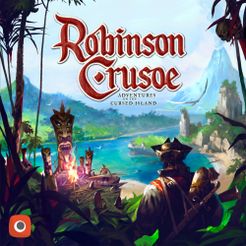
Castaways allocate scarce actions to food, tools, and camp improvements while cooperating to complete a scenario before injuries, weather, and events overwhelm them.
Robinson Crusoe: Adventures on the Cursed Island supports 1–4 players; community best: 1–2 players; playing time: 60–120 minutes. A WANGO browser trial has not been confirmed.
Background & introduction
Robinson Crusoe: Adventures on the Cursed Island is a cooperative survival game designed by Ignacy Trzewiczek. Each player controls a castaway with personal abilities and an invention. The group shares victory or defeat, while the chosen scenario supplies its objectives, time limit, and special rules.
Each round moves through events, morale, camp production, jointly planned actions, weather, and night. A character can split two action pawns between jobs or commit both to one task to reduce risk. Exploring, gathering, building, hunting, and recovering all compete for the same workforce.
Adventure cards can shuffle the consequences of an encounter into the event deck to return later. Resources gained during actions normally become usable only after that phase ends, so a sound plan must cover tonight’s food and shelter while preserving time for the scenario objective.
Core rules & scoring
Setup and round: Choose a scenario and follow its map, event-deck, and round instructions. Each player takes a character, two action pawns, and a personal invention. Resolve Event, Morale, Production, Action, Weather, and Night in that order; skip the first round’s Event phase.
Events, morale, production: Resolve an event immediately and place it in the threat area; a card pushed off the left end triggers its threat effect. Actions can remove threats first. Morale normally gives or costs the first player determination, with wounds for unpaid tokens. Active sources on the camp tile produce resources available immediately.
Joint planning: Assign all player action pawns before resolving anything. Building resources, tools, terrain, and other requirements must already exist during planning: wood gathered later cannot fund a building action that round. New resources and items normally wait in Future Resources until the phase ends; determination, wounds, and track-level changes have immediate exceptions.
Resolution order: Resolve Threat, Hunt, Build, Gather, Explore, Arrange Camp, and Rest, choosing the order within each type. The character with the top pawn in a stack resolves the action and takes its personal benefits and consequences; others support. Hunting needs two pawns and a beast in the hunting deck; use combat strength and weapon differences rather than normal action dice.
Risk and costs: Building and gathering or exploring adjacent to camp normally use one pawn with three matching action dice, or two pawns for automatic success. Distance and special tokens add pawns. Success, wounds, and adventure resolve independently: failure can still cause injury and adventure, and awards two determination. Failed builds return assigned resources; automatic success does not cancel a mandatory adventure token.
Camp and recovery: Build inventions, shelter, or levels of roof, palisade, and weapons; roof and palisade need shelter already present during planning. Each Rest pawn heals one wound. Arrange Camp normally gives two determination and one morale; with four players choose one benefit. Each resource source can be gathered once per round, and each invention or exploration location attempted once per round.
Weather and night: Roll the scenario’s weather dice and include weather tokens. Each snow cloud first costs one wood; then subtract roof from total rain and snow clouds, paying one food and one wood for each unblocked cloud. Each missing resource wounds all characters in camp. Resolve animals and storm next. At night each character eats one food or takes two wounds; lacking natural or built shelter causes another wound, and unstored perishable food spoils.
Victory and player counts: Normally win together immediately on achieving the scenario goal. A player character’s death, an inaccessible camp tile, or reaching the deadline without the objective causes defeat, subject to scenario exceptions. Two players add Friday; solo also adds Dog, uses two-player building costs, keeps the player as first player, and raises morale by one before each Morale phase. Friday’s death does not immediately lose the game; Dog only supports Hunt or Explore.
Rules & gameplay questions
Do two pawns let me build twice?
A stack represents one action, normally guaranteeing that build’s success. To raise weapons, roof, or palisade twice, plan two actions and assign separate pawns and costs. Each invention and the shelter can only be attempted once per round; distance or tokens can also increase pawn requirements.
Can a newly explored terrain let us build its tool this round?
It cannot supply a missing planning requirement. All building conditions must exist when assigning pawns; newly found terrain and resources cannot validate an action that was illegal to plan. Built items normally take effect only after the Action phase, so building a prerequisite and its dependent item in that same phase is also unavailable.
Does failure cancel the injury and adventure dice?
No. Success, wound, and adventure results are independent. A failed action can still injure the character and draw an adventure, while granting two determination; allocated building resources return. Two-pawn automatic success avoids the usual roll, but an adventure token on the deck still forces an adventure.
Does a high roof remove the wood cost of snow?
No. First pay one wood per snow cloud for heating, regardless of roof. Then total rain and snow clouds and subtract roof; each remaining cloud costs another food and wood. Every missing resource causes one wound to each character in camp. You cannot choose wounds to preserve resources you can pay.
Is solo just the multiplayer game with other players removed?
Also add Friday and Dog, use the two-player shelter, roof, and palisade costs, remain first player, and increase morale by one before resolving each Morale phase. Friday may resolve actions alone and has special wound rules; his death does not immediately end the game. Dog is a neutral support pawn restricted to hunting and exploration and cannot resolve an action alone.
Rules & introduction sources
- Edition
- Base game for 1–4 players, using the 2016 rewritten 40-page Portal Games English base rules and publisher-verified Dized rules. Covers general survival without scenario solutions; explicit scenario and card exceptions take precedence. Excludes Book of Adventures, Mystery Tales, Voyage of the Beagle, Treasure Chest, and Collector’s Edition add-on modules.
- Rule references
- Introduction source
- BoardGameGeek
WANGO editorial
| Parameter | Recorded value |
|---|---|
| BGG overall rank (snapshot) | #121 |
| Complexity Weight | 3.83 / 5 |
| Best player count (community) | 1–2 |
| Player range | 1–4 |
| Playing time (minutes) | 60–120 |
| Core mechanisms | Action Queue · Area Movement · Cooperative Game · Dice Rolling · Die Icon Resolution · Events · Hexagon Grid · Map Addition · Movement Points · Narrative Choice / Paragraph · Scenario / Mission / Campaign Game · Solo / Solitaire Game · Tile Placement · Turn Order: Progressive · Variable Player Powers · Worker Placement |
| Chinese publication | Unconfirmed |
| WANGO browser play | No confirmed WANGO trial |
| Year published | 2012 |
| Suggested age | 14+ |
BGG statistics are stored snapshots, not live rankings. Source checked:2026-09-27
Player questions
What is the best player count for Robinson Crusoe: Adventures on the Cursed Island, and can I play online?
Robinson Crusoe: Adventures on the Cursed Island supports 1–4 players; community best: 1–2 players; playing time: 60–120 minutes. A WANGO browser trial has not been confirmed. Recorded mechanism tags: Solo / Solitaire Game.
How complex is Robinson Crusoe: Adventures on the Cursed Island, and which mechanisms does it use?
Weight: 3.83 / 5. Mechanisms: Action Queue · Area Movement · Cooperative Game · Dice Rolling · Die Icon Resolution · Events · Hexagon Grid · Map Addition · Movement Points · Narrative Choice / Paragraph · Scenario / Mission / Campaign Game · Solo / Solitaire Game · Tile Placement · Turn Order: Progressive · Variable Player Powers · Worker Placement. Chinese publication: Unconfirmed.
Where can I learn Robinson Crusoe: Adventures on the Cursed Island?
No rule guide, strategy article or WANGO trial has been confirmed for this record.