Terra Mystica
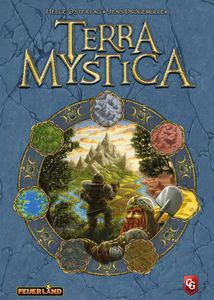
Terraform, build and upgrade with one of fourteen fantasy factions, cycling Power through six rounds of competition for territory, Cults and victory points.
Terra Mystica supports 2–5 players; community best: 4 players; playing time: 60–150 minutes. A WANGO browser trial has not been confirmed.
Background & introduction
Terra Mystica gives each player one of fourteen base-game factions, transforming terrain into its home type before building dwellings and upgrading structures. Faction powers, public round-scoring tiles and bonus-card combinations create changing development routes on the shared map.
Income uncovered by buildings, income lost when upgrading, and conversions among workers, coins, priests and Power constrain expansion. Neighbors compete for land and shared Power actions, but also reduce trading-house upgrade costs and offer the option of spending points to gain Power.
Across six rounds, balance immediate scoring against the final largest connected area and four Cult rankings. Towns require direct adjacency, while Shipping can provide indirect connections for final area scoring. Stronghold powers and the Sanctuary’s town exception serve different purposes.
Core rules & scoring
The base game has fourteen factions. Each round collects income, then players take one action per turn until everyone passes, followed by Cult bonuses and cleanup. Round six ends directly after everyone passes, without that round’s Cult bonuses.
Transform and Build requires unoccupied terrain directly or indirectly adjacent to your structures. Pay spades according to the terrain cycle; after reaching your home terrain, you may pay to build a dwelling or leave it unbuilt. Unbuilt terrain remains available to others. Use spades immediately rather than saving them; faction exceptions follow the faction board.
Upgrade dwellings to trading houses, then to a stronghold or temple; a temple may become a sanctuary. Return the replaced building to your board, changing income. A directly adjacent opponent reduces the coin cost of a trading house. Temples and sanctuaries grant favor tiles, while strongholds provide faction-specific effects.
Gaining Power first moves tokens from Bowl I to II; only after I is empty does it move tokens from II to III. Spend only from III, returning spent tokens to I. Conversions supplement your action on your turn. Sacrificing Power moves one token from II to III and permanently removes another token from II.
When an opponent builds or upgrades, total the Power values of your own directly adjacent buildings: dwellings one, trading houses/temples two, strongholds/sanctuaries three. Accepting n Power normally costs n−1 points. Reduction is allowed for insufficient charging capacity or avoiding a negative score, not simply to pay fewer points.
Each shared Power action is available to only one player once per round. Priests may permanently occupy a Cult space to advance two or three steps, or return to your supply for one step. Only one player reaches space ten on each Cult, and a corresponding town key is required.
A town forms automatically with at least four directly connected buildings totaling seven Power. Including a sanctuary reduces the building count to three; a specific favor reduces the Power threshold to six. Bridges give direct adjacency; Shipping does not. Mermaids have a one-river-space exception. Choose a town tile and gain its immediate rewards.
Passing ends your actions that round; the first passer starts the next round. In rounds one to five, exchange your bonus card for an available card, without immediately reclaiming the one just returned. Final Cult rankings score 8/4/2 each, but a token still on space zero scores nothing for that track; largest directly or indirectly connected building areas score 18/12/6. Ties pool the occupied ranks and divide, rounding down. Convert remaining resources to coins for one point per three coins, or per two for Alchemists. A final score tie is shared.
Rules & gameplay questions
Can Shipping connections form a town?
Normally no: towns require direct adjacency, which bridges provide, while Shipping gives indirect adjacency. Mermaids have a faction exception allowing one river space to be skipped when founding a town.
Whose buildings determine Power from neighboring construction?
Add the Power values of your own buildings directly adjacent to the construction site, not the opponent’s new building. Actual charging also depends on your Power-cycle capacity and the prohibition on paying into a negative score.
Does a stronghold allow a three-building town?
No. The three-building exception requires a sanctuary and still needs the required total Power. Stronghold and sanctuary are different upgrade branches.
Can spades wait until next round to build a dwelling?
Spades must be used immediately. Spades from Cult bonuses cannot include building a dwelling or buying extra spades with workers; build on eligible terrain during a later action phase.
Does the base game include Fire & Ice factions or solo play?
This page covers the fourteen-faction, 2–5-player base game using official English v3.0. It excludes Fire & Ice, Merchants, Fan Factions and Automa. The introductory and freely chosen main-game setups differ; v3.0 main-game starting points follow its faction table.
Rules & introduction sources
- Edition
- Terra Mystica fourteen-faction base game for 2–5 players; official English rules v3.0, excluding expansions and Automa
- Introduction source
- BoardGameGeek
WANGO editorial
| Parameter | Recorded value |
|---|---|
| BGG overall rank (snapshot) | #36 |
| Complexity Weight | 3.97 / 5 |
| Best player count (community) | 4 |
| Player range | 2–5 |
| Playing time (minutes) | 60–150 |
| Core mechanisms | Chaining · End Game Bonuses · Hexagon Grid · Income · Increase Value of Unchosen Resources · Network and Route Building · Tech Trees / Tech Tracks · Turn Order: Pass Order · Variable Player Powers · Variable Set-up · Victory Points as a Resource |
| Chinese publication | Unconfirmed |
| WANGO browser play | No confirmed WANGO trial |
| Year published | 2012 |
| Suggested age | 12+ |
BGG statistics are stored snapshots, not live rankings. Source checked:2026-09-27
Player questions
What is the best player count for Terra Mystica, and can I play online?
Terra Mystica supports 2–5 players; community best: 4 players; playing time: 60–150 minutes. A WANGO browser trial has not been confirmed.
How complex is Terra Mystica, and which mechanisms does it use?
Weight: 3.97 / 5. Mechanisms: Chaining · End Game Bonuses · Hexagon Grid · Income · Increase Value of Unchosen Resources · Network and Route Building · Tech Trees / Tech Tracks · Turn Order: Pass Order · Variable Player Powers · Variable Set-up · Victory Points as a Resource. Chinese publication: Unconfirmed.
Where can I learn Terra Mystica?
No rule guide, strategy article or WANGO trial has been confirmed for this record.