Ra
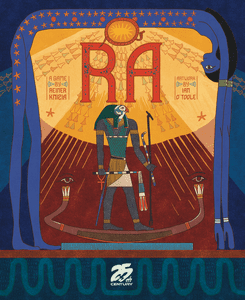
Draw and auction civilization, river and monument tiles across three Egyptian epochs, bidding with limited sun disks and judging when to wait or invoke Ra.
Ra supports 2–5 players; community best: 3–4 players; playing time: 45–60 minutes. A WANGO browser trial has not been confirmed.
Background & introduction
Designed by Reiner Knizia, Ra casts players as royal advisors whose family lines span generations. They collect pharaohs, civilization, rivers and monuments, weighing immediate rewards against disasters and the future value of their sun disks.
On a turn, draw a tile to expand the auction, invoke Ra to start bidding, or spend god tiles to take tiles from the auction track. Each player has one bidding opportunity. The winner takes the whole lot and exchanges the winning disk for the central disk, which cannot be used again during this epoch.
Ra tiles drive the epoch toward its end, so an unpurchased lot may disappear. Long-term collections such as pharaohs and Nile tiles persist, while floods and civilization must be acquired again. Regular scoring across three epochs combines with final monument and sun-disk scores to determine the winner.
Core rules & scoring
Setup and epochs: the classic 2016 base game supports two to five players over three epochs. Each starts with ten points and a randomly assigned disk group from the player-count table; disk 1 starts centrally. Mix all 180 tiles in the bag. The highest disk owner starts each epoch; only players with faceup disks take actions or bid.
Actions: draw one tile, invoke Ra, or spend god tiles. Non-Ra tiles enter the auction track; Ra tiles enter the Ra track from the player-count starting space and trigger an auction. Filling its final space instead ends the epoch immediately without an auction. Drawing is forbidden while the auction track is full.
Auctions: starting left of the Ra player and ending with that player, each bids one faceup disk or passes, once only; later bids must exceed the current bid. After a drawn Ra tile, everyone may pass and leave the lot. After a voluntary invocation with a nonfull track, the invoker must bid if everyone else passes; with a full track everyone may pass, discarding the entire lot.
Winning and disks: the highest bidder takes all auction tiles and the central disk, placing that disk facedown and unavailable this epoch. The winning bid becomes the new central disk; losing bidders recover their disks faceup. Resolve disasters, then resume turns to the left of the Ra player.
Gods and disasters: spend one or more god tiles in an action, each taking one non-god auction tile; spent gods leave the game. Resolve acquired disasters immediately: war removes civilization, funeral removes pharaohs, drought removes rivers and earthquake removes monuments. Each disaster removes two matching tiles, or all available if fewer; drought removes floods before Nile tiles.
Epoch end: all personal disks facedown or a full Ra track ends the epoch immediately. Discard both tracks, leaving the central disk. Score, turn personal disks faceup, discard personal tiles without a scarab icon and keep those with one. After scoring epoch three, the game ends.
Every epoch: most pharaohs earn five points and fewest lose two, with tied players each receiving the full gain or loss; if everyone has the same count, neither applies. Each gold earns three and each unspent god two. With at least one flood, every river tile earns one; otherwise Nile tiles earn nothing. No civilization types loses five; three/four/five types earn five/ten/fifteen, with no reward for one or two. Scores cannot fall below zero.
Final bonuses: one to six monument types earn one point per type, seven/eight earn ten/fifteen. Each type with three/four/five matching tiles adds five/ten/fifteen, using its applicable tier only. Highest personal disk-value total earns five, lowest loses five, with tied players each gaining or losing five; equal totals for everyone score neither. Highest total score wins; ties go to the holder of the highest disk.
Rules & gameplay questions
Can I invoke Ra and then pass with everyone else?
With a nonfull auction track, you must bid if every other player passes. With a full track everyone may pass, but all auction tiles are discarded. If a drawn Ra tile triggered the auction, everyone may pass and the tiles remain.
Can I bid immediately with the central disk I just won?
No. Place it facedown in front of you; it cannot be used again this epoch. Your winning bid becomes the new central disk. Losing bidders recover their own disks faceup. Each player gets only one bid or pass in an auction.
Does filling the auction track start an auction or allow another draw?
Neither. A full track forbids drawing but does not automatically trigger an auction. You may invoke Ra, or legally spend god tiles to remove non-god tiles. Later drawn tiles can fill the resulting gaps.
Can we buy the lot after the final Ra space fills?
No. Filling the final Ra space ends the epoch immediately without that auction, discarding both tracks. An epoch also ends immediately when every player’s disks are facedown. Waiting for a better lot therefore does not guarantee it can eventually be purchased.
Do Nile tiles and monuments score every epoch?
Nile tiles persist, but at least one flood is needed each epoch to score rivers; floods are discarded after scoring. Monuments persist and score their variety and matching groups only after epoch three. Civilization, gold and unspent gods score and are discarded each epoch; pharaohs persist.
Rules & introduction sources
- Edition
- Ra classic base game for two to five players, explicitly using the ©2016 Windrider Games English edition. Excludes 25th Century component changes, Traders, Razzia and Ra: The Dice Game.
- Rule references
- Introduction source
- BoardGameGeek
WANGO editorial
| Parameter | Recorded value |
|---|---|
| BGG overall rank (snapshot) | #112 |
| Complexity Weight | 2.30 / 5 |
| Best player count (community) | 3–4 |
| Player range | 2–5 |
| Playing time (minutes) | 45–60 |
| Core mechanisms | Auction / Bidding · Auction: Once Around · Closed Economy Auction · Constrained Bidding · Hidden Victory Points · Push Your Luck · Set Collection |
| Chinese publication | Unconfirmed |
| WANGO browser play | No confirmed WANGO trial |
| Year published | 1999 |
| Suggested age | 12+ |
BGG statistics are stored snapshots, not live rankings. Source checked:2026-09-27
Player questions
What is the best player count for Ra, and can I play online?
Ra supports 2–5 players; community best: 3–4 players; playing time: 45–60 minutes. A WANGO browser trial has not been confirmed.
How complex is Ra, and which mechanisms does it use?
Weight: 2.30 / 5. Mechanisms: Auction / Bidding · Auction: Once Around · Closed Economy Auction · Constrained Bidding · Hidden Victory Points · Push Your Luck · Set Collection. Chinese publication: Unconfirmed.
Where can I learn Ra?
No rule guide, strategy article or WANGO trial has been confirmed for this record.