War of the Ring: Second Edition
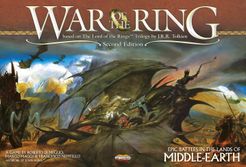
Command armies across Middle-earth while shaping the fate of the Fellowship and the One Ring.
War of the Ring: Second Edition supports 2–4 players; community best: 2 players; playing time: 150–240 minutes. A WANGO browser trial has not been confirmed.
Background & introduction
The struggle for Middle-earth unfolds on two connected fronts: armies contest cities and strongholds while the Fellowship attempts to reach Mount Doom. The Free Peoples must mobilize nations not yet at war, resist the Shadow’s forces and protect the Ring-bearers’ journey.
Each turn begins by recovering action dice and drawing Event cards, followed by the Fellowship phase, Shadow Hunt allocation and both sides’ action rolls. Players then alternate using their die results to act. These results determine available actions, including movement, recruitment, political advancement and Event cards. Events create special opportunities or alter crucial battles, allowing similar positions to develop very differently.
Military conquest offers one route to victory, while the Ring creates a parallel contest. The Shadow must balance its offensive with the Hunt for the Fellowship. The Free Peoples must weigh the benefits of committing companions and resources to the war against the greater danger this may bring to the quest.
Core rules & scoring
Each turn proceeds through recovering action dice and drawing 2 Event cards each, 1 from each deck; the Fellowship phase; Shadow Hunt allocation; action rolls; alternating actions; and a military victory check. The Free Peoples start with 4 action dice and the Shadow with 7; qualifying characters can add dice in later turns. The Free Peoples act first. Use 1 die result for one permitted action; a player with fewer unused dice than the opponent may pass temporarily.
An Army result can move up to two different armies into adjacent regions, or attack an adjacent enemy with one army. A Character result can move or attack with a led army, or handle companions and the Fellowship. Muster can advance one nation on the Political Track or recruit for a nation At War: one elite, or a legal combination of two regulars and/or leaders. Two figures must use different free settlements of their own nations; a besieged stronghold cannot muster.
Activation and being At War are distinct: a passive Free Peoples nation cannot enter the At War step. A nation not At War cannot attack, recruit with Muster dice or normally cross into another nation’s territory. Being attacked or losing settlements advances its political position. Free Peoples army units and leaders killed are permanently removed; Shadow army units and Nazgûl normally return to reinforcements and can be recruited again. Eliminated characters normally leave permanently.
A normal region holds at most 10 army units, and a besieged stronghold at most 5. In each combat round, roll up to 5 dice according to combat strength, normally hitting on 5 or 6; leadership rerolls the appropriate number of misses. Each hit removes one regular or downgrades one elite to a regular; two hits may instead remove an elite. In a siege, the attacker normally hits only on 6 and fights for just 1 round, extending it by downgrading one participating elite for each additional round.
While Hidden, the Fellowship can use a Character die to advance progress 1 step and resolve the Hunt, then place that Free Peoples die in the Hunt Box. A Revealed Fellowship must spend a separate action to hide before moving; hiding and moving are not one action. Its figure marks its last known location and its progress records distance traveled from there. Voluntarily declaring its location in the Fellowship phase differs from being revealed by the Hunt: declaration can leave it Hidden.
Before rolling, the Shadow openly allocates Hunt dice, normally up to the number of companions still in the Fellowship, but may always allocate at least 1. At least 1 is required if a Free Peoples movement die remained in the Hunt Box last turn. Rolled Eyes then join them. Outside Mordor, each Fellowship move rolls up to 5 Hunt dice based on Shadow dice in the box, normally succeeding on 6, with +1 for each Free Peoples die placed there by earlier moves that turn. At least one success draws just 1 Hunt tile. Resolve its damage and reveal effect; events, the Guide or sacrificing one companion may reduce damage under their rules, with the remainder becoming Corruption.
In the Fellowship phase, the Fellowship may enter the Mordor Track from Minas Morgul or Morannon. Each movement attempt then draws 1 Hunt tile automatically instead of rolling Hunt dice. Normally advance 1 step; a Stop icon prevents advancement. An Eye tile deals damage equal to all dice in the Hunt Box, including Free Peoples dice. The Fellowship must still be Hidden to advance and companions can no longer voluntarily separate. If it neither attempts to move nor hides during the entire turn, add 1 Corruption at the end of Action Resolution.
The Shadow wins immediately at 12 or more Corruption. The Free Peoples win immediately by completing the Mordor Track’s five steps to the Crack of Doom with Corruption below 12. Check military victories only at turn end: the Shadow needs enemy settlements worth at least 10 points; the Free Peoples need at least 4. Each enemy city is worth 1 and stronghold 2. The numbered priority is Corruption, Ring destruction, Shadow military victory, then Free Peoples military victory; reaching a military threshold does not end play immediately.
Rules & gameplay questions
Does activating a nation mean it is already At War?
No. Active or passive is the political counter’s face, while At War is its position on the Political Track. A Free Peoples nation must first activate to enter the At War step. Only being At War removes its normal restrictions on crossing national borders, attacking and recruitment with Muster dice.
Is Hunt allocation secret, and do rolled Eyes count against its companion limit?
Allocation is open. The Shadow first places allocated action dice in the visible Hunt Box, then rolls the rest and adds every Eye result. The companion limit applies to preallocated dice, not rolled Eyes. Even with no companions, 1 die may be allocated; the prior-turn movement condition can make that minimum mandatory.
Does a successful Hunt always reveal the Fellowship and add Corruption?
No. At least one success draws one tile. Its reveal icon determines revelation and its value determines damage; an ordinary Eye tile in a normal Hunt uses the number of successes. Events, the Guide or sacrificing one companion can reduce damage under their rules before the remainder becomes Corruption. In Mordor, Eye damage instead counts both sides’ dice in the Hunt Box.
Does entering a stronghold’s region immediately earn its two points?
Not if defenders remain inside. During a siege, the surrounding region is available to the besieger, but the defender retains the stronghold. Capture requires eliminating all defenders while the besieger still has an army unit; an empty stronghold can be captured by an entering enemy army. Only control of enemy cities and strongholds gives military points, and recapture by the original owner removes those conquest points.
Can Free Peoples casualties be recruited again like Shadow troops?
Normally not. Free Peoples army units and leaders killed leave permanently, while Shadow army units and Nazgûl casualties return to reinforcements for possible recruitment. Units removed for exceeding stacking limits can return to reinforcements. Downgrading an elite requires obtaining a regular of the same nation under the rules; characters and explicit exceptions follow their cards.
Rules & introduction sources
- Edition
- War of the Ring: Second Edition base game, standard two-player game; based on the complete public mirror of Ares’ official English rulebook Version 2.3 (2011, 2016 copyright). The product also supports 3–4-player team rules, which this summary excludes, along with First Edition, expansions, the card game and simplified introductory play.
- Rule references
- Introduction source
- BoardGameGeek
WANGO editorial
| Parameter | Recorded value |
|---|---|
| BGG overall rank (snapshot) | #8 |
| Complexity Weight | 4.23 / 5 |
| Best player count (community) | 2 |
| Player range | 2–4 |
| Playing time (minutes) | 150–240 |
| Core mechanisms | Area Majority / Influence · Area Movement · Campaign / Battle Card Driven · Card Play Conflict Resolution · Dice Rolling · Events · Hand Management · Movement Points · Team-Based Game · Variable Player Powers · Variable Set-up |
| Chinese publication | Unconfirmed |
| WANGO browser play | No confirmed WANGO trial |
| Year published | 2011 |
| Suggested age | 13+ |
BGG statistics are stored snapshots, not live rankings. Source checked:2026-09-26
Player questions
What is the best player count for War of the Ring: Second Edition, and can I play online?
War of the Ring: Second Edition supports 2–4 players; community best: 2 players; playing time: 150–240 minutes. A WANGO browser trial has not been confirmed. Recorded mechanism tags: Team-Based Game.
How complex is War of the Ring: Second Edition, and which mechanisms does it use?
Weight: 4.23 / 5. Mechanisms: Area Majority / Influence · Area Movement · Campaign / Battle Card Driven · Card Play Conflict Resolution · Dice Rolling · Events · Hand Management · Movement Points · Team-Based Game · Variable Player Powers · Variable Set-up. Chinese publication: Unconfirmed.
Where can I learn War of the Ring: Second Edition?
No rule guide, strategy article or WANGO trial has been confirmed for this record.