Seasons
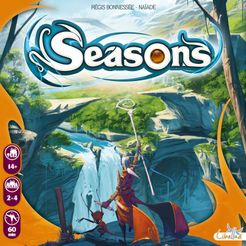
In Seasons, sorcerers draft nine Power cards, then compete across a three-year tournament by choosing seasonal dice, gathering elemental energy, and summoning magical items and familiars. Players adapt to changing transmutation rates and balance crystals, card effects, and resource management to earn the most Prestige.
Seasons supports 2–4 players; community best: 2 players; playing time: 60 minutes. A WANGO browser trial has not been confirmed.
Background & introduction
In the kingdom of Xidit, sorcerers gather in the Argos forest for a three-year tournament to determine who will become Archmage. Seasons uses a deck of Power cards and dice that change with the seasons to shape the players’ decisions. Before the tournament, each player drafts nine cards and arranges them into a plan for three years. During the tournament, players choose one die from those rolled for the current season, gaining elemental energy, crystals, a larger summoning gauge, or another action.
Power cards need the right costs and room on a player’s summoning gauge before they can enter play. Once summoned, a card may provide an immediate effect, a permanent ability, or an effect that must be activated later. Air, water, fire, and earth energy vary in availability as the seasons change, while the board’s transmutation chart changes how many crystals each energy can produce. Players balance drafting, dice selection, and resource management: summoning too quickly can fill the gauge, while waiting too long may leave a card with too little time to matter.
The seasonal dice change both the actions available in a round and the pace of the tournament. Dice can provide energy or crystals, increase the summoning gauge, draw a card, or transmute energy. After everyone chooses, the die left behind advances the season wheel by its pip value. That movement affects when the next season begins and when the next year arrives, so taking a strong die and managing the clock are both part of the same decision. Players may also spend a limited number of bonuses for immediate benefits, but each bonus use creates a Prestige penalty at the end.
At the end of the third year, players total their crystals and the Prestige printed on Power cards in play, then subtract penalties for cards left in hand and bonuses used. Unused energy is not automatically worth points; it matters only if it was converted or spent during play. The official rules use cards 1–30 as an approachable starting set and recommend adding the more complex cards numbered 31–50 after players know the system. To win, players must connect their draft, seasonal timing, energy exchange, card combinations, and endgame penalties into one plan.
Core rules & scoring
Objective and structure: The game has two phases, the Prelude and the Tournament. During the Prelude, players select and arrange nine Power cards. The Tournament lasts three game years, and the goal is to finish with the highest Prestige total. Prestige comes mainly from crystals and Power cards in play, while unused cards in hand and bonuses create penalties. A sorcerer must plan beyond the immediate gain of a few crystals and consider how their cards will perform across all three years.
Setup and difficulty: Place the year marker at the first year and the season marker at the start of winter, then prepare the season dice for the player count. Each player takes an individual board, Sorcerer tokens, Power cards, and Library II and Library III markers. New players can use the preconstructed nine-card sets in the rulebook. Intermediate games can use only cards numbered 1–30; once the group is familiar with their effects, cards 31–50 can join the base deck for a more advanced game.
Prelude draft: Each player receives nine Power cards and chooses one face down, passing the remaining cards to a neighbor. Players keep selecting one card from each received set until all nine have been drafted. Then divide the cards into three groups of three. The first group is the starting hand for year one. Put the second and third groups under Library II and Library III; add them to the hand at the beginning of years two and three respectively.
Tournament and season dice: Each tournament round uses dice matching the current season. Roll one more die than the number of players. The first player chooses a die, then the other players choose in turn, leaving one die unselected. Players take their turns in order and resolve the actions on their chosen die. At the end of the round, the number of pips on the unselected die determines how far the season marker advances on the wheel.
Die actions: A die can offer one or more benefits, such as taking a type of elemental energy, gaining crystals, increasing the summoning gauge, drawing a Power card, or transmuting energy. Some die actions must resolve before the player takes other actions; afterward, the player can summon or activate Power cards and use bonuses in an allowed order. A player can keep at most seven energy tokens, so a full reserve may force a choice before new energy is gained.
Energy and transmutation: Power cards may require air, water, fire, or earth energy, and some also require crystals as a summoning cost. A transmutation action lets a player turn energy from their reserve into crystals according to the chart for the current season. The value of each energy type changes across winter, spring, summer, and fall. Crystals can pay some card costs and are each worth one Prestige at the end. Energy left unused when the game ends is worth no points by itself.
Summoning and card effects: To summon a Power card, pay the energy and/or crystal cost shown on it and make sure the summoning gauge has room. The gauge limits how many Power cards can be in play at once. Magical items generally affect their owner, while familiars can affect several players. Card effects may trigger when the card enters play, remain active, or require a later activation. An activated card is turned sideways and readied at the start of the next round; resolve special cases according to the card text.
Season and year progression: The unchosen die determines how many spaces the season marker moves after each round. Crossing spaces 3, 6, 9, and 12 changes the season and may trigger card effects. When the marker moves from space 12 back to space 1, a new year begins and the cards assigned to Library II or III enter the relevant players’ hands. The unchosen die controls the pace: a low pip can leave more time to develop, while a higher pip may advance the year and bring the endgame closer.
Bonuses and their cost: The individual board offers several bonuses that improve certain actions, such as gaining extra resources or replacing a die action. A player can use at most three bonuses in a game and may repeat one or choose different bonuses. Each use moves the Bonus marker and creates an endgame Prestige penalty. The official rules list penalties of 5, 12, or 20 points for using one, two, or three bonuses respectively. Weigh the immediate action against that final deduction before using a bonus.
Final scoring: The game ends when, during year three, the season marker passes space 12. Each player adds the number of crystals they have to the Prestige printed on Power cards in play, then subtracts five points for each Power card still in hand and any penalty on the Bonus track. Unused energy is not scored. The highest Prestige total wins the title of Archmage; if players tie, the player with more Power cards in play wins.
Rules & gameplay questions
What are the phases of a game of Seasons?
The game begins with the Prelude, where players draft nine Power cards and divide them among three game years. The Tournament then lasts three years. In each round, players choose a die for the current season, take its resources, and summon or activate cards. At the end of the third year, crystals, cards in play, cards left in hand, and bonus penalties determine each player’s Prestige.
Why do players split their drafted cards into three groups?
The nine cards you draft are divided into three groups of three, one group for each year. The first group forms your starting hand. The second and third groups wait under the Library II and Library III markers, then join your hand at the start of those years. This gives you a way to plan your early engine, later combinations, and the resource needs of each stage before the tournament begins.
How should I choose a season die?
The current season determines which colored dice are rolled, and their faces can provide energy, crystals, a new card, more summoning capacity, or transmutation. Players choose one die in order and leave one behind. That unchosen die advances the season wheel at the end of the round, so your choice should account both for the action you need now and how quickly the game will move through seasons and years.
What are the four energies and crystals used for?
Air, water, fire, and earth energy usually pay Power-card summoning or activation costs, and a transmutation action can convert them into crystals. The current season changes the exchange value of each energy type. Crystals can also pay for some cards, and each crystal is worth one Prestige point at the end of the game. A player may hold no more than seven energy tokens, and leftover energy is not scored.
How do Power cards enter play and use their effects?
To summon a Power card, pay the energy or crystal cost printed on it and make sure your summoning gauge has an open space. Magical items usually affect their owner, while familiars can affect multiple players. Effects may happen when a card enters play, continue while it remains in play, or require an activation. Some activated cards turn sideways and cannot be readied again until the next round.
How does the season wheel control the tournament?
After each round, the season marker moves by the pip value on the die nobody selected. It changes seasons when it passes marked spaces, and moving from space twelve to space one begins a new year, when a previously drafted group of cards joins the hand. The third year ends when the marker moves past space twelve. The unchosen die therefore affects how many development turns remain.
What is the cost of using a bonus?
A bonus gives an immediate benefit, but every use advances the Bonus marker on your board and subtracts Prestige at the end. A player can use at most three bonuses in the whole game. The official rules list penalties of five points for one use, twelve for two uses, and twenty for three. A bonus can help complete a crucial card effect or catch up, but its final deduction should be part of the decision.
How is final Prestige calculated?
Add your crystals to the Prestige values on the Power cards you have in play. Then subtract five points for every Power card remaining in your hand and deduct the penalty shown on your Bonus track. Energy that was not used or transmuted has no point value. The player with the most Prestige becomes Archmage; if there is a tie, the tied player with more Power cards in play wins.
Can beginners use simpler cards?
Yes. The official rules include preconstructed nine-card sets that remove the challenge of drafting during a first game. After learning the basic system, players can use only Power cards numbered 1–30, whose effects are easier to understand. Once the group has more experience, it can add cards 31–50 for more complex interactions. The Prelude, dice selection, season wheel, and scoring remain the same at each level.
How many players can play, and are expansions in the base box?
Libellud’s current product page lists two to four players, ages fourteen and up, and a playing time of about sixty minutes. The base box includes dice, player boards, crystal and energy pieces, and Power cards. Enchanted Kingdom and Path of Destiny are separate expansions that require the base game and add cards or rules; this entry covers the base deck and its core procedure only.
Rules & introduction sources
- Edition
- This entry covers the Seasons base game by Libellud. The current official product page lists 2–4 players, ages 14+, and about 60 minutes. Procedures follow Libellud’s current official English rulebook. The beginner preconstructed decks and difficulty levels described here are options within the base rules; expansions such as Enchanted Kingdom and Path of Destiny are excluded.
- Rule references
- Introduction source
- BoardGameGeek
WANGO editorial
| Parameter | Recorded value |
|---|---|
| BGG overall rank (snapshot) | #362 |
| Complexity Weight | 2.78 / 5 |
| Best player count (community) | 2 |
| Player range | 2–4 |
| Playing time (minutes) | 60 |
| Core mechanisms | Closed Drafting · Dice Rolling · Die Icon Resolution · Hand Management · Open Drafting · Tags · Take That · Turn Order: Progressive · Victory Points as a Resource |
| Chinese publication | Unconfirmed |
| WANGO browser play | No confirmed WANGO trial |
| Year published | 2012 |
| Suggested age | 14+ |
BGG statistics are stored snapshots, not live rankings. Source checked:2026-09-27
Player questions
What is the best player count for Seasons, and can I play online?
Seasons supports 2–4 players; community best: 2 players; playing time: 60 minutes. A WANGO browser trial has not been confirmed.
How complex is Seasons, and which mechanisms does it use?
Weight: 2.78 / 5. Mechanisms: Closed Drafting · Dice Rolling · Die Icon Resolution · Hand Management · Open Drafting · Tags · Take That · Turn Order: Progressive · Victory Points as a Resource. Chinese publication: Unconfirmed.
Where can I learn Seasons?
No rule guide, strategy article or WANGO trial has been confirmed for this record.