Memoir '44
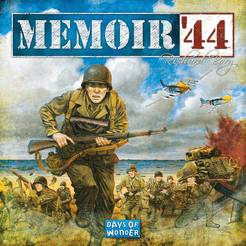
Use command cards to coordinate infantry, armor, and artillery across a hex battlefield, exploiting terrain and retreats to meet scenario medal objectives.
Memoir '44 supports 2–4 players; community best: 2 players; playing time: 30–45 minutes. A WANGO browser trial has not been confirmed.
Background & introduction
Original Memoir ’44 stages a two-player battle between opposing forces on a hex map. Each scenario supplies terrain, deployments, hand sizes, starting side, and victory conditions, allowing a common rules system to represent varied battlefield situations.
Command cards limit which sections and how many units can act. All ordered movement happens before units resolve their battles one at a time. Card availability and dice results reward careful timing of advances, concentration, and support.
Terrain affects movement, fire, and protection. Eliminating a complete enemy unit normally earns a medal, while flags can force retreats and open positions. A weakened standard unit retains its normal firepower, making even a lone surviving figure relevant.
Core rules & scoring
This entry uses original two-player base rules. Follow the chosen scenario for board side, terrain, obstacles, deployments, and objectives. Standard infantry has four figures, armor three, artillery two. Scenario instructions specify special troops, command hand sizes, starting side, and medal target; six medals is not a universal condition.
Each turn plays one command card, declares every ordered unit, moves ordered units, resolves battles unit by unit, then discards and draws one card. Section cards use left/center/right; a hex crossed by a dividing red line belongs to either adjacent section. Order a unit at most once per turn; unused orders are lost.
Complete all movement before battling, moving one unit fully at a time. Standard infantry moves one and battles or two without battle; armor moves up to three and battles; artillery moves one or battles in place. No moving through occupied hexes, stacking, splitting figures, or merging depleted units. Terrain and specific cards can alter these limits.
Ordered units may decline movement or battle. Normally battle at most once and do not divide dice among targets. A unit adjacent to enemies must choose an adjacent target if it battles rather than firing farther away. One remaining figure retains the unit’s ordinary firepower.
Infantry ranges three hexes with 3/2/1 dice; armor ranges three with three dice at each distance; artillery ranges six with 3/3/2/2/1/1. Infantry and armor require center-to-center line of sight; artillery does not. Intervening units and designated terrain block sight; terrain in the target hex does not hide the target from itself.
Calculate the full dice allowance after range and terrain before rolling. Matching troop symbols and grenades each hit; stars normally miss unless a card says otherwise. Remove one figure per hit, ignoring excess hits. Resolve casualties before flags. Removing the last figure normally earns a medal.
Each unignored flag requires one retreat hex toward your board edge. Do not pass through units, impassable terrain, or ocean. Normal terrain movement restrictions are ignored during retreat; each impossible retreat hex costs a figure. Choose a legal route maximizing completed retreat distance rather than deliberately taking losses to stay close.
After a successful close assault eliminates or displaces the enemy, infantry may take the vacated ground. Armor must take ground to make one additional Armor Overrun battle, and may take ground again after success, but gains at most one extra battle per turn. Artillery cannot take ground. Terrain still applies, so entering a forest or town prevents another battle.
Entering base forests or towns stops movement and prevents battle that turn. Against occupants, infantry loses one die, armor two, artillery none. Against a target on a hill, infantry/armor attacking from lower ground lose one die; artillery does not, and equal-height attacks have no hill reduction. Terrain/obstacle defensive reductions do not add together: use the best protection. Sandbags can still separately ignore the first flag.
End immediately when a side meets scenario victory conditions, without finishing the turn, taking ground, or Armor Overrun. Scenario objectives specify whether medals require continued occupation; do not assume permanence. Reshuffle discards when the command deck runs out. Explicit scenario and command-card exceptions override general procedures.
Rules & gameplay questions
Does a one-figure unit roll fewer attack dice?
No. Type, range, terrain, and card modifiers determine standard firepower. Losing figures does not reduce its base dice. Removing the final figure normally awards the opponent a medal.
What if all my cards refer to sections without my units?
Play a section card for an empty section, order no units, discard, and draw a replacement. It does not permit orders elsewhere.
Do sandbags add their defense to a village or hill?
No. Defensive terrain/obstacle reductions in the same hex do not stack; use the best protection. Sandbags can separately ignore the first flag. They can provide a reduction between equal-height hills where the hill itself gives none. Special attack cards can override ignored flags.
Can armor enter a forest after driving out its defender and attack again?
It may take the vacated forest ground, but entering forest prevents another battle that turn. The same applies to towns. Taking ground into hedgerows additionally requires starting the turn adjacent.
Can I take ground onto an objective after winning my last medal?
No. The official FAQ ends battle immediately on reaching the required medals, before taking ground, Armor Overrun, or finishing the turn. Do not import special campaign exceptions into the base battle.
Rules & introduction sources
- Edition
- Original Memoir ’44 two-player base battles, using mm_rules_part1_en.pdf from the current Days of Wonder Old Rules archive: seventeen rule-section pages for the 2004 original, plus applicable base-game general/terrain clarifications from the currently linked Official FAQ v2. The website separately offers a 2025 refresh; its components/revisions are not blended here. Excludes Overlord, Breakthrough, air and other expansions, and fan solo. No scenario-specific winning solution or optimal battle script.
- Rule references
- Introduction source
- BoardGameGeek
WANGO editorial
| Parameter | Recorded value |
|---|---|
| BGG overall rank (snapshot) | #226 |
| Complexity Weight | 2.27 / 5 |
| Best player count (community) | 2 |
| Player range | 2–4 |
| Playing time (minutes) | 30–45 |
| Core mechanisms | Area Majority / Influence · Campaign / Battle Card Driven · Command Cards · Dice Rolling · Die Icon Resolution · Grid Movement · Hand Management · Hexagon Grid · Line of Sight · Modular Board · Movement Points · Scenario / Mission / Campaign Game · Simulation · Team-Based Game · Variable Set-up |
| Chinese publication | Unconfirmed |
| WANGO browser play | No confirmed WANGO trial |
| Year published | 2004 |
| Suggested age | 8+ |
BGG statistics are stored snapshots, not live rankings. Source checked:2026-09-27
Player questions
What is the best player count for Memoir '44, and can I play online?
Memoir '44 supports 2–4 players; community best: 2 players; playing time: 30–45 minutes. A WANGO browser trial has not been confirmed. Recorded mechanism tags: Team-Based Game.
How complex is Memoir '44, and which mechanisms does it use?
Weight: 2.27 / 5. Mechanisms: Area Majority / Influence · Campaign / Battle Card Driven · Command Cards · Dice Rolling · Die Icon Resolution · Grid Movement · Hand Management · Hexagon Grid · Line of Sight · Modular Board · Movement Points · Scenario / Mission / Campaign Game · Simulation · Team-Based Game · Variable Set-up. Chinese publication: Unconfirmed.
Where can I learn Memoir '44?
No rule guide, strategy article or WANGO trial has been confirmed for this record.