Descent: Journeys in the Dark (Second Edition)
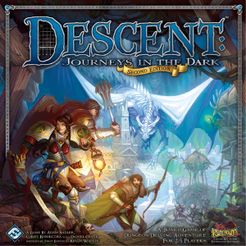
Descent: Journeys in the Dark Second Edition pits a hero team against one overlord in objective-driven dungeon battles, where positioning, fatigue, and activation order matter as much as defeating monsters.
Descent: Journeys in the Dark (Second Edition) supports 1–5 players; community best: 5 players; playing time: 120 minutes. A WANGO browser trial has not been confirmed.
Background & introduction
Heroes cooperate on a modular map while the overlord applies pressure through monsters and a hand of cards. Their responsibilities differ: heroes manage class skills, equipment, and teammates, while the overlord manages group activations, blocking positions, and card timing. Each quest defines its own objectives, so clearing the map does not automatically secure victory.
A hero normally has just two actions, with movement, attacks, searches, doors, and rescues competing for that allowance. Fatigue can buy extra movement or pay for skills; resting costs an action and only clears fatigue at the end of the turn. Heroes can choose the next acting hero as the round unfolds, making the order of clearing corridors and removing blockers consequential.
The core box supports individual quests and a campaign linking results, gold, and experience. Heroes develop through their class cards while the overlord improves a deck, carrying the effects of earlier quests forward. This guide uses the physical second-edition hero-versus-overlord rules and their errata, avoids quest solutions, and keeps cooperative modes and other editions outside its procedures.
Core rules & scoring
One overlord faces two to four heroes; in a two-player game, the hero player controls two separate heroes. Each hero chooses an unused class matching their archetype and takes its basic skill and starting equipment. The overlord begins with the 15 basic Overlord cards and draws one card per hero.
Each round, all heroes complete one full turn each before the overlord acts. Heroes may decide who acts next after a hero finishes. A hero resolves start effects and refreshes cards, equips items, performs up to two actions, then flips their Activation card; repeating an action is normally allowed.
A move action grants movement points equal to Speed. Entering an adjacent space, including diagonally, normally costs one point; friendly figures may be passed through but not occupied at movement end, while enemies and obstacles block passage. Heroes may suffer one fatigue per extra movement point without first taking a move action, up to Stamina. Another action may interrupt movement before it resumes.
Melee attacks normally target an adjacent enemy space; ranged attacks require line of sight. Declare weapon and target, then roll attack and defense dice. An X on the blue die misses; ranged attacks need sufficient total range, possibly supplied by an applicable surge. After surges are spent, each defense shield cancels one damage and the remainder is suffered.
Each surge result can be spent once, and each individual surge ability can trigger only once per attack. An attacking hero may spend at most one unused surge to recover one fatigue. Skill costs and voluntary extra movement cannot exceed Stamina; fatigue forced beyond Stamina by other effects becomes damage instead. Rest clears all fatigue at the end of the turn.
To search, stand on or adjacent to a search token; remove an ordinary token and draw a Search card, while unique tokens use quest instructions. Opening or closing an adjacent door costs an action. Closed doors block movement, line of sight, and adjacency across them. Equipped items are limited to two hands in total, one Armor, and two Other items.
The overlord draws one card at turn start, handles the relevant timing and refreshes cards, then activates monsters one group at a time, finishing a group before moving to another. Each monster normally gets up to two actions and at most one attack; special actions containing an attack count toward that limit, although explicit card effects can provide exceptions.
At damage equal to Health, monsters normally leave the map and heroes are knocked out. Replace a hero with a token, fill fatigue to Stamina, discard conditions, and allow the overlord to draw one card. Standing up rolls two red dice, recovering damage from damage results and fatigue from surges, then immediately ends that hero turn. An adjacent teammate may instead spend an action to revive the hero.
With exactly two heroes, FAQ v1.6 grants each hero one additional regular attack without spending an action during their Perform Actions step. It cannot be a special action containing an attack. A hero who did not perform this free attack may instead recover two damage at turn end. Knockout and stand-up restrictions still apply.
The final encounter objective determines the quest winner; finishing the first encounter need not win the quest. A campaign phase follows the complete quest: resolve search gold, cleanup, and rewards, then shop before spending experience. Normal shopping reveals five Shop Item cards. Heroes share gold but cannot transfer experience; the overlord also spends experience on new cards.
Rules & gameplay questions
What takes priority when a card conflicts with a quest rule?
FAQ v1.6 corrects the hierarchy: quest rules in the Quest Guide override cards, abilities, and the rulebook; cards and abilities override ordinary rulebook rules. Do not retain the original book's incorrect priority order.
Does a three-player table receive the two-hero adjustment?
Yes, if one player is the overlord and the other two each control one hero. Exactly two heroes qualifies for the FAQ v1.6 free regular attack or two damage recovery at turn end. Count heroes, not total people.
Can a knocked-out hero stand up and then spend fatigue to move?
No. Standing up immediately ends the hero turn, leaving no opportunity for fatigue movement, skills, or a second action. Being knocked out during your own turn also immediately ends that turn.
Does Stunned remove an entire turn?
No. The figure must spend its first available action discarding Stunned, then can normally perform its second action. If it becomes Stunned after already performing its first action, its second action must remove the condition.
Can heroes shop and clear damage after every encounter?
No. Between encounters of one quest, heroes keep damage, conditions, and Search cards, recover fatigue, and refresh heroic feats; the overlord keeps the current hand, and knocked-out heroes may stand up for free. Campaign cleanup, shopping, and advancement follow the entire quest.
Rules & introduction sources
- Edition
- Scope: the original Descent: Journeys in the Dark Second Edition core box, physical heroes versus overlord and basic campaign overview. Read the 24-page English rulebook pp.2-3,5,7-15,18-22 and applicable base-game portions of FAQ v1.6 (2016-01-18), pp.1-4. References are publisher-authored mirrors, not verified working current official links. Excludes expansions, cooperative adventures, the Road to Legend app, and Legends of the Dark; no quest plot or solutions reproduced.
- Rule references
- Introduction source
- BoardGameGeek
WANGO editorial
| Parameter | Recorded value |
|---|---|
| BGG overall rank (snapshot) | #233 |
| Complexity Weight | 3.22 / 5 |
| Best player count (community) | 5 |
| Player range | 1–5 |
| Playing time (minutes) | 120 |
| Core mechanisms | Action Points · Dice Rolling · Grid Movement · Hand Management · Line of Sight · Map Addition · Modular Board · Movement Points · Multiple Maps · Once-Per-Game Abilities · Role Playing · Scenario / Mission / Campaign Game · Solo / Solitaire Game · Stat Check Resolution · Team-Based Game · Variable Player Powers |
| Chinese publication | Unconfirmed |
| WANGO browser play | No confirmed WANGO trial |
| Year published | 2012 |
| Suggested age | 14+ |
BGG statistics are stored snapshots, not live rankings. Source checked:2026-09-27
Player questions
What is the best player count for Descent: Journeys in the Dark (Second Edition), and can I play online?
Descent: Journeys in the Dark (Second Edition) supports 1–5 players; community best: 5 players; playing time: 120 minutes. A WANGO browser trial has not been confirmed. Recorded mechanism tags: Solo / Solitaire Game, Team-Based Game.
How complex is Descent: Journeys in the Dark (Second Edition), and which mechanisms does it use?
Weight: 3.22 / 5. Mechanisms: Action Points · Dice Rolling · Grid Movement · Hand Management · Line of Sight · Map Addition · Modular Board · Movement Points · Multiple Maps · Once-Per-Game Abilities · Role Playing · Scenario / Mission / Campaign Game · Solo / Solitaire Game · Stat Check Resolution · Team-Based Game · Variable Player Powers. Chinese publication: Unconfirmed.
Where can I learn Descent: Journeys in the Dark (Second Edition)?
No rule guide, strategy article or WANGO trial has been confirmed for this record.