Village
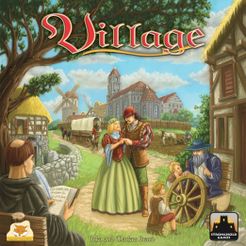
Guide several generations through farming, trade, travel and public life, turning limited lifetimes into prestige and places in the village chronicle.
Village supports 2–4 players; community best: 4 players; playing time: 60–90 minutes. A WANGO browser trial has not been confirmed.
Background & introduction
Village gives each player a family whose story unfolds across generations. Relatives can harvest at home, learn crafts, enter the council chamber or church, or visit distant cities. Each career offers different rewards, and the family’s reputation depends both on achievements in life and on whether its deceased members enter the village chronicle.
Public influence cubes drive action selection: taking a cube grants the opportunity to use its location. Its color becomes a resource for later spending but need not match what that location demands. Black plague cubes consume lifetime instead. Many actions also cost time, and crossing the bridge on the lifetime track means losing one of your oldest relatives.
Markets convert grain and goods into customers worth prestige; travel leaves city markers; the church and council reward members still holding office. Filling the chronicle or anonymous graves brings the end closer, so growing the family, choosing careers and managing aging form one connected planning problem. Success comes from arranging contributions that continue across generations.
Core rules & scoring
Each player begins with 4 number-1 family members and 1 coin; other relatives remain in the supply. The oldest player starts. Each round, use the player-count setup card to mix influence and plague cubes in the green bag, then randomly seed the action spaces.
Take 1 cube from an action space: keep colored influence at your farmyard, or return black plague immediately and advance 2 time. You may perform that location’s action or decline it, except a market day must occur. Alternatively, pay 3 same-color influence cubes for any action without taking a cube, while at least 1 cube remains on the board.
Time costs advance your lifetime marker clockwise. Crossing the bridge usually lets you finish the action before a visible, lowest-numbered relative dies at turn end; choose among equal numbers. During a market day, resolve death immediately. Relatives in the black bag or not yet born cannot die. Enter the matching career’s chronicle space if available, otherwise an anonymous grave.
Harvest requires at least one relative at home and gives 2 grain; a horse and plow give 3, or an ox and plow 4. Goods are not spent, and storage is capped at 5 grain. The family action takes the lowest-numbered available relative from the supply or recalls a living employed relative home.
A craft action produces one good. You may spend time training a relative from home in its workshop, then pay production time; later production skips training while that relative remains there. Alternatively, pay the building’s influence or grain cost without employing anyone. The mill holds no relatives and converts 2 time plus 2 grain into 2 coins.
All players may join a market day. Its initiator sells first by paying only a customer’s required goods or grain. Other sales, including the initiator’s later sales, additionally cost 1 green influence and 1 time. Serve only blue-bordered customers; rotate until everyone passes or they are served. Passing prevents re-entry that day. Keep customer tiles for final scoring.
Travel sends a relative from home to a city neighboring the village or moves an existing traveler along a path to an adjacent city. Pay the path’s time, wagon and influence costs. Each family marks and receives the reward from each city only once. Existing markers remain for final city-count scoring.
The council action spends 1 scroll or 2 green influence plus the relevant time to enter or advance. Alternatively, stay put and freely use one privilege at your current or a lower stage. The four privileges are next-round starting player, 2 influence cubes, 1 good, and spending 1 coin for 3 prestige.
The church action spends 1 brown influence or 3 time to put a relative from home into the black bag. After the last cube of a normal round is taken and its action resolved, hold mass: select 4 pieces total, first allowing players to pay 1 coin per chosen relative, then drawing the rest randomly. Return black monks, place relatives in the rightmost window, allow grain-paid advancement leftward, and award 2 prestige for church majority, breaking ties by the leftmost relative.
Filling the final chronicle space or anonymous grave triggers the end. Normally the triggering player gets no further action and everyone else gets one clockwise, followed by final mass. Add travel, council, church, chronicle and customer points plus 1 per coin. Highest prestige wins; ties break by customers served, then living relatives.
Rules & gameplay questions
Do we roll these colored cubes for values?
No. They are influence cubes, not dice. Mix and randomly distribute them according to the setup card, then choose a location and a cube on your turn. Black cubes are plague, not influence to store.
Must I employ a relative at a workshop to buy goods with influence?
No. A trained relative is required only when producing by spending time. Direct purchases using influence or grain do not require an employed relative.
Must I assign my lowest-numbered relative to a job?
No. You may choose any relative at home to place on the board or in the church bag. Numbers constrain birth and death: take the lowest available number when adding a new relative, and choose the lowest visible living number when one dies.
What happens to travel progress and chronicle points after a death?
A traveler’s death does not remove existing city markers. The deceased enters the matching career section of the chronicle if there is room, otherwise an anonymous grave. A family scores 0 for 1–2 chronicle members, 4 for 3, 7 for 4, and 12 for at least 5.
Does the game always wait for the current round to finish?
No. Normally the player filling the last chronicle space or grave gets no more actions and everyone else gets one. If another participant fills it during a market day, finish that market and then everyone gets one clockwise action, ending with the market’s initiator. If cubes run out during final actions, do not reseed; remaining players choose any action without the three-matching-cube substitute cost. Hold final mass only afterward.
Rules & introduction sources
- Edition
- 2011 Village base game for 2–4 players. Read original eggertspiele/Pegasus English rulebook pages 2–12, including its native FAQ on page 12, via a non-official 1jour-1jeu mirror. Excludes Inn, Port, Big Box rule changes, extra customers and other promotional content.
- Rule references
- Introduction source
- BoardGameGeek
WANGO editorial
| Parameter | Recorded value |
|---|---|
| BGG overall rank (snapshot) | #250 |
| Complexity Weight | 3.06 / 5 |
| Best player count (community) | 4 |
| Player range | 2–4 |
| Playing time (minutes) | 60–90 |
| Core mechanisms | Area Majority / Influence · Contracts · Set Collection · Turn Order: Claim Action · Worker Placement · Worker Placement, Different Worker Types |
| Chinese publication | Unconfirmed |
| WANGO browser play | No confirmed WANGO trial |
| Year published | 2011 |
| Suggested age | 12+ |
BGG statistics are stored snapshots, not live rankings. Source checked:2026-09-27
Player questions
What is the best player count for Village, and can I play online?
Village supports 2–4 players; community best: 4 players; playing time: 60–90 minutes. A WANGO browser trial has not been confirmed.
How complex is Village, and which mechanisms does it use?
Weight: 3.06 / 5. Mechanisms: Area Majority / Influence · Contracts · Set Collection · Turn Order: Claim Action · Worker Placement · Worker Placement, Different Worker Types. Chinese publication: Unconfirmed.
Where can I learn Village?
No rule guide, strategy article or WANGO trial has been confirmed for this record.