A Game of Thrones: The Board Game (Second Edition)
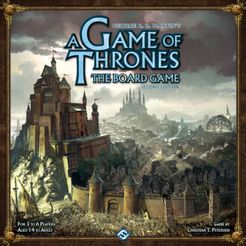
Great Houses secretly assign orders, negotiate support and bid for political influence while competing for castles and strongholds across Westeros.
A Game of Thrones: The Board Game (Second Edition) supports 3–6 players; community best: 6 players; playing time: 120–240 minutes. A WANGO browser trial has not been confirmed.
Background & introduction
On the shared map, ships create transport routes, land forces control castles and supply limits how many armies a House can sustain. Expansion changes more than territory: it can affect future mustering, bidding and nearby battles.
Everyone places orders facedown in areas containing units, then reveals them together. Raids disrupt support and power collection before marches turn threats into combat. Promised assistance remains uncertain until support is actually declared.
Combat combines units, orders and one House character card. Strong cards temporarily leave your hand after use, while victory still demands attention to casualties and retreat destinations. The Iron Throne, Fiefdoms and King’s Court rankings govern turn order, ties and access to special orders.
Core rules & scoring
The 2011 second-edition base game supports three to six players. Use the permitted Houses, neutral forces and three/four-player King’s Court overlay for the player count. Each round has Westeros, Planning and Action phases; skip Westeros in round one and play at most ten rounds. Use the official v2.0 correction to Lannister’s starting units.
In Westeros, reveal one card from each of three decks, advance wildling threat and resolve decks I, II and III in order. When mustering, a castle provides one point and a stronghold two. Footmen/ships cost one, knights/siege engines two, or one to upgrade a footman to either. Mustering cannot exceed supply.
A Supply event recalculates your track position from supply icons in controlled areas; other specified effects can also adjust it. The track limits army count and each army’s size. Two or more units in an area form an army. Movement, mustering and retreats must obey the current track, including fleets.
In Planning, assign one facedown order to each controlled area containing units, never multiple orders in one area. Reveal simultaneously, then use the Messenger Raven. King’s Court rank limits starred orders. The Raven holder may exchange one of their orders for an unused order or inspect and retain/bury the top wildling card, at most once per round.
In Action, cycle through Iron Throne order resolving raids one at a time, then marches and combats, then Consolidate Power. A normal raid removes an adjacent enemy Support, Raid or Consolidate Power order; a starred raid can also remove Defense. A normal land Consolidate Power order usually gains one power plus printed power icons.
One march may split its units among several adjacent areas but initiate only one attack. Land units cannot enter seas/ports and ships cannot enter land. Your ships in consecutive sea areas transport land units for marching/retreating. Other Houses’ ships cannot transport you, and transport does not create adjacency for support or raids.
Combat begins with support declarations in turn order, then initial strength: footmen/ships one, knights two, siege engines four only when attacking or supporting an attack on a castle/stronghold, otherwise zero. Adjacent support can aid either side but never oppose your own units. A House must assign all its support in that combat to one side.
Both sides must secretly select and simultaneously reveal a House card, adding its strength and resolving abilities. The Blade can add one once per round. Higher final strength wins; ties favor the higher Fiefdoms rank. Played cards enter public discards. After using your last card, retrieve the other six, leaving the just-played card discarded.
Normally only the loser removes units equal to the winner’s swords minus their own fortifications; supporting units take no such casualties. Then retreat: an attacker returns to origin; a defender chooses a legal adjacent or ship-connected area other than the attack’s origin. No legal retreat destroys the force; supply may require destroying retreating units first. Losing siege engines are destroyed in addition to other casualties, never used to satisfy them.
Retreated units are routed: zero strength, unable to move, still counting for supply and destroyed if forced to retreat again. Restore them at round end. Control of seven castle/stronghold areas wins immediately, but determine control after combat fully ends. Otherwise the most such areas after round ten wins; ties use total controlled land areas, then Supply rank, then Iron Throne rank.
Rules & gameplay questions
Does capturing a supply icon immediately allow another army?
No. A Supply event or explicit supply-adjusting effect changes the track. New map icons do not relax the current movement or mustering limits. Non-combat moves within one march cannot temporarily exceed supply either.
Can an ally split support between both sides, or support remotely via transport?
No. One House must offer all its support orders to the same side in that combat, each area contributing its full strength or none. Transport extends marching and retreating, not support adjacency. The recipient can accept or decline each declaration.
Can a loser sacrifice siege engines for sword casualties, or retreat to any friendly area?
No. The official FAQ destroys losing siege engines in addition to other casualties. A defender’s normal retreat destination must still be adjacent or reachable by their own ship transport and meet supply/control restrictions.
Does the Iron Throne holder decide every tie?
No. Combat ties use Fiefdoms rank. Round-ten victory first compares castle/stronghold areas, then the errata’s total land areas, Supply and Iron Throne. Other ties such as bidding normally fall to the Iron Throne holder.
Can an alliance transfer power, reveal hidden orders or prevent betrayal?
Base rules forbid gifting game items and prematurely showing assigned hidden orders; bids must also stay secret. Promises are nonbinding. Mother of Dragons gifting, vassals and extra Houses are outside this entry.
Rules & introduction sources
- Edition
- FFG 2011 A Game of Thrones: The Board Game Second Edition, base three-to-six-player play. Publisher 32-page rulebook read from a mirror: pages 2–4 and 7–28, corrected using base-game clauses on official Errata and FAQ v2.0 pages 1–5. Uses updated victory tiebreakers and Lannister setup. Excludes first edition, the similarly named card game, optional Tides of Battle and every expansion, especially Mother of Dragons eight-player play, vassals, loans and power gifting.
- Rule references
- Introduction source
- BoardGameGeek
WANGO editorial
| Parameter | Recorded value |
|---|---|
| BGG overall rank (snapshot) | #242 |
| Complexity Weight | 3.73 / 5 |
| Best player count (community) | 6 |
| Player range | 3–6 |
| Playing time (minutes) | 120–240 |
| Core mechanisms | Advantage Token · Alliances · Area Majority / Influence · Area Movement · Auction / Bidding · Auction: Sealed Bid · Card Play Conflict Resolution · Events · Hand Management · Income · Negotiation · Order Counters · Player Elimination · Simultaneous Action Selection · Sudden Death Ending · Turn Order: Auction · Variable Player Powers |
| Chinese publication | Unconfirmed |
| WANGO browser play | No confirmed WANGO trial |
| Year published | 2011 |
| Suggested age | 14+ |
BGG statistics are stored snapshots, not live rankings. Source checked:2026-09-27
Player questions
What is the best player count for A Game of Thrones: The Board Game (Second Edition), and can I play online?
A Game of Thrones: The Board Game (Second Edition) supports 3–6 players; community best: 6 players; playing time: 120–240 minutes. A WANGO browser trial has not been confirmed.
How complex is A Game of Thrones: The Board Game (Second Edition), and which mechanisms does it use?
Weight: 3.73 / 5. Mechanisms: Advantage Token · Alliances · Area Majority / Influence · Area Movement · Auction / Bidding · Auction: Sealed Bid · Card Play Conflict Resolution · Events · Hand Management · Income · Negotiation · Order Counters · Player Elimination · Simultaneous Action Selection · Sudden Death Ending · Turn Order: Auction · Variable Player Powers. Chinese publication: Unconfirmed.
Where can I learn A Game of Thrones: The Board Game (Second Edition)?
No rule guide, strategy article or WANGO trial has been confirmed for this record.