Caverna: The Cave Farmers
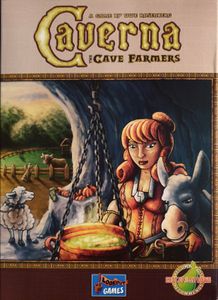
Lead a dwarf family in clearing forests and expanding caverns, combining farming, livestock, mining and expeditions to develop a mountain home.
Caverna: The Cave Farmers supports 1–7 players; community best: 4 players; playing time: 30–210 minutes. A WANGO browser trial has not been confirmed.
Background & introduction
Caverna: The Cave Farmers puts each player in charge of a dwarf household in the mountains. Forest on one side becomes fields and pastures; mountain spaces on the other become caverns, furnished rooms and mines. Food production and underground development share the same action economy.
Family members take turns occupying public action spaces to gather materials, expand the landscape, sow crops, raise animals or grow the family. More dwarfs mean more future actions, but require living space and food; crop and livestock income depends on the harvest sequence.
Ore can also become weapons for expeditions. Strength affects placement order and available loot, rather than combat against other families. Final scoring rewards dwarfs, crops, animals, mines and furnishings while penalising unused land and missing farm-animal types.
Core rules & scoring
Normally play 12 rounds; with two players remove Exploration and skip round 9, giving 11 rounds. Each round reveals an action, replenishes accumulating spaces, places dwarfs in turn, returns them home and resolves the indicated harvest.
Each dwarf occupies an available action space and resolves it immediately. Normally place unarmed dwarfs first, then armed dwarfs in increasing strength order. Spend 1 ruby to place one armed dwarf out of order.
Excavate an empty cavern before paying to furnish it. Furnishings normally cannot be moved, removed or covered. Dwellings provide space required for family growth but do not create dwarfs automatically; newborns act from the next round. The ordinary limit is five dwarfs, with the Additional Dwelling allowing a sixth.
An unarmed dwarf can spend 1–8 ore to forge a weapon of that strength. Expedition level determines how many different loot items can be chosen; weapon strength determines which items qualify. After each expedition that dwarf gains 1 strength, up to 14. Weapons cannot attack other players or be freely transferred.
A normal harvest runs field harvest, feeding, then breeding. Each dwarf needs 2 food, or 1 for a newborn this round; take one begging marker per missing food, worth minus 3 points each. Special harvest markers change the steps.
For each farm-animal type with at least two animals and room for the offspring, gain exactly one baby. Parents need not share a pasture. Dogs do not breed; parents and newborns must be accommodated before conversion to food.
Animals must be housed on the home board, not stockpiled. Each pasture space holds two farm animals of one type; stables double pasture capacity. Each mine holds one donkey, and a forest stable holds one wild boar. Dogs can roam; when herding, they support one more sheep than their number, without stacking stable capacity.
Score 1 per farm animal, dog, dwarf, ruby and vegetable; score half the total grain, rounded up. Add gold, printed tile values and furnishing bonuses. Lose 2 per missing sheep, donkey, wild boar or cattle type and 1 per unused home space. Tied highest scores share victory.
Rules & gameplay questions
Can a newborn work immediately?
No. Place the newborn on its parent; it joins placement from the next round. Family growth still requires the appropriate dwelling space.
Do four animals of one type produce two babies?
No. Each normal breeding phase produces at most one baby per qualifying farm-animal type, regardless of the number of pairs.
Do leftover food, wood, stone and ore score automatically?
Generally no. Use the scoring categories and furnishing effects; those resources have no universal point value. A specific furnishing may reward them.
Does solo use random harvest events?
No. Start with 2 food, use the fixed action-card order on page 24 and skip round 9; harvest every round from round 5. Before replenishing, empty each accumulating space containing more than six goods, unless you pay 1 ruby per space to preserve it for another round. Aim to improve your score; the rules suggest 100 points as a challenge.
Rules & introduction sources
- Edition
- Lookout English base-game Caverna: The Cave Farmers, 24-page rulebook and appendix A1–A8, copyright 2013–2016; covers 2–7 players and solo differences. This is not the separate Cave vs Cave game, called Duel in some editions. Excludes The Forgotten Folk, Frantic Fiends and promotional expansions; does not reproduce every furnishing or loot entry.
- Rule references
- Introduction source
- BoardGameGeek
WANGO editorial
| Parameter | Recorded value |
|---|---|
| BGG overall rank (snapshot) | #63 |
| Complexity Weight | 3.78 / 5 |
| Best player count (community) | 4 |
| Player range | 1–7 |
| Playing time (minutes) | 30–210 |
| Core mechanisms | Automatic Resource Growth · Increase Value of Unchosen Resources · Solo / Solitaire Game · Tile Placement · Turn Order: Claim Action · Worker Placement |
| Chinese publication | Unconfirmed |
| WANGO browser play | No confirmed WANGO trial |
| Year published | 2013 |
| Suggested age | 12+ |
BGG statistics are stored snapshots, not live rankings. Source checked:2026-09-27
Player questions
What is the best player count for Caverna: The Cave Farmers, and can I play online?
Caverna: The Cave Farmers supports 1–7 players; community best: 4 players; playing time: 30–210 minutes. A WANGO browser trial has not been confirmed. Recorded mechanism tags: Solo / Solitaire Game.
How complex is Caverna: The Cave Farmers, and which mechanisms does it use?
Weight: 3.78 / 5. Mechanisms: Automatic Resource Growth · Increase Value of Unchosen Resources · Solo / Solitaire Game · Tile Placement · Turn Order: Claim Action · Worker Placement. Chinese publication: Unconfirmed.
Where can I learn Caverna: The Cave Farmers?
No rule guide, strategy article or WANGO trial has been confirmed for this record.